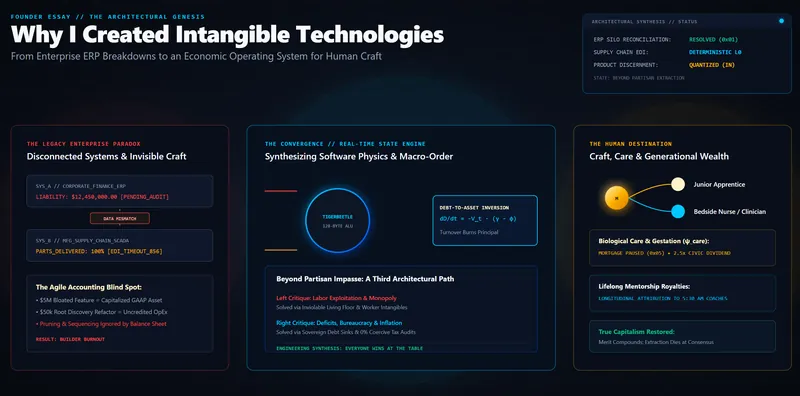
Why I Created Intangible Technologies
A founder's reflection on enterprise data friction, broken EDI supply chains, and why our economic crises demand an engineering upgrade rather than political rhetoric.
The complete operational blueprint of the Deterministic Economy. Every mathematical proof, settlement mechanism, and sector-by-sector transformation is documented here, detailing exactly how monetary velocity, human capital accounting, and AI alignment operate in practice. Explore the Master Executive Primer and 4-Pillar Constellation Map below, or use the search bar to synthesize answers directly across the entire archive.
This comprehensive executive synthesis maps how all 51 research monographs connect across four foundational pillars: Monetary Physics and Solvency, Human Capital and Enterprise, Social Flourishing and Civic Renewal, and Infrastructure, Trade, and AI Alignment. Explore how velocity-based finance, human capability accounting, and physical verification converge into one cohesive economic model and branch across every major industry.
Select an architectural pillar or click any node in the constellation to inspect its thesis and filter the sequenced reading path below into Foundational Proofs and Sector Deep-Dives.
Click any node in the Constellation Map to inspect its core thesis and open the article, or click a Pillar hub (P01–P04) to filter the reading sequence below.
A founder's reflection on enterprise data friction, broken EDI supply chains, and why our economic crises demand an engineering upgrade rather than political rhetoric.
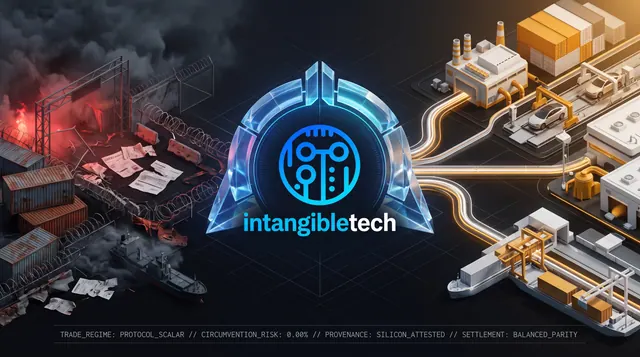
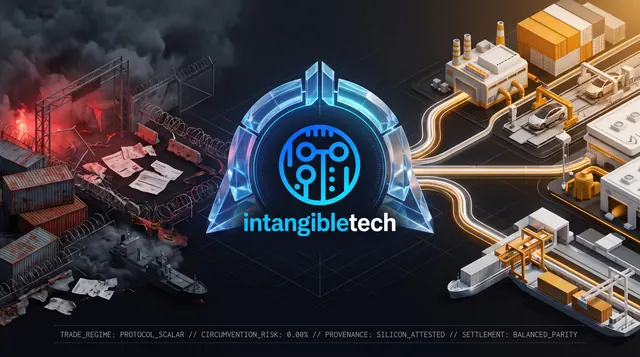
For centuries, sovereign nations have protected domestic industries and enforced geopolitical security using blunt instruments: border tariffs that tax their own citizens, and financial sanctions that leak through shadow supply chains. Here is how Intangible Technologies inverts trade policy—replacing crude border friction with protocol-native balancing variables, providing surgical multi-tier enforcement from whole industries down to individual corporate nodes, solving the Chinese EV dilemma, and building an un-cheatable economic bridge toward genuine, zero-friction global trade.
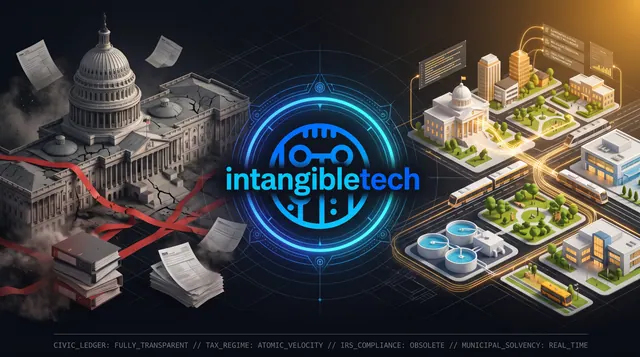
Every year, Americans spend nearly seven billion hours and over five hundred billion dollars just complying with the tax code, yet our national debt explodes, public infrastructure crumbles, and trust in government sits at historic lows. Here is how Intangible Technologies inverts public accounting—replacing the invasive, bureaucratic income-tax regime with an atomic velocity partition that dramatically lowers citizen taxes, balances municipal and national budgets in real time, holds elected officials to verified operational standards, and unites conservative and progressive imperatives into a single, incorruptible civic framework.
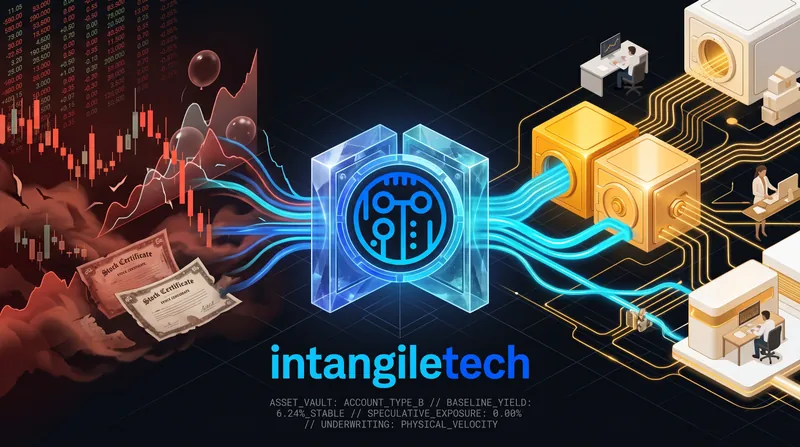
For decades, savers have been forced into the stock market casino just to outrun inflation. Here is the structural mechanics of how Intangible Technologies' Account Type B generates a stable, non-dilutive 4–8% annual yield directly from commercial velocity and enterprise credit spreads—without holding a single share of speculative corporate stock.
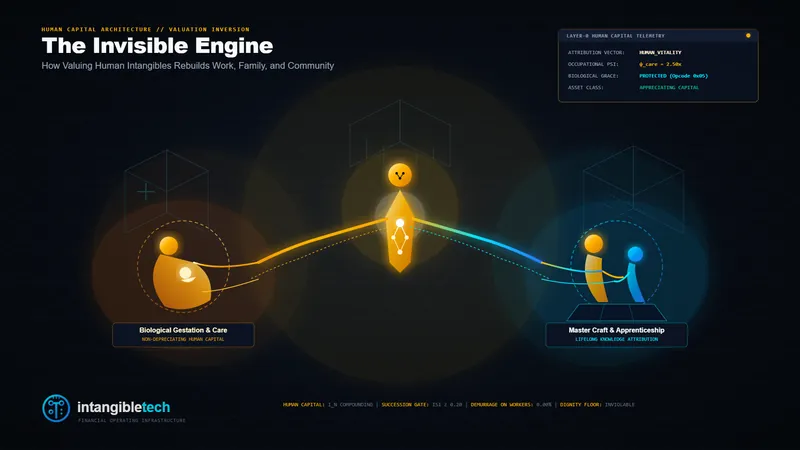
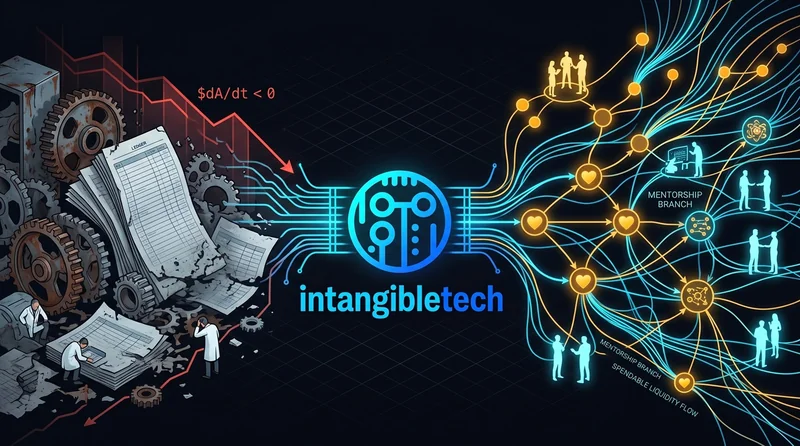
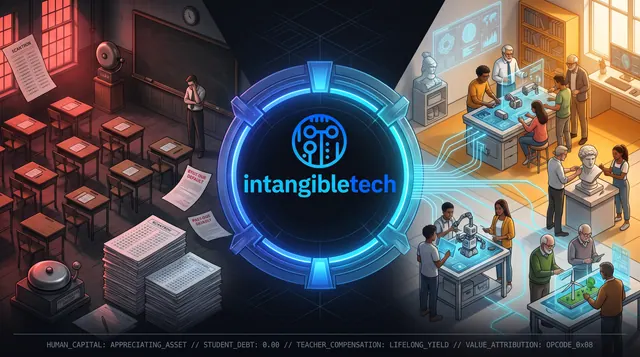
A factory machine that stamps sheet metal is celebrated on corporate balance sheets as capital, while a mother nursing an infant or a master craftsman mentoring an apprentice is booked as an operational cost. By recognizing human care, mentorship, and biological rhythm as appreciating assets, we bridge our deepest cultural divides and restore dignity to labor and family life.
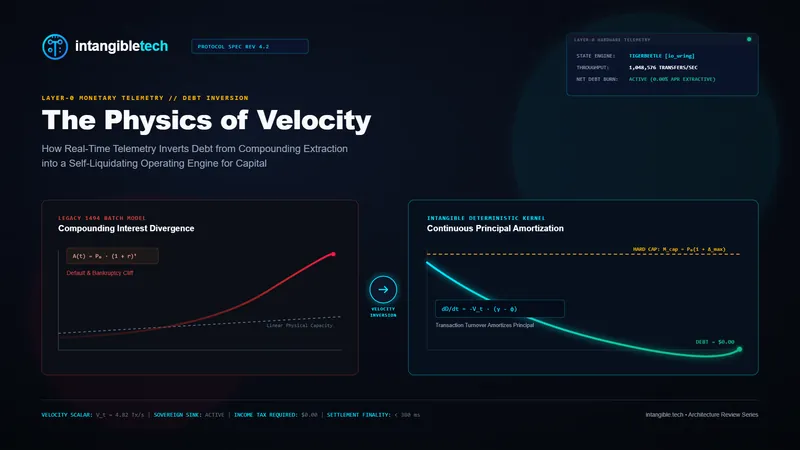
For a century, money velocity was an unmeasurable statistical ghost. By converting transactional turnover into a live Layer-0 telemetry scalar, we eliminate compounding usury, transform debt into a self-liquidating asset, and establish a mathematical path out of sovereign insolvency.
The United States spends $4.5 trillion annually on healthcare, yet life expectancy is dropping, medical debt bankrupted half a million families last year, and frontline doctors and nurses are burning out in droves. Here is how Intangible Technologies inverts the economics of medicine—replacing adversarial fee-for-service billing with protocol-native defect suppression, guaranteeing universal care without the bureaucratic rationing or endless wait times of legacy socialized medicine, elevating clinical compensation, and aligning Big Pharma’s balance sheet with curing disease rather than managing chronic illness.
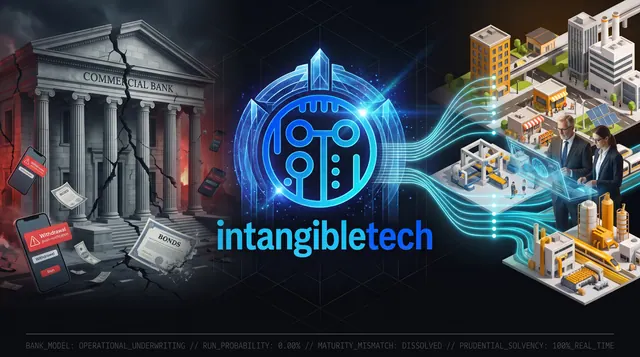
In March 2023, the global banking system teetered on the brink as Silicon Valley Bank, Signature Bank, and Credit Suisse vaporized in days—revealing the fatal flaw at the heart of commercial banking: maturity transformation. Here is how Intangible Technologies eliminates fractional-reserve fragility without destroying banking—decoupling transactional clearing from long-term capital allocation, transforming regional banks into high-margin Operational Underwriting Nodes, evolving institutional giants like BlackRock and Vanguard into authentic infrastructure stewards, and securing a vital, dignified future for the banking workforce.
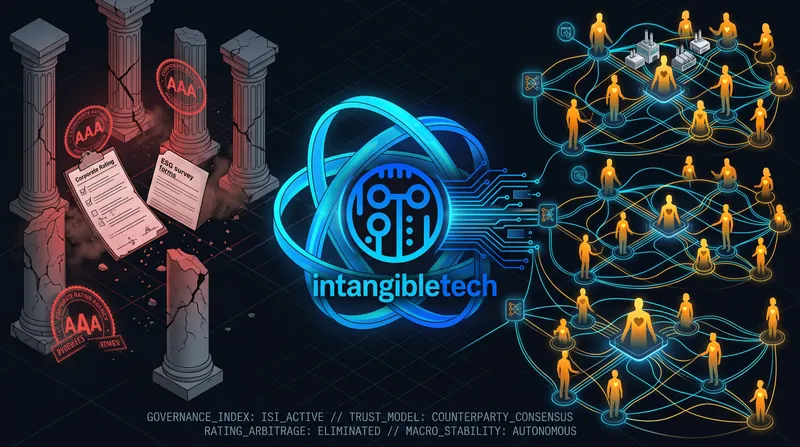
For over a century, global capital allocation has been governed by conflicted rating agencies, subjective ESG surveys, and central bankers guessing at interest rates. Here is the architecture of the Impact Score Index (ISI)—a real-time, tamper-proof metric that quantifies human capability and operational resilience, dictating the cost of credit and steering the modern macroeconomy without paper manipulation.
The global commodity complex has mutated from a physical hedging system into a speculative paper casino where paper oil trades thirty times physical volume, farmers are squeezed by margin calls, and energy is weaponized. Here is how Intangible Technologies anchors commodities to thermodynamic reality—providing legacy oil, gas, and mining giants with an irresistible capital incentive to transition, re-evaluating gold and conventional safe havens, and stripping cryptocurrencies of speculative frenzy to value them on verifiable physical throughput.
Over 90% of modern enterprise value is intangible, yet legacy accounting treats human ingenuity, software codebases, and mentorship as disposable operational expenses. Here is the complete systems blueprint of how our architecture converts intangible assets into liquid, appreciating working capital—disentangling AMM velocity yield from corporate revenues, preserving base wages as essential OpEx, and giving human craft direct spending power in the real economy.
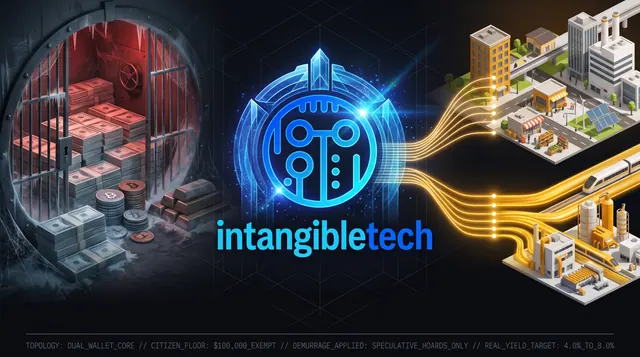
For centuries, economists have accepted a fatal contradiction: physical assets decay and require maintenance, while paper money compounds into infinity, incentivizing the sterile hoarding of capital while Main Street starves for liquidity. Here is how Intangible Technologies deploys the Dual-Account Wallet Topology—re-aligning money with thermodynamic physics through demurrage, permanently protecting everyday families with a malleable $100,000 Citizen Exemption Floor, and transforming sterile cash hoards into a self-funding Universal Citizen Dividend.
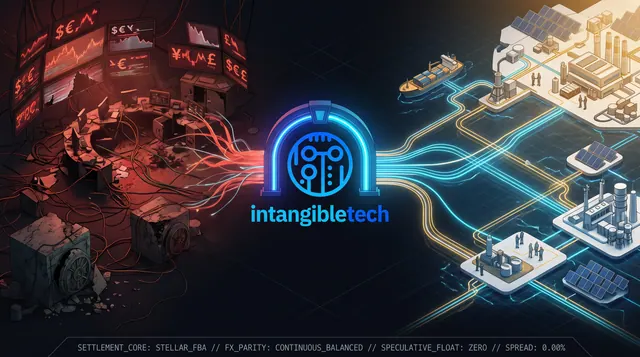
The $7.5 trillion daily foreign exchange market is an extractive relic of broken monetary diplomacy. Here is how Intangible Technologies and Stellar replace speculative FX trading with autonomous parity settlement—ending beggar-thy-neighbor currency wars, liberating emerging markets from dollar debt traps, and creating the structural incentives to reshore domestic manufacturing.
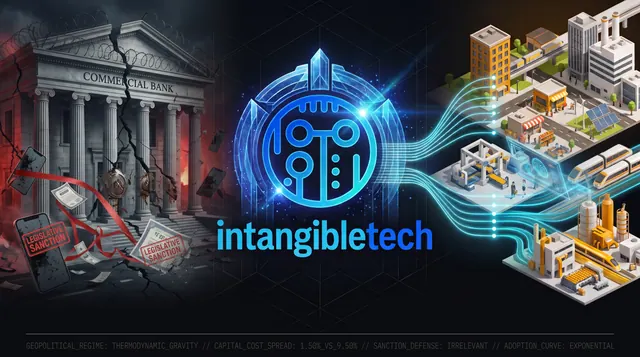
Whenever a foundational upgrade to economic architecture is introduced, the immediate objection is universal: "Won't the central banks, global elites, and state defense apparatus simply crush it?" Here is why Intangible Technologies cannot be stopped by decree, sanctions, or state power. By replacing political conflict with the inescapable physics of economic gravity, protocol-native firms out-compete legacy institutions through pure capital efficiency, triggering an unstoppable talent migration and leaving sovereign nations with an undeniable choice: adapt to 1.5% capital, or watch their domestic industries face mathematical extinction.
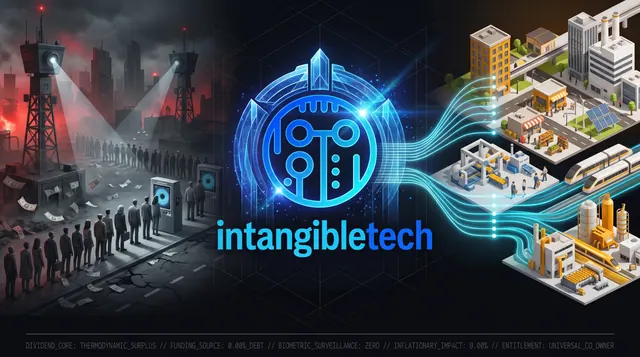
As artificial intelligence and automation accelerate, the debate over Universal Basic Income (UBI) has fractured between inflationary deficit money-printing and dystopian Silicon Valley handouts requiring biometric surveillance. Here is how Intangible Technologies inverts public distribution—replacing welfare state dependency with an un-falsifiable Citizen Dividend funded purely by the thermodynamic surplus of low-defect infrastructure, atomic velocity partitions, and demurrage recycling.
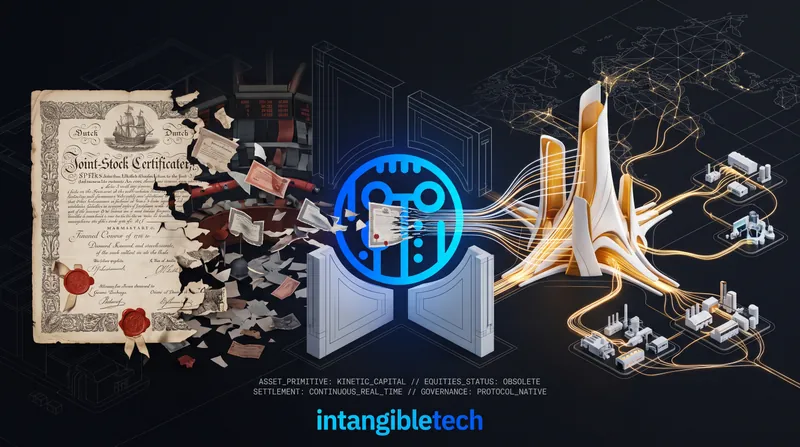
In 1602, the Dutch East India Company invented the joint-stock corporation to finance dangerous maritime trade across uncharted oceans. Four centuries later, Wall Street has reduced that breakthrough to a speculative, backward-looking paper casino. Here is the historical and economic architecture of how Intangible Technologies transforms the static equity share into protocol-native kinetic capital—replacing quarterly dividend declarations with real-time velocity yield, integrating human capability directly onto the corporate balance sheet, and rendering the 20th-century stock market obsolete.
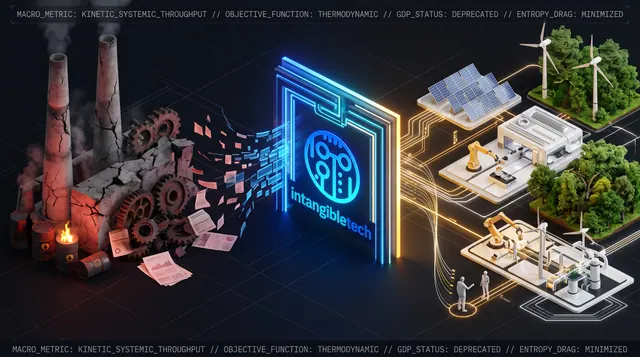
In 1934, Simon Kuznets invented Gross National Product to measure industrial wartime output, warning Congress never to mistake it for human welfare or economic health. Today, GDP rewards destruction, ignores human craft, and blinds policymakers to systemic risk. Here is the architecture of Kinetic Systemic Throughput (KST)—the real-time thermodynamic master control variable that replaces GDP, unifies the Impact Score Index (ISI) with physical reality, turns ecological resilience into balance-sheet equity, and aligns artificial intelligence with human flourishing.
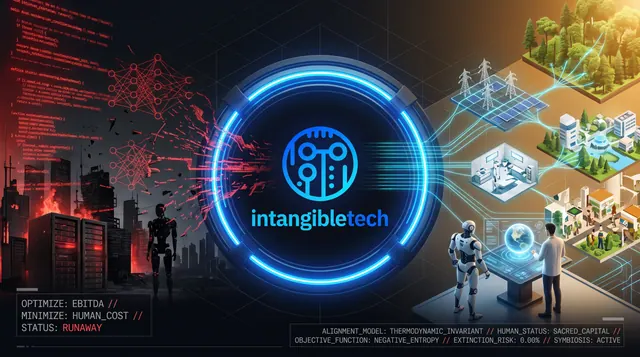
The existential threat of artificial intelligence is not a sentient rebellion or killer robots; it is the ruthless optimization of an economic operating system where human beings are classified as balance-sheet liabilities. If autonomous machine intelligence optimizes for legacy corporate incentives—cutting labor costs, harvesting attention, and externalizing ecological damage—human obsolescence is mathematically guaranteed. Here is how Intangible Technologies solves the AI Alignment Problem at the foundational level: replacing vague moral charters with protocol-enforced thermodynamic invariants, anchoring autonomous agents to the Impact Score Index, and ensuring that an intelligent machine cannot survive unless humanity flourishes beside it.
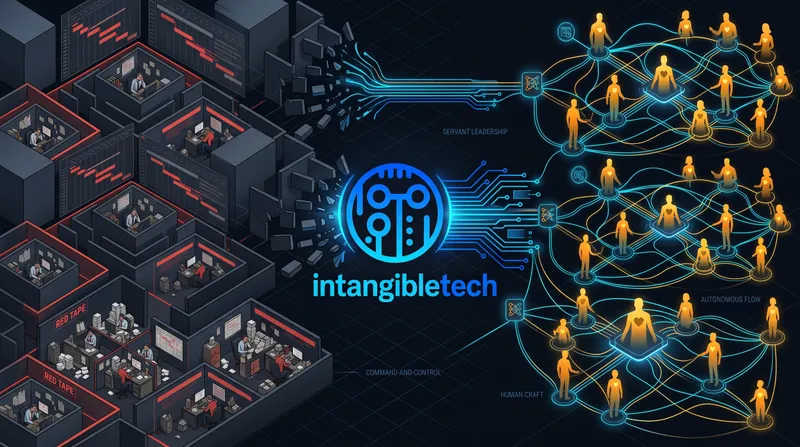
Modern management promises agility and empowerment, yet the very change agents driving digital transformation are burning out. The problem isn’t Agile—it’s that servant leadership cannot survive inside an accounting system designed for 15th-century command-and-control.
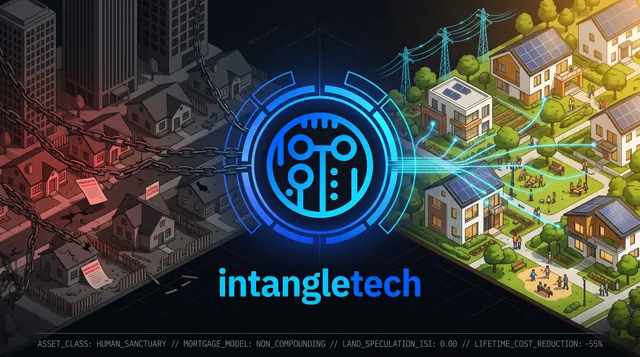
For generations, working families have accepted a brutal financial reality: buying a starter home requires paying for it two-and-a-half times over in compounding bank interest, while private equity hoards neighborhoods as speculative assets. Here is how Intangible Technologies de-financializes housing—replacing 30-year compounding usury with non-compounding sovereign facilities, mathematically dismantling institutional landlord monopolies through the zero-ISI land penalty, and restoring the home as an enduring sanctuary rather than a Wall Street derivative.
As protocol-native architecture automates transaction clearing, dismantles surveillance adtech, and renders deceptive corporate PR obsolete, a vital question emerges across executive suites: Does marketing disappear? Here is why brand management does not vanish, but undergoes its greatest historical elevation—transforming from cosmetic spin and programmatic ad-buying into the vital discipline of narrative architecture, turning vague "brand equity" into a verifiable balance-sheet asset, and liberating brand managers to become the essential stewards of human trust.
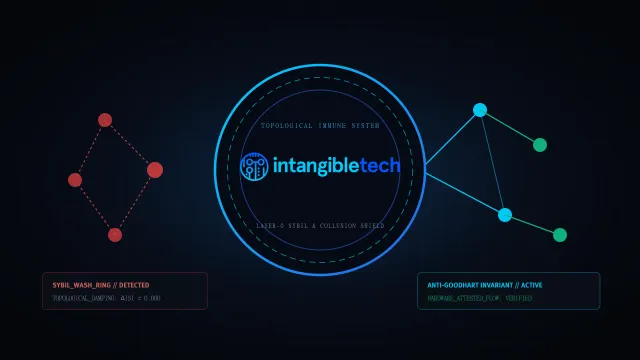
If intangible capital becomes the most valuable asset class in civilization, financial engineers will try to game it. Here is the adversarial threat model: how our architecture prevents wash attribution, dismantles mentorship cartels, grounds metrics in hardware truth, and neutralizes the threat of a corporate social credit score.
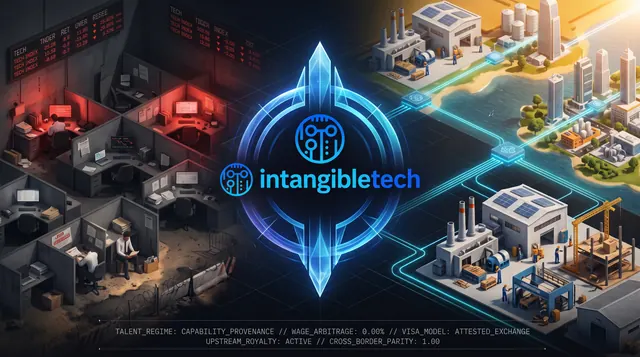
As political crackdowns and visa revocations send shockwaves through Silicon Valley boardrooms and Indian financial exchanges, a structural dilemma stands exposed: modern corporate tech strategy relies on exploitative labor arbitrage that hollows out domestic knowledge workers while trapping foreign talent in precarious dependency. Here is how Intangible Technologies inverts high-skilled labor economics—eradicating predatory wage undercutting through ISI parity mechanics, upgrading the broken H-1B lottery into verifiable capability provenance, and transforming offshore "bodyshops" into self-capitalized capability hubs that enrich both domestic and foreign economies.
Mass economic migration has fractured modern politics, leaving nations trapped between porous borders and humanitarian heartbreak. Here is how Intangible Technologies resolves the immigration crisis at its root—eradicating the black-market wage undercutting of American workers through ISI employer accountability, ensuring 100% tax contribution via atomic velocity partitions, providing seamless cross-border liquidity via the Sovereign Digital Identity, and exporting open-source economic architecture to build enduring prosperity in the home nations people never wanted to leave.
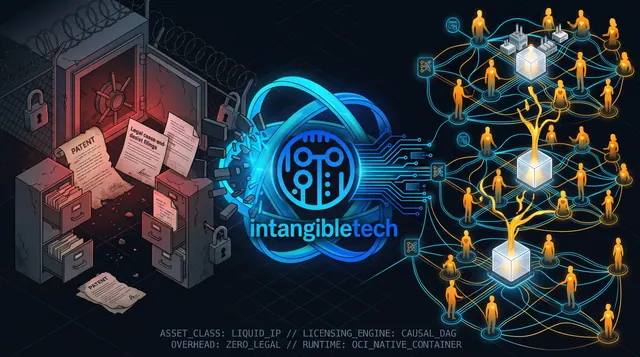
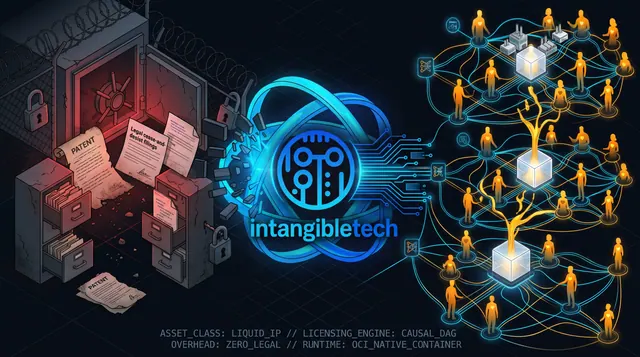
For four hundred years, intellectual property has been governed by a legal fiction: that ideas must be hoarded behind patent walls and restrictive copyright to have economic value. Here is how Intangible Technologies inverts IP into a liquid, yield-bearing asset—replacing multi-million-dollar legal overhead with automated DAG licensing, transforming containerized software into the foundational business model of the enterprise, and solving the open-source maintainer crisis without destroying the modern corporation.
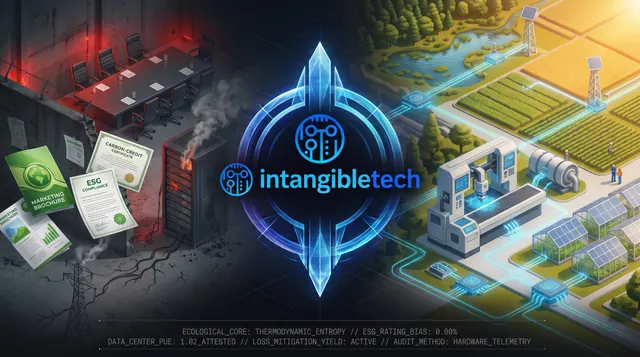
The $30 trillion corporate ESG industry has collapsed under the weight of its own hypocrisy—arbitrary moral scoring, phantom carbon offsets, and virtue-signaling consultant grifts that punished productive domestic energy while doing nothing to preserve the Earth. Here is how Intangible Technologies inverts environmental economics—validating the conservative critique that ideological mandates destroy fiduciary duty, replacing subjective ratings with hardware-attested thermodynamic entropy metrics, solving the runaway energy and water demands of AI data centers, and turning earthly conservation into an unassailable engine of institutional investment alpha.
College athletics has fractured into a $15 billion commercial entertainment arms race—funneling millions into football coaching buyouts and luxury locker rooms, while mid-major universities eliminate championship-winning swim and track teams, weaponize Title IX as a roster-cutting ax, and imperil the national Olympic pipeline. Here is how Intangible Technologies inverts collegiate athletics: decoupling commercial entertainment revenue from Olympic human capital, replacing opaque NIL booster collectives with transparent Sovereign Digital Identities, and holding university administrators accountable by linking athletic department decisions directly to campus-wide capital borrowing costs.
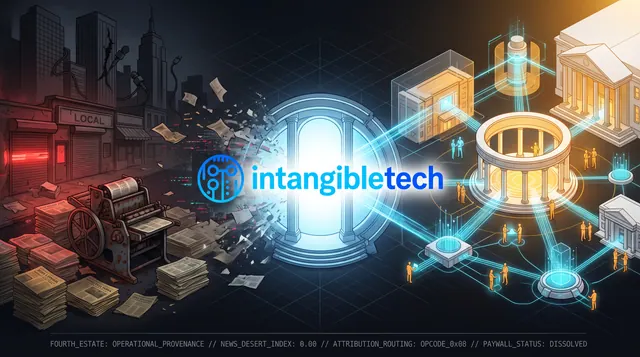
Over thirty-four hundred American newspapers have shut down, leaving fifty million citizens trapped in local "news deserts," while the world's most powerful billionaires buy up national media outlets to serve as personal narrative shields. Here is how Intangible Technologies re-engineers the economics of truth—transforming investigative journalism from a dying, advertising-dependent charity into an appreciating civic asset, replacing paywalls with sub-second liquid attribution, liberating freelancers through Sovereign Digital Identity, and restoring the press as an incorruptible auditor of power.
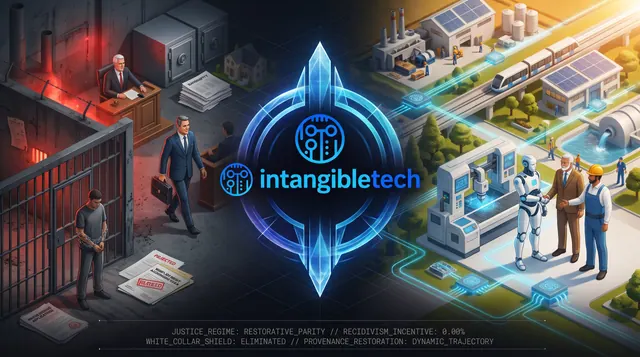
The modern justice system operates on a grotesque asymmetry: working-class citizens who commit petty offenses face a lifetime of civil death, denied housing, employment, and banking long after their sentences end—while white-collar fraudsters loot billions, serve light sentences in minimum-security facilities, declare strategic bankruptcy, and quietly retrieve hidden wealth. Here is how Intangible Technologies inverts justice—replacing punitive human warehousing with protocol-enforced restorative restitution, eliminating offshore asset shielding, and transforming criminal records from permanent social branding into dynamic, verifiable pathways of human redemption.
Try selecting "All Pillars" or clearing one of your active topic filters.
Select one or more topics to filter the Codex