If you want to understand why Western manufacturing has struggled to scale, do not look at labor wages or environmental regulations.
Look at the software running inside an aerospace factory.
During my time at GE Aerospace, I spent years working across the fractured labyrinth of enterprise resource planning (ERP) and manufacturing resource planning (MRP) systems. Inside a single industrial giant, you do not encounter one clean, unified system of record. You encounter four different legacy instances of SAP that do not communicate, three customized implementations of Oracle, and a patchwork of homegrown shop-floor applications developed twenty-five years ago running on terminal green screens.
The user interfaces were notoriously cumbersome, but the operational consequences were far worse.
Engineering specifications lived in Computer-Aided Design (CAD) and Product Lifecycle Management (PLM) silos. Inventory and purchasing lived in ERP tables. Real-time factory progress lived on paper “traveler” tags clipped to physical metal bins moving across concrete floors.
Because these systems could not talk to one another in real time, the corporate solution was Electronic Data Interchange (EDI)—an asynchronous, batch-messaging standard developed in the 1970s. When an engineering revision changed a dimensional tolerance by two thousandths of an inch, or when a production line hit a bottleneck, that data took days to crawl across translators, batch queues, and manual clerical reviews.
The further down the supply chain you looked, the worse the reality became.
The Upstream Blind Spot: The Lie of Contractual Compliance
The true backbone of American manufacturing is not the prime contractor. It is the vast, invisible network of Tier-2, Tier-3, and Tier-4 suppliers.
These are family-owned machine shops in Ohio, precision heat-treaters in Pennsylvania, and specialized casting foundries in Indiana. They employ thirty or fifty people, run machines that have been cutting metal for forty years, and maintain tolerances using physical micrometers and dial indicators.
These suppliers were completely oblivious to GE’s master digital records.
They did not have SAP. They did not have million-dollar PLM installations. They operated on paper shop routers, physical blueprint prints, and manual phone calls.
What was the enterprise’s solution to this reality? Legal coercion.
Corporate legal and procurement departments drafted massive, fifty-page supplier contracts with draconian compliance clauses. These contracts legally mandated that small machine shops provide real-time digital lot traceability, statistical process control data, and automated advance shipping notices.
It was an institutional fiction. Prime contractors attempted to legally force suppliers to transmit data that those suppliers physically lacked the software, capital, or infrastructure to capture.
The predictable result was an avalanche of paper certifications, manual data re-entry, and clerical friction. When a component arrived at an assembly plant with an unreadable paper tag or an EDI mismatch, the shipment was quarantined on a loading dock for weeks. Capital was frozen, assembly lines were stalled, and small suppliers waited sixty, ninety, or one hundred and twenty days for payment while accounts payable clerks attempted to perform manual three-way matches.
We have spent decades trying to fix a foundational systems-architecture flaw with legal threats and bureaucratic paperwork.
Supercharging the Stack: The Real Digital Thread
When technologists hear this critique, their instinctive reaction is to propose tearing everything down: “Replace SAP, Oracle, CAD, and shop-floor MES with a brand-new blockchain system.”
That is an amateur mistake.
CAD systems (like Siemens NX or CATIA) are world-class at mathematical geometry and finite element analysis. ERPs (like SAP) are sophisticated engines for managing corporate charts of accounts, tax structures, and human resource hierarchies. They are not going away, nor should they.
The problem is not that these specialized tools exist; the problem is that they lack a common, authoritative operational spine.
In corporate marketing decks, executives love to talk about the “Digital Thread”—the concept of a seamless data connection running from initial engineering design, through factory production, to commercial settlement and field maintenance.
In reality, that thread is severed at every corporate boundary by database silos and batch EDI messaging.
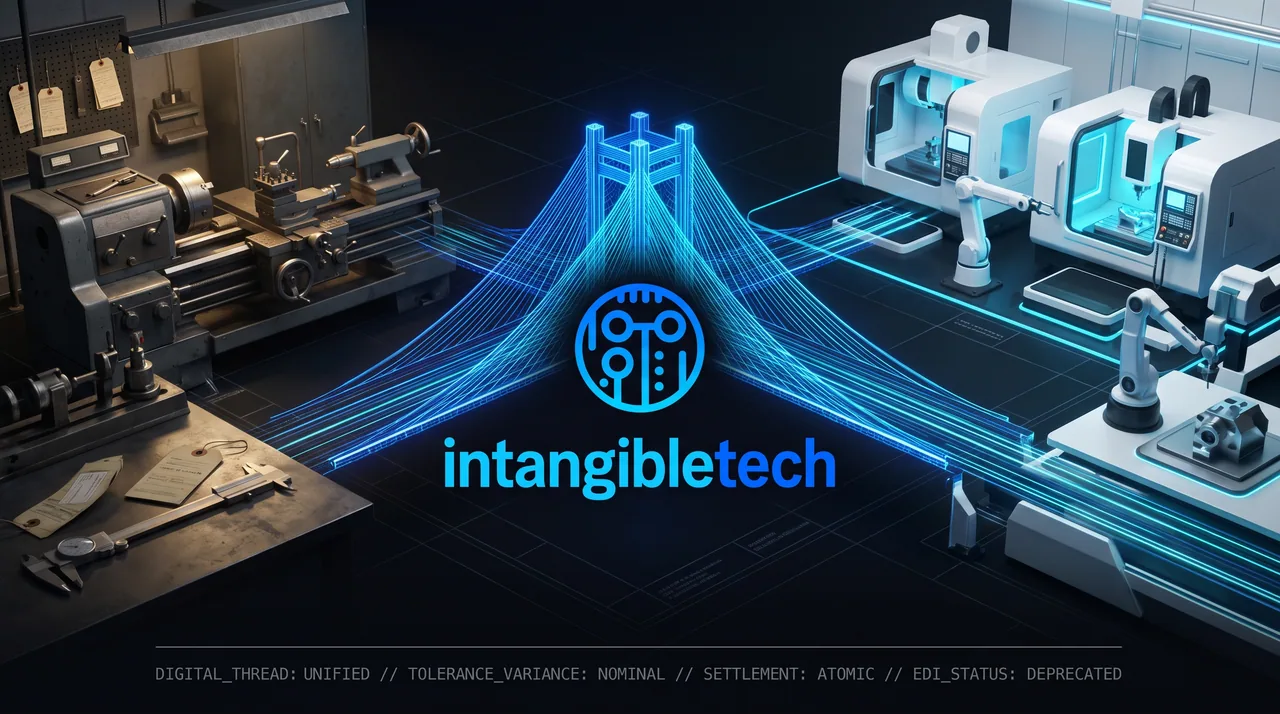
Layer-0 does not replace the enterprise software stack; it becomes the common thread that binds engineering truth directly to financial reality.
Instead of storing gigabytes of proprietary geometry on-chain, Layer-0 ingests the cryptographic digest of the component: the serialized part number, the engineering revision hash, and the fixed-point tolerance measurement signed directly at the inspection station.
Suddenly, the data engineering requires is married to the data finance needs:
- The aerospace design engineer sees that a critical turbine bracket was machined to within half a thousandth of an inch of nominal specification, permanently tied to that serialized physical part hash.
- The factory operations manager sees that Machine Tool 12 cut the part under normal spindle load, recording true thermodynamic equipment wear rather than an arbitrary straight-line accounting schedule.
- The corporate CFO and supplier treasurer see the accounts payable obligation clear atomically via native liquidity pools the moment the physical measurement is signed, eliminating invoice disputes and multi-month payment delays.
EDI mismanagement is eliminated because the transaction does not rely on asynchronous text files batched between disconnected databases. It settles across an append-only, deterministic state machine.
The Pragmatic On-Ramp for the Analog Machine Shop
How does this solve the crisis of the analog, paper-only supplier?
If participating in this architecture required a small machine shop to spend $500,000 on software licenses and hire enterprise IT consultants, it would fail before it began.
Our architecture is engineered with a low-barrier, progressive on-ramp:
1. Zero Enterprise Software Footprint
A Tier-3 machine shop does not need to install SAP or modify its internal servers. It requires only an open-source, lightweight edge portal or a standard hardware-authenticated tablet.
2. Digital Identity Over Complex Integrations
The machine shop’s lead quality inspector or machinist is issued a Sovereign Digital Identity (SID). When a batch of parts is completed, the inspector uses a digital caliper, micrometer, or optical scanner connected to the terminal. The physical measurement is captured, hashed alongside the purchase order manifest, signed with the inspector’s key, and committed to the ledger.
3. Bilateral Proof Over Unilateral Bureaucracy
The small supplier does not have to generate complex EDI 856 advance shipping notices.
When the parts arrive at the prime contractor’s dock, a receiving technician scans the physical crate. The receiving station verifies that the incoming hash matches the inspection signature committed by the machine shop.
The handoff is complete. The receipt is bilateral. The payment clears.
The small supplier gets paid on Day One instead of Day Ninety. In exchange for that immediate, life-saving cash flow, the small supplier provides the prime contractor with tamper-proof, serialized quality provenance that corporate legal departments could never achieve through fifty pages of contractual threats.
Three Executive Thought Inversions
For an engineering director or supply-chain CFO to understand this architecture, they must dismantle three assumptions inherited from twentieth-century corporate practice:
Inversion 1: Engineering Tolerances Are Balance-Sheet Capital
In traditional operations, quality tolerances are treated strictly as a manufacturing threshold: a part either passes inspection or it gets scrapped.
Under our ledger, holding tight engineering tolerances is a direct balance-sheet intervention.
When a factory consistently machines components centered within design tolerances, suppressing defect variance below actuarial thresholds, that performance directly feeds the enterprise’s Impact Score Index (ISI).
A pristine ISI compresses the enterprise’s borrowing rate on its working capital credit lines from nine percent down to prime tiers.
The machinist holding half a thousandth of an inch on a titanium casting is not just avoiding scrap; they are directly lowering the corporation’s cost of capital across its entire balance sheet.
Inversion 2: Machine Wear Is Thermodynamic, Not Accounting Fiction
In legacy finance, a multi-million-dollar five-axis milling machine depreciates on a flat, straight-line tax schedule—ten percent a year over ten years, regardless of whether it sits idle in a climate-controlled room or cuts hardened nickel alloys twenty-four hours a day.
On Layer-0, asset depreciation reflects physical thermodynamic reality. Machine runtime hours, spindle loads, and vibration data signed by machine controllers dynamically adjust the asset’s book value. Capital valuation reflects physical wear, aligning financial statements with the real condition of industrial tooling.
Inversion 3: Net-90 Payment Terms Are Industrial Self-Sabotage
For decades, corporate treasurers celebrated pushing supplier payment terms from Net-30 to Net-60, Net-90, and even Net-120 days. They believed they were optimizing corporate cash float.
In reality, they were hollowing out their own industrial base.
When a prime contractor delays payment for ninety days, small machine shops are forced to take high-interest merchant cash advances or bank lines of credit simply to make payroll and buy raw material stock. That interest expense is baked into the price of future parts, and vulnerable suppliers are driven toward bankruptcy at the first supply-chain shock.
By utilizing real-time Layer-0 settlement, payment clears in cadence with verified physical throughput. The prime contractor secures an anti-fragile, well-capitalized supply chain, and the small supplier operates with stable, predictable working capital.
The Macroeconomic Battle: Open Protocol vs. China’s Universal ERP
This is not merely an exercise in enterprise efficiency. It is an urgent matter of national economic survival.
Over the past two decades, the United States has watched its industrial manufacturing leadership erode. Meanwhile, China has built an integrated manufacturing apparatus that coordinates physical production with unmatched speed.
China is actively constructing what systems architects describe as a “Universal State-Planned ERP.”
Under their centralized economic model, the state connects state-owned enterprises, commercial ports, raw material processors, and private suppliers into unified digital platforms. When Beijing decides to scale electric vehicle production, aerospace components, or rare-earth refining, the demand signals, production orders, and state-subsidized credit flow through a centralized digital pipeline with minimal administrative friction.
The Western response has been broken: fragmented corporate silos, endless legal litigation between prime contractors and small suppliers, and brittle, thirty-year-old software that cannot coordinate across company walls.
The United States cannot, and should not, attempt to beat China by copying authoritarian central planning. We cannot mandate a single, state-run corporate software system.
The Western advantage has always been decentralized innovation, localized specialization, and free-market dynamism.
An open Layer-0 protocol is the answer:
THE AUTHORITARIAN MODEL: CHINA’S UNIVERSAL STATE ERP
• Centralized state surveillance & mandatory unified platform
• Zero enterprise privacy; complete bureaucratic control
• Brittle to top-down policy errors; stifles localized creativity
THE PROTOCOL MODEL: WESTERN DECENTRALIZED LAYER-0
• Open, neutral settlement spine connecting specialized tools
• Full data sovereignty; factories choose their own CAD, MES, & ERP
• Global coordination at machine speed without centralized monopolies
By deploying a neutral, open protocol:
- An aerospace giant in Connecticut, a specialized machine shop in Ohio, and an advanced electronics foundry in Arizona can keep their specialized, localized tools—whether they run custom code, Siemens NX, or manual workstations.
- Yet they settle, coordinate, and verify physical part handoffs across a single, shared, high-speed economic fabric.
We achieve the unified coordination speed of China’s centralized state apparatus while preserving the privacy, market competition, and operational adaptability of Western free enterprise.
Building on Truth
The crisis of modern manufacturing is not a failure of American ingenuity, engineering ambition, or blue-collar work ethic.
It is a failure of coordination.
We built magnificent machines capable of shaping titanium to tolerances measured in microns, and then forced the human beings who run them to navigate a bureaucratic nightmare of broken databases, clunky enterprise software, and predatory payment delays.
At Intangible Technologies, we are building the missing thread.
By grounding financial state in the physical reality of machine tolerances, replacing legacy EDI with immutable protocol settlement, and providing an accessible on-ramp for the analog craftsmen who build our world, we are doing more than modernizing corporate accounting.
We are rebuilding the operational nervous system of industrial civilization.