Sit with the Chief Technology Officer or the Head of Operations at any global enterprise, and they will tell you their most persistent, expensive headache is simply knowing what is actually happening.
They do not suffer from a lack of data. They are drowning in it:
- They have logistics databases tracking cargo container locations,
- SCADA systems recording the generation of solar and wind power grids,
- Cold-chain monitors recording the temperatures of life-saving biopharmaceuticals in transit, and
- Industrial safety logs attesting to the maintenance and integrity of high-pressure pipelines.
Yet, if you look behind those databases, you discover a multi-billion-dollar auditing and compliance racket:
A cargo container gets warm, spoiling a million dollars in vaccines, but the manual temperature log is backdated by an overwork contractor to read a perfect 4°C. An energy plant is paid millions in public subsidies for “generating green power” while silently venting unmetered gas or over-reporting output. A sub-tier contractor attest that they used high-durability, American-made steel on a bridge, while actually sourcing cheaper, substandard foreign imports and falsifying paper origin certificates.
When enterprise leaders and risk committees look at decentralized ledgers and automated value-sharing systems, they always confront the ultimate, fatal engineering roadblock—what computer scientists and blockchain architects call The Oracle Problem.
The risk committee asks:
“We understand that your ledger is immutable and that its eight pre-compiled opcodes are secure. But how does the ledger actually know what happened in the physical world? How does the software know that a physical gear actually turned, or that a solar panel generated a kilowatt-hour, without a human, a flawed database, or an easily hacked cloud API lying to it?”
To a general executive-level audience, an “Oracle” is any software or information gateway used to connect a digital system to external, real-world data.
In legacy systems, this gateway is typically a piece of software, a web scrapers, or an API that fetches off-chain data (like weather, stock prices, or shipping coordinates) and feeds it to a computer.
The traditional Web3 approach to the Oracle problem is heavily software-centric and centralized: it relies on “consensus-based” networks of data-scraping software nodes, off-chain API pools, and complex, multi-party consensus algorithms that attempt to average out data from different websites to find the truth.
This software-only approach works well enough for digital-only environments like tracking stock prices or sports scores. But for the physical-to-ledger bridge, it is a dangerous, systemic failure point.
A software Oracle can only verify what digital inputs told it. It cannot verify whether the sensor that generated the input was a real physical device or an attacker running a simulation on a virtual machine. If the data-gathering middleware, the cellular router, or the cloud database (like AWS IoT or Azure) is compromised, the ledger is simply recording tamper-proof lies.
To secure our global cyber-physical infrastructure, we must execute a fundamental mental inversion:
Stop trying to “verify” physical truth using human audits or centralized cloud APIs after the fact. Prove it at the instant of physical action by embedding cryptographic identity within the silicon chip that actually registers the biophysical event.
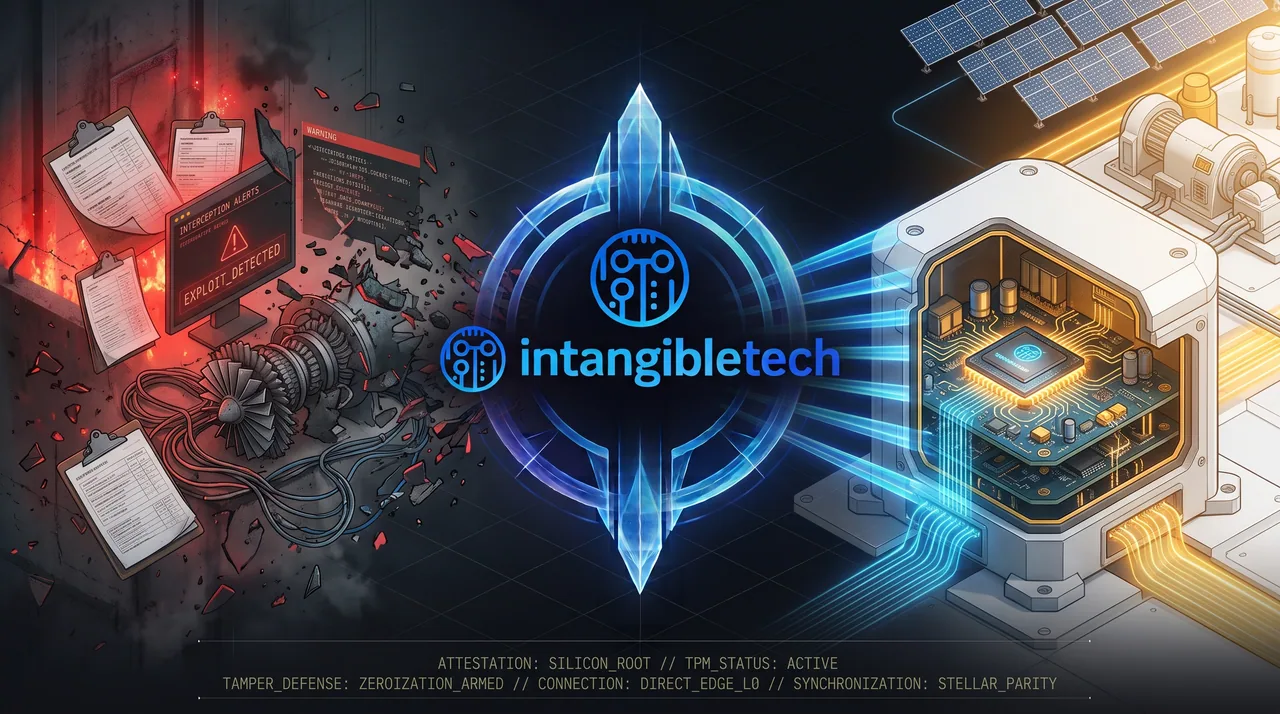
The Intangible Architecture does not ask the ledger to trust software scrapers or human clipboards. We bridge the physical and digital worlds by deploying the Hardware Root of Trust.
By embedding cryptographic signing directly at the sensor bus, enforcing physical zeroization on tamper attempts, and enabling edge-to-Layer-0 attestation pipelines that operate without cloud dependence, we ensure that physical reality and ledger state remain permanently, mathematically bound.
1. The Illusions of the Old School: Paper, Databases, and the Middleware Trap
To understand why a hardware-level solution is necessary, you have to look at the extensive, expensive friction points of legacy operational audits.
Traditionally, enterprises and governments have relied on three tiers of insecure validation, each carrying massive administrative overhead and risk:
The Human Clipboard (Verify-on-Site)
Historically, the only way to prove a physical event happened was to send a human to look at it.
An auditor from a major firm (like Deloitte or EY) or a state inspector traveled to a facility, read an analog meter, signed a paper checklist, and typed the numbers into a corporate mainframe. This manual workflow was expensive, slow, and highly vulnerable to human error, backdating, and bribery.
The Insecure Connected Sensor
With the rise of the Industrial Internet of Things (IIoT), companies replaced clipboards with digital sensors.
However, these sensors were built with zero native security:
- A temperature sensor or flow meter measures an event,
- converts it to a simple, unencrypted electrical signal, and
- sends it over an open physical bus (like SPI, I2C, or CAN) to a local computer or router (like a PLC).
- The local router, running insecure software, packages this data into an unencrypted network protocol (like Modbus or MQTT) and uploads it to a centralized cloud database.
[ Physical Event ]
│
▼ (Raw analog/digital electrical signals)
[ Unsecured Sensor ] ──► (Insecure CAN/SPI bus: Trivial to intercept, fake, or replicate)
│
▼ (Unencrypted network data)
[ Local Router / Gateway ] ──► (Modbus/MQTT: No identity, easily falsified)
│
▼ (Centralized transit)
[ IoT Cloud / Database (AWS/Azure) ] ──► (Accessible to admin bypass, API hacks, & retro-edits)
│
▼ (The software ‘Oracle’ bridge)
[ The Ledger ] ──► (Immutable state of tamper-proof lies)
Notice the fatal flaw in this chain: The data is completely naked during its most vulnerable transit phases.
A malicious contractor, a compromised employee, or an external hacker does not need to crack the blockchain’s cryptography. They simply intercept the open physical bus, inject fake electrical signals into the wire using fifty dollars of hobbyist hardware, or edit the values inside the IoT cloud before they ever reach the ledger.
The “integrity” of the ledger is useless if the pipeline that feeds it is a sieve.
2. Phase 3: Hardware Root of Trust and Silicon-Level Attestation
The Intangible Architecture ends this translation hazard by enforcing a strict physical boundary: Silicon-Level Attestation.
We do not trust any software, gateway, or human operator that sits between the physical event and the Ledger. The sensor that measures the environmental force is the exact same cryptographic node that signs the ledger transaction.
1. Cryptographic Enclaves and TPM 2.0 at the Sensor Bus
Instead of using software to generate a data report, we embed dedicated cryptographic hardware—specifically Trusted Platform Modules (TPM 2.0), secure enclaves, or microcontrollers equipped with Physically Unclonable Functions (PUF)—directly on the physical sensor bus:
- Hardware Encryption at the Bus: Hardware-level sensors (like flow meters, electrical encoders, and temperature probes) are integrated with TPM 2.0 microcontrollers physically embedded on the sensor’s primary SPI, I2C, or CAN bus.
- The Foundry Key: During silicon manufacture, a unique private cryptographic key is burned into the enclave’s non-volatile memory, inaccessible to software, external readouts, or the firmware itself.
- On-Chip Signing: The instant a physical event occurs (e.g., a rotor spins or an electrical current passes), the sensor’s micro-controllers measure the physical signal and immediately generate a cryptographically signed payload.
- The Invariant Struct: This payload packs the event telemetry, timestamp, and a sequential cryptographic nonce into the protocol’s standard 128-byte state struct, signed by the device’s Hardware Root of Trust.
No human can alter the measurement, and no software can intercept it, because the data is cryptographically sealed before it ever travels an inch down the wire.
3. Tamper-Evident Enclosures & Active Zeroization
A common, valid objection from industrial operations and security auditors is physical tampering:
“Crypto chips are great. But what stops a rogue technician or bad actor from opening the device, tapping the physical SPI bus wires on the circuit board, or using custom electrical probes to inject fake sensor data directly into the TPM?”
In physical security, this is known as a Probing Attack. It is a major vulnerability for remote, un-monitored infrastructure like solar arrays, pipeline valves, and shipping containers.
We solve this through the ultimate hardware-level defense: Tamper-Evident Enclosures and Cryptographic Zeroization.
1. Active Tamper-Evident Meshes
The physical sensor and its cryptographic enclave are encased within an armored, tamper-evident enclosure:
- The inner casing is wrapped in a highly sensitive, energized Active Kapton or FPC (Flexible Printed Circuit) mesh. This mesh is threaded with microscopic, patterns of resistive or capacitive traces that carry continuous, low-power current.
- Additional micro-switches, light-detection sensors, and continuous voltage drop detectors are integrated onto the internal circuit board.
2. The Zeroization Event
If a bad actor attempts to breach the enclosure—whether they try to drill through the casing, slide a probe inside, tap the CAN bus, or open the lid:
- The physical disturbance inevitably breaks, shorts, or alters the electrical continuity of the active mesh or sensors.
- Within milliseconds, the device’s internal hardware triggers Cryptographic Zeroization.
- A tiny internal energy charge discharges directly into the secure enclave, immediately and permanently vaporizing the private cryptographic keys stored in the non-volatile registers.
The device’s Sovereign Digital Identity is erased forever.
Once zeroized, the hardware is mathematically “dead”: it cannot sign another state transaction, its attestation will be rejected by consensus, and the enterprise ledger automatically flags a physical breach.
Fraud is stopped, not by a compliance audit months later, but by the instantaneous, self-destructing physics of the hardware.
4. Edge Telemetry and Bypassing Cloud Dependence
Another critical concern from operational engineers is network resilience:
“Industrial equipment operates in the real world: on deep-water offshore platforms, remote desert pipeline stations, and moving rail cars. If these sensors require a continuous, high-speed internet connection to send data to your digital ledger, what happens when they lose connectivity? Does your system freeze or fail?”
In legacy IoT, losing internet connectivity is an operational disaster: the connection to AWS IoT or Azure breaks, caching fails, and data packets are lost, resulting in un-audited blind spots that force enterprises to pause operations or face massive regulatory fines.
The Intangible Architecture resolves this through Edge Telemetry without Cloud Dependence:
- Point-to-Point Validation: Attested edge devices do not connect to a bloated centralized cloud. They binary-pack and sign their state transitions directly, transmitting tiny, high-integrity 128-byte data structs to the nearest peer-to-peer gateway via low-overhead, resilient transit (LoRaWAN, cellular, or satellite).
- Consensus Validation on the Spot: A nearby local Layer-0 validator on the edge of the network can cryptographically authenticate the signature of the TPM on the fly—without checking database tables or validating against centralized cloud servers. If the signature is intact, the transaction is verified and queued.
- Disconnected Cache & Synchronized Playback: If a remote sensor—like an offshore rig or a rail container—loses all connection to the outside world, it does not stop operating. The secure enclave continues to log, timestamp, and cryptographically sign its operations into a secure, encrypted local cache.
- Because the keys cannot be extracted, this cache cannot be retroactively backdated or altered by the local crew.
- When the container or rig re-establishes connectivity, the queued, signed transaction timeline is “played back” to Layer-0, which validates and settles the sequence atomically on the global Stellar network.
Network dropouts do not create security voids. They are simply buffered gaps in a timeline whose integrity is permanently secured by silicon.
5. The Synchronized Global Mesh: How the Nodes Synchronize
How does this cyber-physical system maintain its absolute, global parity? If we are processing millions of physical events across the globe, how do we prevent fake hardware or virtual simulations from injecting bad data into our ledger?
The protocol enforces alignment through Linear Sovereign Initialization:
THE LEGACY SIMULATION EXPLOIT (UNPROTECTED):
Attacker spins up virtual sensor simulation ──► Sends data to cloud API ──► Accepted as real.
VS.
THE PROTOCOL BOOTSTRAP PIPELINE (INTANGIBLE):
- foundry Key Registration (Cryptographic Birth)
• Secure hardware manufacturer registers Silicon Foundry Public Keys on Layer-0.
- The On-Chain Genesis Ceremony
• Validator nodes verify physical device SID matches foundry lineage.
- Live Sensor Attestation (Edge Check)
• Edge sensors sign binary-packed 128-byte state structs with their hardware-locked keys.
- Parity Synchronization
• Transactions settle on Stellar rails in 3-5 seconds.
• The global mesh validates state, synchronizing the entire physical-digital border.
- Foundry Authentication: The secure hardware manufacturer (e.g., Infineon, NXP, STMicroelectronics) signs and registers their Silicon Foundry Root Keys directly onto Layer-0. The Ledger knows the cryptographic “DNA” of every legitimate security enclave ever manufactured.
- The Genesis Ceremony: When an industrial enterprise installs a new smart flow meter or energy grid controller, the installation is cryptographically registered on-chain. This registers the device’s Sovereign Digital Identity (SID) on the DAG as a verified child node of both the foundry and the licensed enterprise.
- Continuous Parity Synchronizations: Every transaction signed by this verified SID contains a sequential, tamper-proof provenance nonce. If an attacker attempts to “spoof” a device by running a virtual simulation of its telemetry, the consensus validators immediately detect the missing hardware root signature, the incorrect sequence number, or the lack of physical attestation, and automatically reject the transaction.
The Ledger remains synchronization-ready, updating the Global Mesh in 3-5 seconds across Stellar consensus, providing an un-cheatable, single version of physical-to-digital reality.
6. Real Impact: Bringing Accountability to Everyday Life
Why does this silicon-level attestation matter to the average citizen? How does a deeply technical hardware bridge improve the daily lives of families and the operational metrics of political and business leaders?
1. Water, Environmental, and Community Safety
Imagine a municipal water filtration plant:
- In the old school, testing was manual: a subcontractor manually collected water samples, and a lab technician filled out paper reports. This manual loop resulted in scandals like the Flint water crisis—where administrative delays, backdated paperwork, and falsified inspection logs allowed lead-poisoned water to flow into family homes for months.
- With silicon-level attestation, automated spectrometers, pH probes, and filtration systems are equipped with Hardware Roots of Trust. Water quality and flow data are signed on-chip and streamed continuously to the public ledger.
- If lead or chemical contaminants spike, the protocol detects the defect instantly and alerts the community. There is no room for administrative delays or political cover-ups.
The physical safety of children is protected by the un-bribable laws of silicon.
THE OLD SCHOOL TRAGEDY (FLINT, MI):
Manual Water Samples ──► Paper Logs Backdated by Contractors ──► Bureaucratic Cover-Up
Outcome: Thousands of children poisoned; Years of legal finger-pointing.
THE SILICON-ATTENDED REALITY:
Automated pH/Chemical Sensors with Native TPM 2.0 ──► Cryptographic Attestation Payload
Outcome: Instantaneous alert on the public ledger; Defect detected on-chain; Cover-up impossible.
2. Attestation for Natural Disasters and Parametric Insurance
For families and businesses hit by hurricanes, floods, or crop failure, the legacy insurance process is a nightmare:
- Wait months for a human adjuster to inspect damage, while corporate adjusters debate definitions to avoid payout.
- Contrast this with Hardware-Attested Parametric Insurance:
-
-
Attested wind-gauges, storm-surge telemetry, and moisture sensors in farmers’ fields are cryptographically signed at the sensor bus on Layer-0.
-
If a Category 4 hurricane hits a coastal community, the hardware attests to the velocity in real time.
-
No adjusters are needed. The data triggers Opcode 0x04 (Parametric Escrow), releasing relief funds to affected families in milliseconds.
-
The physical event and the financial relief are atomically bound.
3. Absolute Trust in Supply Chains and Pharmaceuticals
For global industries and healthcare providers:
- Biological enclaves on cold-storage vaccine cases sign every single L1 temperature measurement directly.
- If a shipment has been exposed to high temperatures, the system registers the “heat defect” instantly, and the vaccine is quarantined.
- The supplier cannot claim the shipment was kept cold, because the cryptographic signature of the sensor’s secure enclave was permanently zeroized or faulted on the ledger.
Medical efficacy is secured by mathematical certainty.
The Recovery of the Un-Bribable World
For the past three decades, the global business community has been told to accept a dangerous disconnect.
We were told to rely on an economic system that exists entirely in the digital and administrative clouds: accepting that paper invoices, manual audits, and easily manipulated databases could verify the physical reality of our energy, our supply chains, our infrastructure, and our environmental resources.
We watched in frustration as this gap was exploited by bad actors—allowing financial fraud, environmental destruction, and supply-chain compromises to operate in the dark while we spent billions on retroactive, paper-based compliance.
We accepted this disconnect because we believed that a digital ledger could never truly know the physical world.
That belief is obsolete.
The Intangible Architecture restores the connection between physical work and digital truth.
By embedding cryptographic identity at the silicon layer, enforcing active zeroization on tamper attempts, and enabling edge-to-Layer-0 attestation pipelines, we solve the Oracle Problem at its foundation:
- Where no clipboard can be backdated, and no database can be manipulated.
- Where every kilowatt-hour of energy, every gallon of water, and every container of medicine is attested by its own physical signature.
- Where fraud is stopped by the self-destructing physics of the hardware, and
- Where human industry, ecological stewardship, and democratic self-governance are anchored to the un-bribable, mathematical reality of our world.
The clipboard has been retired.
The silicon bridge is active.
And the physical world is finally secure on the ledger.