
Layer-0 & The Tri-Tier Operating System for Thermodynamic Value
A progressive engineering and macroeconomic implementation blueprint. Intangible Technologies replaces 530-year-old Venetian batch accounting, locked SQL mainframes, and fragile Web3 smart contracts with a 128-byte bare-metal Layer-0 settlement kernel, hardware-attested NPU Oracle containers, and Stellar Layer-1 global finality—turning real-time money velocity () into a live, measurable state variable.
Not a Web3 token project, RWA wrapper, or DAO. Zero speculative platform altcoins minted. All 15 governing macroeconomic equations and 128-byte wire schemas are published openly so any startup, bank, or enterprise can build Dockerized Oracle software via the Intangible Root SDK—plugging directly into Node 0 (bytes 80..95).
Per Pinned L1-Cache Core
0.4 ms local finality via 128-byte structs, isolcpus & io_uring.
Global FBA StateRoot Anchor
Inter-cluster atomic settlement () at 0.00001 XLM.
Immutable Genesis Constant
Hardcoded in bytes 80..95 of every 128-byte wire envelope ().
0x05) & 4-Layer Restitution (0x07)
0x01 tax split, Debt Sinks, , FX Parity , Smart Art. 5 & 15-Eq Table
Layer-0: The Bare-Metal Monetary Kernel & The Tri-Tier "Mobile SoC" Compute Topology
Why can't a national or planetary economy run on a cloud PostgreSQL/Oracle cluster or an Ethereum virtual machine? Because relational SQL databases suffer catastrophic row-level lock contention (~250 µs mutex queues capping hot accounts at ~4,000 TPS), dynamic heap garbage-collection pauses, and POSIX kernel context switches—forcing commercial banks to pay $50M+ in predatory IBM zSeries COBOL mainframe "MIPS" licensing taxes. Conversely, Web3 blockchains force every node on Earth to sequentially re-execute arbitrary Solidity bytecode at 15–100 TPS while exposing $10B+ in reentrancy and bridge honeypots.
Intangible Technologies solves both by separating sequential balance settlement, heavy graph/telemetry calculus, and global cross-border consensus into a Tri-Tier Hardware Topology analogous to a modern System-on-Chip (SoC):
"How does a single-threaded TigerBeetle state machine scale across modern 128+ core enterprise server chips? Does the Layer-0 binary require a custom operating system, how do we deploy open-source containers globally without giving cloud providers a centralized kill-switch, how do banks and apps query the system if Layer-0 is optimized strictly for writes, and how does this decimate the IBM mainframe monopoly?"
Layer-0 Deterministic Settlement Kernel — "The CPU Core" (Bare-Metal Linux + TigerBeetle VSR)
Kernel-bypass io_uring NIC ingress. Verifies Ed25519 / post-quantum FIPS 204 ML-DSA signatures and 200-byte zk-SNARK validity receipts in parallel across 96 cores; places pre-verified batches of 8,192 instructions into lock-free L3 memory rings.
Isolated via isolcpus (no malloc, 0.0 ms GC jitter). Each core pins a single-threaded 128-byte accounting shard inside its 32 KB L1 cache (~1 ns access), executing 8 pre-compiled opcodes (0x01–0x08). Intra-chip transfers clear via L3 rings in sub-microseconds.
Zero SELECT * analytical queries on Layer-0. Every finalized VSR batch broadcasts via zero-copy pub/sub (Kafka/Redpanda) to Bank DevOps Guardians and enterprise read-replicas (Databricks, Snowflake, dbt, Atlan)—decimating $50M+ IBM COBOL mainframes on $15k Linux servers.
Confidential Oracle & Attribution Coprocessors
- • Hardware Enclaves (TPM 2.0 / AWS Nitro / AMD SEV-SNP): Runs Apache Kafka, Flink, Databricks & zk-SNARK provers on encrypted RAM (SHA-512 PCR0–PCR7 attested) so raw corporate trade secrets and citizen PII remain 100% private.
- • Defeating the 2008 Moody's Trap (5-of-7 Orthogonal Consortium): Operated by competing labs (UL, TÜV SÜD), insurers, OEMs, and evolved institutions funded neutrally from and backed by staked Account Type B Surety Bonds subject to millisecond Opcode
0x07slashing.
Stellar Layer-1 Global Settlement Anchor (FBA)
- • Overlapping Quorum Slices (): Anchors 3-second cryptographic state roots from all regional Layer-0 clusters (Indiana L0, Ohio L0, UK L0), preventing any regional cluster from secretly printing unbacked money.
- • XLM as "Digital Computational Crude Oil": 100% invisible to retail citizens spending USD/EUR on L0; required in the L1 engine room for institutional base reserves,
0.00001 XLMstroop fees, and cross-border AMM seesaw liquidity pools.
Why Stellar Is the Global System of Truth & How XLM Operates as "Computational Crude Oil"
The speed of light through fiber-optic glass (~200 ms round-trip globally) makes a single planetary bare-metal queue physically impossible. Intangible Technologies solves global scaling by pairing Federated Regional Layer-0 Clusters (0.4 ms local finality) with Stellar Layer-1 (3.0s cross-cluster finality):
When an Indiana L0 account pays an Ohio L0 recipient, Indiana L0 reads bytes 108..109 (shard_routing_id) and locks the funds in a two-phase PENDING_ESCROW (t_timeout = 3000ms) while Visa/Mastercard AI nodes sniff for fraud in parallel. Because Indiana and Ohio share overlapping Stellar FBA validator slices (), Stellar verifies the transfer (applying Algorithmic FX Parity if crossing currencies) and both clusters execute POST_PENDING_TRANSFER atomically at 3.0s—or auto-restore via VOID_PENDING if connectivity drops.
Citizens never hold or see XLM at checkout. Down in the Layer-1 engine room, finite XLM scales infinitely via four physics rules: (1) 10,000-to-1 Batch Compression from L0 to L1; (2) Microscopic Stroop Divisibility (0.00001 XLM per L1 state-sync); (3) Unit Price Appreciation as global expands each XLM's FX routing capacity; and (4) Anti-Hoarding Demurrage ( on cold-storage XLM hoards, flushing XLM into active institutional pools).
Instead of selling XLM on retail exchanges to pay USD operating expenses, the non-profit Stellar Development Foundation (SDF) locks its XLM into Cross-Border AMM Seesaw Pools (USD ↔ XLM ↔ EUR) and Sponsored Reserve Leases for regional Layer-0 clusters—retaining 100% ownership of its XLM on Layer-1 while streaming continuous daily USD turnover yield () into its Layer-0 wallet.
Why Only This Architecture Turns Money Velocity () Into a Live Actionable Variable
In legacy macroeconomics, money velocity () is a useless statistical ghost estimated 90 days after the quarter ends because commercial banks trap dollars inside disconnected, private SQL silos. On the Intangible Layer-0 kernel, every commercial payment clears atomically through 3-Primitive Enterprise AMM Reserve Pools bound to verified Sovereign Digital Identities (SID), transforming into a live millisecond speedometer:
Evaluated continuously every 2 to 5 seconds across all active AMM settlement pools with zero double-counting via Sovereign ID provenance filters.
Streams real primary-cash dividends () daily—ending the retiree 4% sell-down rule.
Commercial turnover continuously burns down loan principal () up to hard cap .
A tiny 1.0% split across $500T+ high-velocity settlement generates $5T/yr with zero April 15th IRS filings.
Feeds to govern elastic money issuance (), PID damping, and cross-border FX parity ().
Built on Stellar Physics: Why Only Stellar—Not XRPL, Ethereum, or Solana—Can Anchor the Intangible Layer-0 Kernel
Corporate executives are often pitched Ripple (XRPL) as the "enterprise blockchain" or Ethereum/Solana as the "programmable standard." When evaluated at the silicon and macroeconomic layer, both approaches collapse under institutional requirements. Here is why the Intangible Financial Architecture is built strictly as a bare-metal extension of Stellar’s foundational physics.
| Architectural Dimension | Ethereum / Solana (EVM/SVM) | Ripple / XRPL | Stellar Layer-1 + Intangible Layer-0 |
|---|---|---|---|
| 1. Serialization & CPU Cache Physics | Variable-length bytecode & dynamic heap allocation; constant L1 cache misses. |
Variable-length STObject (TLV) fields stored in pointer-chasing SHAMap radix trees in RAM (~100ns cache-miss penalty; caps out at ~1,500 TPS).
|
Strict RFC 4506 XDR fixed binary schemas mapped to contiguous 128-byte structs (two 64-byte L1 cache lines, ~1ns access, 1,000,000–4,000,000 TPS/core).
|
| 2. Smart Contracts vs. Pre-Compiled Operations | Arbitrary Turing-complete smart contracts ($10B+ drained in reentrancy/logic hacks) + pervasive MEV front-running. | Bolt-on WebAssembly "Hooks" and fragmented EVM sidechains that reintroduce smart-contract exploit surfaces and cross-chain bridge risk. | Zero arbitrary user bytecode. 8 Pre-Compiled Silicon Opcodes (0x01–0x08) on L0 paired with Stellar’s pre-compiled C++ operations and randomized zero-MEV block ordering.
|
| 3. Statutory Restitution & Clawback Architecture |
Blacklist smart-contract wrappers (USDC/USDT) with zero downstream restitution mechanics.
|
Naive Token/MPT Clawbacks (XLS-39d/XLS-33d). Fails completely when an offender spends tokens to innocent third parties and leaves a $0.00 wallet balance.
|
Pre-commit zk-SNARK statutory gating in L1 cache + Opcode 0x07 Statutory Garnishment Valve (sweeps offender's future inflows + slashes Oracle CAP-35 Surety Bonds while keeping innocent downstream holders 100% whole).
|
| 4. Corporate Governance & Reserve Economics | Plutocratic Proof-of-Stake whale cartels & volatile retail gas fees. | The "Web3 IBM" Trap: For-profit corporation selling closed-source enterprise middleware while unlocking up to 1 billion XRP/month from corporate escrow to dump on the market. | 100% Open-Source Public Utility: Non-profit foundation (SDF) + Democratic Code Federation. Zero token dumping—SDF leases XLM via Sponsored Reserves (CAP-33) and AMM seesaw pools (CAP-38) to earn real Layer-0 USD yield.
|
Why Stellar Was Rewritten From Scratch Over XRPL (XDR vs. SHAMap Pointer Chasing)
XRPL stores ledger state inside an in-memory radix tree (SHAMap) using variable-length Type-Length-Value (STObject) encoding. Evaluating a transaction or traversing a state pointer in XRPL forces the CPU core to chase memory addresses across main DRAM—triggering ~100ns L1/L2 cache misses and limiting throughput to ~1,500 TPS.
Stellar (stellar-core) discarded XRPL's state model entirely in favor of RFC 4506 XDR (External Data Representation)—a rigid, deterministic binary wire standard—and flat relational state tables. Our Layer-0 kernel takes that exact binary determinism down to bare metal: packing every Account () and Instruction () into a fixed 128-byte struct that never chases a pointer in RAM.
Protocol-Native Constant-Product AMMs (CAP-38) + Zero-MEV Ordering
While XRPL originally relied on a fragmented Central Limit Order Book (CLOB) that suffered from thin cross-currency liquidity and later bolted on AMMs without solving enterprise balance-sheet velocity, Stellar engineered native Constant-Product AMMs (CAP-38), multi-hop PathPaymentStrictSend, and cryptographically randomized transaction ordering at consensus.
This guarantees that no validator can front-run corporate treasury flows, synchronizing 1-to-1 with our Layer-0 3-Primitive Enterprise AMM (Opcode 0x03) and turning money velocity () into a manipulation-proof macroeconomic variable.
Federated Byzantine Agreement (SCP) vs. Top-Down UNL Lists
XRPL relies on a Unique Node List (UNL) historically published from the top down by Ripple. Stellar’s Federated Byzantine Agreement (SCP) is the first provably safe consensus mechanism based on dynamic Quorum Slices ()—allowing each regional Layer-0 cluster (Indiana L0, UK L0, Japan L0) to be governed by its own local Commercial Bank DevOps Guardians, Credit Unions, and Sovereign Treasuries while mathematically guaranteeing global intersection.
Ending the Escrow Dump Model (Open-Source Infrastructure vs. Proprietary Middleware)
Banks migrating off IBM mainframes refuse to trade IBM’s closed-source MIPS tax for Ripple’s closed-source enterprise licensing and monthly XRP escrow liquidations. On Intangible Layer-0 + Stellar Layer-1, the entire stack is 100% open-source, self-funded by a microscopic fraction of velocity (), and requires zero speculative token sales.
Legacy 1494/SQL vs. Web3/DAOs vs. The Intangible Financial Architecture
Why did all seven Web3 paradigms—DeFi (150% over-collateralized mirror rooms), ReFi (unverified carbon token inflation), DePIN (emission Ponzinomics), RWA Tokenization ("lipstick on a 1494 pig"), Turing-Complete EVM Contracts ($10B+ hack surface), Treasury Stablecoins (Eurodollar deficit vacuums), and Web3 DAOs (plutocratic whale capture & the "Grant Proposal Circus")—fail to fix the real economy? Because they digitized 1494 scarcity on global broadcast nodes without building a closed-loop thermodynamic state machine.
| Architectural Dimension | Legacy 1494 / 1973 SQL Banking | Web3 / Crypto / RWA / DAOs | Intangible Architecture |
|---|---|---|---|
| Core Data Model & Execution | Fragmented bank SQL tables; row-locks; asynchronous batch reconciliation. | Global nodes running Turing-complete VMs (EVM/SVM); sequential gas auctions. | Tri-Tier SoC: 128-byte Layer-0 (io_uring, 1M–4M TPS/core) + NPU Oracles + Stellar L1 FBA.
|
| Smart Contract Attack Surface | Opaque COBOL/Java middleware; insider fraud & reconciliation drift. | Extreme Risk: Arbitrary Solidity bytecode, reentrancy, flash-loan & bridge hacks ($10B+). | Zero Arbitrary Bytecode: 8 pre-compiled, formally verified financial opcodes (0x01–0x08).
|
| Monetary Issuance & Backing | Unbacked commercial bank debt expansion + central bank QE (). | Fixed deflationary supply caps (BTC 21M) or hyper-inflationary governance tokens. | Thermodynamic Elasticity (Eq. 8): Non-inflationary gated strictly by real growth. |
| Store of Value vs. Exchange | Conflated in a single bucket; high interest rates reward idle hoarding over production. | Deflationary cold-wallet hoarding or extractive T-bill arbitrage (USDT/USDC). | Dual-Account Topology (Eqs. 2–4): Liquid Checking A (lazy decay ) + Productive Vault B (). |
| Enterprise Balance Sheet & Credit | Compounding usury (), rigid DSCR default traps, debt-fueled share buybacks. | 150% over-collateralized crypto loans; RWA tokens wrapping legacy compounding debt. | 3-Primitive AMM + Dynamic Credit (Eqs. 11–12): 0.25%–3% ISI rates, hard cap & 0x05 grace.
|
| Enterprise & Civic Governance | Short-term EPS maximization; golden parachutes; hostile private-equity LBOs. | Web3 DAOs: 1-Token-1-Vote whale plutocracy, flash-loan raids & Discord grant theater. | Post-DAO Accountability: Executive Spread (), DISSENT veto, Liquid/Quadratic voting & Anti-LBO Poison Pill.
|
| Macro Yardstick & Taxation | Archaic 1934 GDP (counts pollution/war as growth) + retrospective April 15th IRS filings. | Total Value Locked (TVL) & wash-traded market caps; pseudonymous tax evasion. | Master Parameter (Eq. 7) & Atomic Tax (Eq. 14): Millisecond PID loop + 0x01 tax split.
|
| Citizen Privacy vs. Auditability | Inverted: Total surveillance of citizens' bank accounts; opaque military/corporate budgets. | All-or-Nothing: Public chains expose every purchase, or privacy coins block macro telemetry. | Asymmetric zk-SNARK Firewall: 100% ZK privacy for citizens; 100% public glass-box for state & subsidies. |
Navigate the 6 Progressive Technical Modules
Each module builds directly on the mathematical primitives of the previous one—progressing from the 128-byte bare-metal state machine and Dual-Account velocity physics to NPU Oracle containers, the Master Parameter , non-compounding credit caps, and global geopolitical equilibrium:
Layer-0 Kernel, 128-Byte ABI & Stellar Physics
The Silicon Engine: Why 1494 compound debt () and SQL row-locks fail; 128-core shared-nothing scaling, CQRS mainframe replacement, bit-level 128-byte Account () & Wire () schemas, and 8 pre-compiled opcodes (0x01–0x08).
Structural Isomorphism & Interactive Explorer: Zero-bridge Layer-0 ↔ Stellar L1 synchronization (CAP-38 AMM & Algorithmic FX Parity ), Opcode 0x07 vs. XRPL XLS-39d clawbacks, Interactive Architecture Explorer, and FIPS 204/205 Quantum Shield.
Dual-Account Physics & 3-Primitive Enterprise AMM
Monetary Physics: Separating Account Type A (Liquid Checking with 4 ns lazy demurrage above ) from Account Type B (Long-Horizon Productive Vaults at ), dynamic enterprise buffers (), and market-maker spread discounts ().
Enterprise AMM Triad: Live velocity (), Velocity Entitlements ( — "The New Stock"), Fractal Hydraulic ERP valves, and Post-DAO governance (, DISSENT).
NPU Oracles, Root SDK, Telemetry & ISI Engine
The Oracle Gold Rush: Complete ORACLE_SDK_MANIFEST schema, Node 0 attribution vs. commercial IP (0.5%–25%), TPM 2.0 & Active Kapton Zeroization, and continuous asset depreciation ().
Directional Quality & AI Leashes: Speculative Filter (), Anti-Lobbying Social Impact Multiplier (), 3-Pillar Enterprise ISI, recursive supply-chain ISI, and the 3 Silicon Leashes ().
Master Parameter & PID Control Loops
The Death of GDP: Why 1934 GDP () rewards pollution and planned obsolescence, and how Kinetic Systemic Throughput () integrates verified volume, velocity, , and .
Closed-Loop Stabilization: The 6-subsystem dependency cascade, thermodynamically elastic issuance (), surgical sectoral leverage caps (), dynamic , and millisecond PID damping ().
Dynamic Credit, Cumulative Caps & Restitution
Abolishing Usury: Dynamic ISI-linked interest rates (), immutable Cumulative Dollar Caps (), and hardware-verified Retooling Grace windows (Opcode 0x05).
The "Spent Million" Defense: 4-layer Oracle Malfeasance Restitution (Opcode 0x07 bond slashing, revenue garnishment , executive veil-piercing & guild surety pools) plus Brier-scored predictive capital.
Atomic Tax, Biological Cadence, Global FX & Registry
Continuous Fiscal & Biological Engine: Opcode 0x01 atomic tax split (), Sovereign Debt Sinks retiring $35T+, sigmoidal Living Floor, and Biological Care Multiplier ().
Geopolitics & Master Registry: Algorithmic FX Parity (), Dual-Sided Sovereign Skims, Smart Article 5 deterrence, and the complete 15-Equation & 12-Domain Game-Theory Blueprint.
The 15 Governing Equations of the Intangible Financial Architecture
Every equation in the Master Specification is formulated in closed form so systems engineers can implement it directly in fixed-point integer arithmetic inside Layer-0 or a Dockerized NPU Oracle Coprocessor. Click any equation below to jump directly to its full derivation, variable breakdown, and design rationale:
Download the Complete 118-Page Architectural Specification (Chapters 1–12)
Access the self-contained engineering and macroeconomic implementation guide. Below is the complete chapter directory showing exactly where the topics, wire schemas, diagrams, and equations presented on this overview hub and across the 6 modules are located inside the downloadable PDF monograph:
1494/SQL Failure Modes (Eq. 01), 3-Way Paradigm Comparison (Table 2.1), Tri-Tier SoC Topology (Figure 3.1), Stellar L1 FBA Sync (Ch. 3.5), 128-Byte Schemas & 8 Opcodes.
Dual-Account A/B Topology, Lazy Decay & Market-Maker Invariants (Eqs. 02–04), Live Velocity Scalar (Ch. 4.5 & 5.5.1), 3-Primitive Enterprise AMM & .
Open-Source ORACLE_SDK_MANIFEST (Ch. 3.4.1), TPM 2.0 Attestation, Social Impact Multiplier (Eq. 05), 3-Pillar ISI & AI Succession Leash (Eq. 06).
Dethroning GDP, Master Parameter (Eq. 07), Elastic Issuance (Eq. 08), Dynamic Demurrage (Eq. 09) & PID Controller (Eq. 10).
ISI-Linked Credit (Eq. 11), Cumulative Cap & Grace 0x05 (Eq. 12), 4-Layer Fraud Restitution 0x07 (Eq. 13) & Worked Proof (Ch. 7.7).
Atomic Tax Split & Living Floor (Eq. 14), Care Multiplier (Ch. 10), Algorithmic FX Parity (Eq. 15) & Complete 15-Equation Registry (Ch. 12.7).
Essential Technical Deep-Dives: Layer-0, Oracle Containers, Stellar XLM & 3-Primitive AMMs
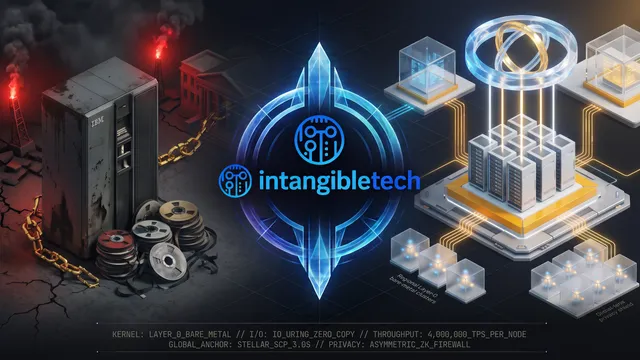 Layer-0 Kernel ABI
Layer-0: The 128-Byte Bare-Metal Kernel Replacing Mainframes & EVMs
Technical deep-dive into the 128-byte L1-cache state struct, io_uring kernel bypass, 128-core shared-nothing scaling, and how 8 pre-compiled opcodes replace COBOL mainframes and Solidity smart contracts.
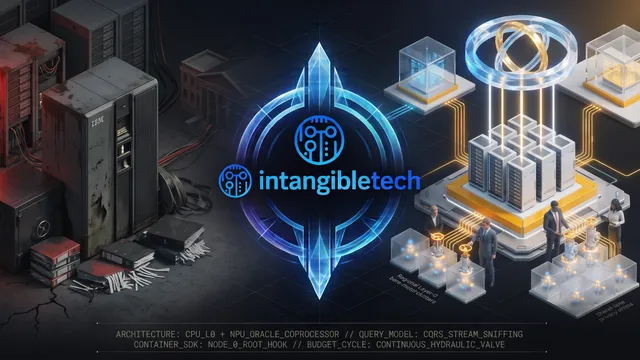 Oracle Root SDK
The Oracle Gold Rush: CQRS Stream-Sniffing & Open-Source NPU Containers
How software engineers, data teams, and PMs implement the 15 equations inside Dockerized Confidential Enclaves using the Node 0 Root SDK—replacing SAP/Oracle ERPs and earning perpetual B2B velocity royalties.
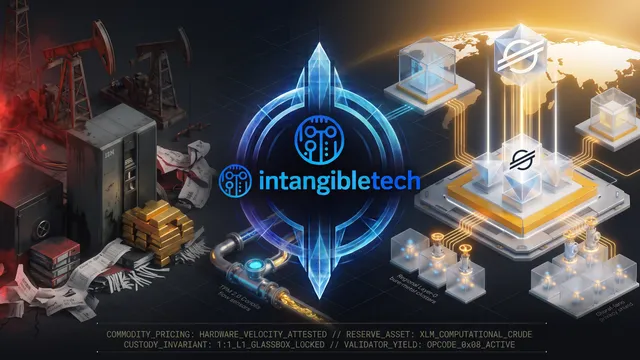 Stellar L1 & XLM
Computational Crude Oil: Stellar Layer-1 Sync & XLM Reserve Mechanics
Exact protocol mechanics of the 3-second Layer-0 to Stellar Layer-1 FBA heartbeat, cross-border AMM seesaw pools, SDF Sponsored Reserve leasing, and hardware-attested gold and crude oil valuation.
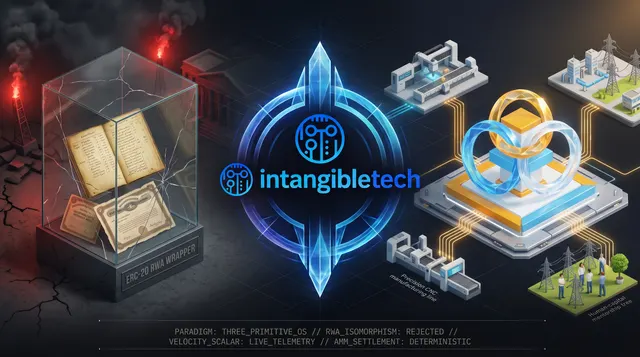 3-Primitive AMM
Why RWA Tokenization Fails & How the 3-Primitive AMM Rewires Enterprise Finance
Why wrapping 1494 stocks and compounding bonds into ERC-20 tokens is a structural dead end, and how Primary Reserve Cash, Velocity Entitlements (), and Velocity-Amortized Bonds () operate on-chain.
Download Master Architecture PDF
Provide your credentials below to access the full 118-page, 12-chapter engineering specification, 128-byte wire schemas, 8 opcodes, and 15-Equation Mathematical Registry.