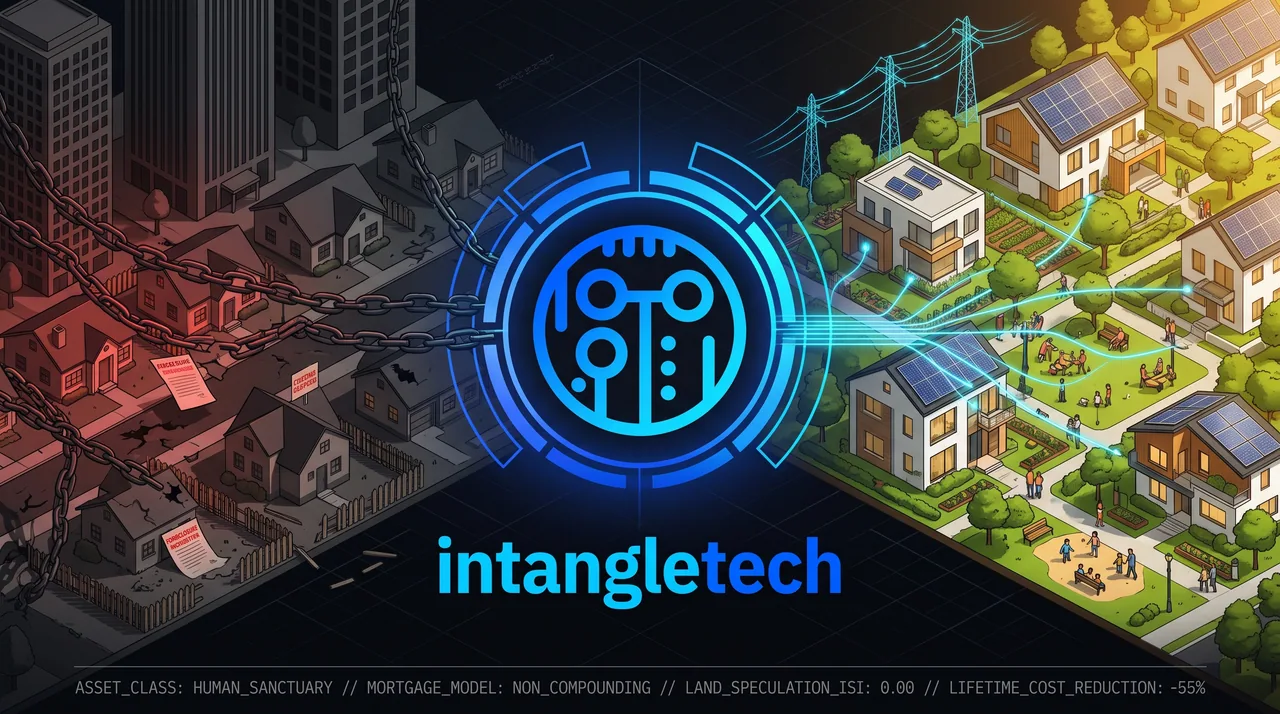
Stand in front of a modest, three-bedroom starter home in almost any American town today.
On the listing sheet, the price tag reads $350,000.
A young couple—perhaps a registered nurse and a precision machinist—has spent seven years skimping, skipping vacations, and saving every spare dollar to pull together a down payment. They sit down at a closing table, sign a sixty-page stack of legal disclosures they cannot decipher, and walk away with the keys, believing they have just achieved the American Dream.
What they actually signed was an indenture contract.
Under a conventional thirty-year fixed mortgage at modern seven percent interest rates, that young family will not pay $350,000 for that house. Over thirty years of monthly payments, they will hand over approximately $838,000.
Think about that number.
The physical structure—the timber, the copper wiring, the concrete foundation, the drywall, the shingles, and the skilled labor of the carpenters and electricians who built it—cost $350,000.
The remaining $488,000 is pure, unadulterated financial extraction.
It is compounding bank usury. That family was forced to buy their own house, and then buy an entire second house—plus half of a third house—for a commercial banking cartel, simply for the privilege of sleeping under a dry roof.
Worse, under legacy amortization schedules, the banking system front-loads this extraction. During the first ten years of payments—when the family is young, growing, and under the greatest financial stress—nearly eighty percent of their monthly check goes toward servicing interest on the loan. They build virtually zero equity. If a medical emergency, a layoff, or an economic downturn strikes a decade into the loan, the bank forecloses, auctions the property, and leaves the family with empty pockets.
Meanwhile, multi-billion-dollar private equity funds and Wall Street conglomerates borrow hundreds of millions of dollars from the Federal Reserve’s low-rate facilities, march into working-class suburban neighborhoods, and buy entire subdivisions in cash before first-time buyers can even submit an offer. They turn single-family homes into permanent, corporate-managed rental streams, jacking up monthly rents, slashing property maintenance, and locking an entire generation of young people into permanent rentier servitude.
Shelter is the single largest asset class on Earth, valued at more than three hundred trillion dollars. It is also the primary mechanism through which generational wealth is systematically drained from working-class families and channeled into the balance sheets of financial intermediaries.
It is time to declare a fundamental truth that modern economics has forgotten: A home is an enduring sanctuary for human life, not a speculative financial chip.
By dismantling the mathematics of compounding mortgage usury and deploying protocol-native constraints against land hoarding, Intangible Technologies provides the architectural blueprint to de-financialize shelter, slash the cost of homeownership by more than half, and restore the home to its sacred place at the center of civilization.
1. The Great Distortion: How the New Deal’s Dream Became a Debt Trap
To fix a broken system, we must understand how it was constructed.
The thirty-year mortgage was not handed down by natural law. It was an emergency intervention born out of the Great Depression.
Prior to the 1930s, home financing looked radically different. Commercial banks offered short-term balloon mortgages that lasted three to five years and required fifty percent down payments. At the end of the term, the borrower was expected to either pay off the remaining balance in a single cash lump sum or roll the loan over into a new note.
When the banking system collapsed in 1929 and liquidity vanished, banks refused to refinance these balloon notes. Hundreds of thousands of families were thrown onto the street overnight, sparking the greatest foreclosure crisis in modern history.
In response, Franklin D. Roosevelt’s New Deal established the Home Owners’ Loan Corporation (HOLC) and the Federal Housing Administration (FHA). They created the thirty-year, fully amortized, fixed-rate mortgage.
At the time, it was a humanitarian breakthrough. By stretching repayment out over three decades and having the borrower pay down a tiny fraction of principal alongside interest each month, homeownership became accessible to millions of blue-collar factory workers, returning veterans, and middle-class households.
So where did the noble intention go wrong?
It went wrong because legacy finance detached the mortgage from physical reality and turned it into an exponential debt instrument.
In the 1970s and 1980s, the financial sector invented mortgage securitization. Wall Street realized that by pooling millions of individual home loans into Mortgage-Backed Securities (MBS), they could convert the basic human need for shelter into an endlessly tradeable, interest-bearing asset class.
Once housing was financialized:
- The Compounding Divergence Took Hold: As commercial banks created trillions of dollars of new credit out of thin air, that money flooded into residential real estate. Because land is physically finite, flooding the market with debt did not create cheaper homes; it simply bid up home prices to astronomical levels.
- The Amortization Extortion: To keep monthly payments seemingly manageable as prices skyrocketed, the thirty-year compounding timeline became an unchallengeable dogma. Generations of families accepted that paying two-and-a-half times the purchase price of their home was normal.
- The Speculative Ratchet: Society embraced a toxic cultural myth: the idea that your primary residence must continuously appreciate faster than inflation.
Think carefully about the madness of that belief: For you to get rich simply by sitting in your home, your children and grandchildren must be priced out of living.
A system that requires housing prices to outrun wages forever is a financial pyramid scheme that cannibalizes its own youth.
2. The Thought Inversion: Decoupling Shelter from Casino Speculation
To rebuild housing finance, progressive leaders, policymakers, and everyday families must execute a fundamental mental inversion:
Stop viewing your primary residence as a retirement investment. Start viewing your home as vital consumer infrastructure, while moving your wealth accumulation into productive industrial yield.
In the legacy world, Americans treat their homes like high-stakes speculative savings accounts because they have no other choice. If they leave their savings in a bank account, inflation destroys their purchasing power. If they put their money into the Wall Street stock market, they are forced to gamble in an unpredictable casino. The home became the only accessible asset where a middle-class family could capture leveraged capital gains.
This created an economic catastrophe: it turned everyday citizens into NIMBYs (Not In My Back Yard), incentivizing homeowners to fight against new local housing construction, transit expansions, and zoning modernization out of fear that more homes in their neighborhood would lower their “property values.”
In the Intangible Architecture, we decouple these two functions completely:
- Where Wealth Accumulates: Productive generational wealth belongs in Account Type B (Savings & Retirement Vaults). Balances parked in Account Type B earn four to eight percent real, non-dilutive, productive yield backed by physical machinery, energy microgrids, and industrial infrastructure. Families build real, un-leveraged wealth without needing to artificially choke the housing supply of their community.
- What Shelter Becomes: A home returns to its true thermodynamic purpose: an enduring, high-durability consumer sanctuary. A home is where children are raised, meals are shared, craft is practiced, and dignity is preserved. Its financial cost should reflect the physical reality of the materials and human labor required to construct and maintain it—nothing more.
LEGACY FINANCIALIZED HOUSING:
Core Purpose: Leveraged Speculative Asset & Wall Street Yield Derivative
Financing Model: 30-Year Compounding Usury (Front-Loaded Amortization)
Macroeconomic Result: $350k Home Costs $838k; Younger Generations Locked Out
Incentive: Restrict Construction to Artificially Inflate Property Values
INTANGIBLE SANCTUARIED HOUSING:
Core Purpose: Enduring Human Sanctuary & Physical Consumer Infrastructure
Financing Model: Non-Compounding Sovereign Home Facility (Velocity-Amortized)
Macroeconomic Result: $350k Home Costs $378k; Monthly Burdens Cut by >55%
Incentive: Wealth Built via Productive Yield; Shelter Abundant and Secure
3. The Core Mechanic: The Non-Compounding Sovereign Home Facility
How does a family finance a home under this architecture without paying half a million dollars in bank usury?
We replace the commercial mortgage with a Non-Compounding Sovereign Home Facility.
Under our Layer-0 execution engine and Stellar settlement rails, housing credit is stripped of exponential interest formulas. The entire mathematical structure of home financing is re-engineered around physical reality:
1. The Fixed Administrative Reserve Commitment
When a qualified household acquires a primary residence—say, that same $350,000 starter home—the facility does not attach an exponential, compounding interest clock.
Instead, the facility originates from protocol-native reserve liquidity with an immutable, transparent, and non-negotiable parameter: a Fixed Administrative Reserve Commitment.
This commitment is capped at a modest, single-digit total lifetime threshold—typically eight percent across the entire life of the facility—solely to cover network reserve maintenance and localized property insurance pools.
On a $350,000 home:
- The total lifetime repayment across all thirty years is capped at $378,000.
- It can never rise to $379,000. It can never compound. It never runs away from the borrower.
2. Velocity-Driven Principal Amortization
How does the debt amortize?
In legacy banking, a borrower sends a check each month, and the bank’s spreadsheet software deducts interest first, barely touching the principal.
Under our ledger, repayment operates via Household Operational Velocity:
- When family members work, build, and participate in the local economy, their earnings clear through protocol-native accounts.
- Every time the family purchases groceries, pays municipal utility bills, or engages in regional commerce, transactions clear across native Automated Market Maker (AMM) corridors.
- The microscopic turnover fee generated by that economic velocity routes directly into the household’s dedicated amortization sink, steadily burning down the principal balance of the home facility.
- Base monthly payments made by the family do not feed a bank’s quarterly profit margins; one hundred percent of every dollar paid goes directly toward retiring the actual physical cost of the house.
3. The 55% Cost-of-Living Liberation
Let us look at what this means for a family’s real monthly budget:
- Under the legacy system, a $350,000 home at 7% interest demands a monthly principal-and-interest payment of approximately $2,328 per month. Over thirty years, that is $838,000.
- Under the Sovereign Home Facility, the total lifetime obligation of $378,000 stretched over thirty years results in a monthly payment of approximately $1,050 per month.
Overnight, the family’s monthly housing cost drops by more than fifty-five percent.
That is an immediate, life-changing infusion of more than twelve hundred dollars in cold, hard cash back into the household’s monthly checking account every single month.
That is money that can buy healthy, organic food. That is money that can fund a child’s education. That is money that can allow a parent to work thirty-five hours a week instead of sixty, restoring family life and mental health across the community.
4. Dismantling the Institutional Landlord: The Zero-ISI Land Penalty
Even if you fix the mortgage, a critical question remains:
“What stops Wall Street private equity firms, sovereign wealth funds, and corporate syndicates from using their massive capital piles to buy up all the homes anyway, keeping prices out of reach?”
In the legacy world, nothing stops them. In fact, the legacy tax code and central bank policies actively encourage them. Institutional landlords can deduct mortgage interest, claim accelerated depreciation paper write-offs, and use tax-deferred exchanges to build vast corporate empires out of single-family homes.
In the Intangible Architecture, we dismantle this predatory playbook using a single, devastating protocol-level constraint: The Zero-ISI Penalty for Residential Speculation.
Remember how capital allocation works on our ledger: an enterprise’s borrowing costs, capital capacity, and operational privileges are governed by its Impact Score Index (ISI).
The ISI measures real thermodynamic productivity: defect suppression, operational resilience, and human succession. It measures the creation of real, living value.
Under our protocol, the rules governing residential property are absolute:
1. Speculative Land Hoarding Equals Zero ISI
If an entity purchases residential land and leaves it unimproved, or if a corporate entity acquires single-family homes solely to warehouse them, extract monopolistic rents, or flip them for speculative profit:
The protocol algorithmically assigns that specific balance-sheet asset an Impact Score Index of exactly zero (ISI = 0.0).
2. Punitive Holding Costs and Credit Throttling
What happens to a corporate conglomerate or private equity fund when an asset on its balance sheet has an ISI of zero?
- Credit Spreads Explode: The protocol recognizes the asset as sterile, non-productive rent-seeking. Borrowing costs on any credit lines tied to that portfolio automatically spike to maximum penalty tiers—climbing from 1.5% to 12% or higher.
- Continuous Demurrage Drag: Any idle speculative capital hoarded to maintain vacant land or suburban housing tracts experiences continuous holding decay (demurrage), with one hundred percent of the decayed funds recycled directly into the local municipal vault and the Universal Citizen Dividend.
- The Death of the Buy-and-Hold Monopoly: Private equity cannot sustain an eleven-percent holding cost on single-family homes when tenants are paying normal market rents. The mathematical model that made corporate landlording profitable completely collapses.
LEGACY WALL STREET PLAYBOOK:
Borrow Fed-Subsidized Cheap Debt ──► Outbid Families with Cash Offers
Warehouse Housing Stock ──► Jack Up Rents & Neglect Maintenance
Result: 15% Private Equity Returns; Generational Homeownership Destroyed
INTANGIBLE PROTOCOL RESPONSE:
Detect Single-Family Residential Hoarding ──► Set Portfolio ISI to 0.00
Algorithmic Spread Spikes to 12%+ ──► Apply Continuous Holding Demurrage
Result: Corporate Holding Costs Outstrip Rental Yields
Outcome: Wall Street Dumps Inventory; Homes Return to Living Families
The protocol does not require passing convoluted anti-trust laws that corporate lobbyists can spend ten years watering down in Congress.
The financial physics of the ledger make the corporate hoarding of residential shelter an unprofitable, self-liquidating disaster. Private equity firms are forced to exit single-family neighborhoods, returning millions of homes to the open market where living human families can acquire them at fair, un-manipulated prices.
5. Protecting Community Dignity: How Tenants and Cities Win
For progressive leaders, mayors, and housing advocates, this architecture solves systemic crises that legacy zoning reforms and tenant protections have struggled to address for half a century:
1. The Tenant-to-Owner Conversion Bridge
What about the millions of families currently renting from private landlords who cannot afford a traditional down payment?
Under our protocol, rental payments made by a tenant residing in a single-family home or municipal housing cooperative are logged via the tenant’s Sovereign Digital Identity (SID):
- If a tenant resides in a home and pays their monthly lease on time, that operational consistency is recognized as Household Provenance.
- A portion of their ongoing monthly payments is credited toward an automated Equity Conversion Reserve.
- Over time, if the property owner decides to sell, the tenant possesses the protocol-enforced Right of First Offer, backed by a pre-qualified Non-Compounding Home Facility.
Renting stops being an extractive black hole where young families throw their money away. It becomes a structured, progressive runway toward unencumbered ownership.
2. Permanent Community Land Trusts Without Bureaucracy
Many progressive cities have attempted to build Community Land Trusts (CLTs) to keep housing permanently affordable. Under legacy law, CLTs require complex legal trust deeds, non-profit boards, and constant battles with local property tax assessors.
On our ledger, a municipality can establish an automated Civic Housing Cooperative directly on Layer-0:
- The municipal land beneath the homes is permanently owned by the local community trust, ensuring that land speculation cannot drive up housing costs.
- The physical homes sitting on the land are owned entirely by the families who live in them, financed through Non-Compounding Facilities.
- If a family decides to move, they sell the physical home at its true, verified replacement cost plus improvements—capturing the value of their maintenance and care—while the land remains permanently protected for the next working family.
Gentrification ceases to be a destructive wave that displaces working-class communities of color and generational residents. Neighborhoods can be revitalized, parks can be built, and transit can expand without pricing out the very people who built the community.
6. Restoring the Sacred Sanctuary
For thousands of years of human history, the concept of home was sacred.
The ancient hearth was not an investment vehicle. It was not a collateral asset to be pledged to an international debt cartel. It was the physical center of the family. It was the place where children felt safe, where elders were cared for, where stories were passed down, and where human beings found refuge from the storms of the world.
Over the past fifty years, our society committed a grave civilizational error.
We allowed an unhinged financial elite to take that sacred hearth, wrap it in complex legal language, and convert it into a thirty-year debt treadmill. We allowed them to turn the basic human need for shelter into an instrument of anxiety, exhaustion, and generational despair.
We do not have to accept this as our permanent reality.
The Intangible Architecture proves that the housing crisis is not a shortage of concrete or an absence of human desire. It is a bug in the financial software that coordinates our lives.
By abolishing compounding mortgage usury, capping administrative costs, and penalizing land speculation out of existence, we restore the home to what it was always meant to be:
- A place of peace, not financial terror.
- A foundation for generational stability, not an engine of foreclosure.
- An enduring sanctuary where free people can build a life, raise their children, and know that the ground beneath their feet is truly their own.
The thirty-year usury trap has run its course.
It is time to bring humanity home.