Every single day, more than seven and a half trillion dollars circulates through the global foreign exchange (forex) market.
It is, by an enormous margin, the largest, most liquid financial market on planet Earth. Corporate treasury departments, central banks, and financial media speak of this staggering volume with reverence, treating it as the crowning achievement of modern globalized capitalism.
Yet if you examine that seven-trillion-dollar river through the cold, unvarnished lens of systems engineering, you uncover a staggering absurdity: less than two percent of global foreign exchange volume represents the actual trade of real physical goods, industrial components, or human services.
The remaining ninety-eight percent is pure, unadulterated financial friction.
It is speculative hedge-fund carry trades, algorithmic arbitrage desks betting on interest rate differentials, multi-day bank settlement float, and multinational corporations spending billions of dollars purchasing complex derivative options simply to insure themselves against the volatility of the money in their own corporate treasuries.
The foreign exchange market was not handed down by natural law. It is an artificial, extractive tollbooth constructed to bridge a fatal design flaw in the international monetary architecture.
When we architected Intangible Technologies, we did not set out to build faster rails for currency speculators. We set out to eliminate the systemic necessity of speculative currency trading entirely.
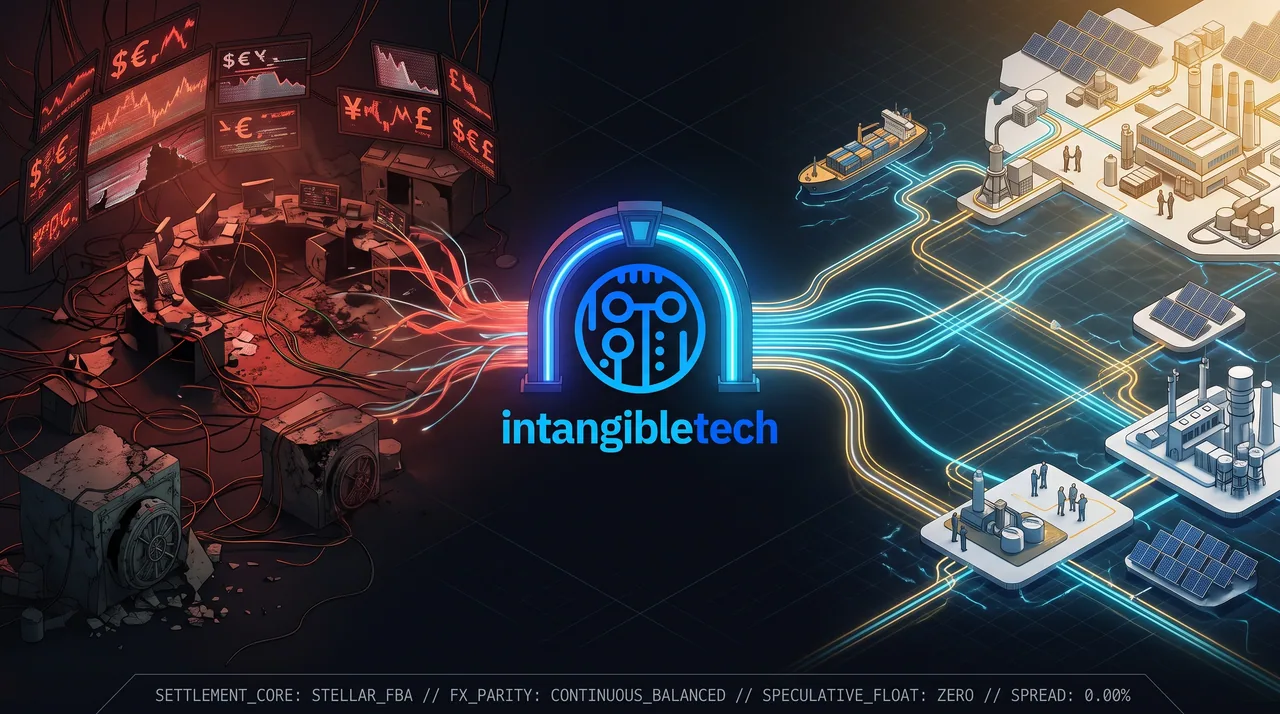
By pairing our high-speed, bare-metal Layer-0 execution engine with the native multi-currency liquidity corridors of the Stellar blockchain, we transform foreign exchange from an adversarial, zero-sum financial casino into an automated, real-time Parity Engine.
To understand how this architecture ends currency wars, lifts the developing world out of sovereign debt servitude, and naturally revitalizes domestic industrial manufacturing, we must first confront why the legacy international monetary system broke in the first place.
1. The Broken Diplomatic Compromise: Why Legacy Forex Failed
The current global currency landscape is the accidental byproduct of a failed diplomatic emergency.
In 1944, delegates from forty-four allied nations gathered at Bretton Woods, New Hampshire, to design a monetary system that would prevent a return to the catastrophic trade wars of the 1930s. Their solution was the gold-exchange standard: the United States pegged the dollar to gold at thirty-five dollars an ounce, and every other major nation pegged its sovereign currency to the dollar.
The system operated with a built-in mathematical paradox known as the Triffin Dilemma: to provide the global liquidity necessary for expanding world trade, the United States had to run continuous balance-of-payments deficits, exporting dollars across the globe. Eventually, the quantity of paper dollars circulating abroad far exceeded the physical gold sitting in Fort Knox.
In August 1971, the system ruptured. Facing sudden gold redemption demands from European allies, the United States unilaterally terminated the convertibility of the dollar into gold.
Almost overnight, the world was thrust into an unprecedented monetary experiment: a system of unanchored, floating fiat currencies.
Without a physical or mathematical anchor, exchange rates became political weapons. The historical goals of the foreign exchange market—fair price discovery, stable international trade settlement, and predictable capital allocation—were completely overwhelmed by three systemic failure modes:
The “Beggar-Thy-Neighbor” Currency War
In a floating fiat regime, governments discovered that the fastest way to stimulate domestic exports was to deliberately debase their own currency. By artificially lowering the value of their currency relative to trading partners, their domestic factories could sell manufactured goods overseas at bargain prices, effectively exporting domestic unemployment to their neighbors. This triggered retaliatory devaluations, volatile trade tariffs, and chronic diplomatic conflict.
The Subjugation of Emerging Markets
For the developing world, the post-1971 floating regime became an inescapable economic trap. Emerging nations were forced to borrow capital in United States dollars to finance basic electrical grids, clean water systems, and transportation infrastructure.
Whenever the Federal Reserve raised interest rates in Washington to cool domestic inflation, capital fled emerging economies. Their local currencies collapsed against the dollar, instantly causing their foreign debt obligations to explode relative to their domestic tax base.
This dynamic trapped generations of developing nations in cycles of IMF structural adjustments, forced austerity, and the fire-sale privatization of national resources to foreign conglomerates.
The $4 Trillion Liquidity Freeze
Because international commercial banks maintain disconnected, proprietary database ledgers that take days to communicate via messaging networks like SWIFT, global banks must hold massive, pre-funded capital balances in foreign currencies sitting idle overseas—known as Nostro and Vostro accounts. Over four trillion dollars of productive capital remains permanently frozen across the globe solely to protect against the settlement risk of multi-day clearing float.
The global economy has spent half a century trapped in a monetary architecture that rewards devaluation, punishes long-term industrial investment, and extracts trillions in middleman tolls on every international transaction.
2. The Mindset Inversion: Exchange Rates as a Thermodynamic Balance
To understand how our architecture resolves this crisis, financial leaders and economists must execute a fundamental mental inversion:
Stop viewing foreign currency as an asset class to be traded for profit. Start viewing foreign exchange as an automated, thermodynamic balancing mechanism.
In a healthy physical system, when water flows between two connected reservoirs of different elevations, the flow is governed by gravity and hydraulic pressure. You do not need a committee of traders standing beside the pipe betting on the water level; the physics of the system naturally achieves hydraulic equilibrium.
Money was invented to coordinate human effort and physical resources. It is an information accounting system.
When an American enterprise trades with a Japanese supplier or an Indian engineering firm, the exchange rate between their national units should not fluctuate wildly because a hedge fund in London executed an eight-billion-dollar algorithmic carry trade.
The true, underlying parity between two sovereign currencies should reflect a single, observable economic reality: the relative purchasing power, transactional velocity, and verified productive output of their respective economies.
Under the Intangible Architecture, foreign exchange trading ceases to be a manual, discretionary enterprise function. It becomes an autonomous protocol property.
3. Why Traditional Forex Trading Becomes Redundant
In our operating framework, the traditional apparatus of foreign exchange—forex brokerages, currency hedging desks, forward contracts, and currency swap facilities—is rendered completely redundant.
Here is how cross-border trade clears under the new architecture:
An enterprise in Ohio purchases five million dollars’ worth of precision optical sensors from a manufacturer in Germany.
- Under the legacy banking model, this transaction requires the American firm to contact its commercial bank, check the current bid-ask spread on the Euro, execute a forward foreign-exchange hedge, pay wire fees, and wait forty-eight to seventy-two hours for intermediary clearinghouses to settle the funds.
- Under our architecture, the American enterprise initiates payment in its local sovereign working reserve via its bare-metal Layer-0 terminal.
The transaction envelope does not enter an opaque banking queue. It passes directly to our settlement layer, which taps the native Automated Market Maker (AMM) pools and atomic pathfinding engine on the Stellar network.
Stellar’s consensus engine autonomously surveys the global liquidity corridors, discovers the mathematically optimal path across native order books and liquidity pools, converts the US Dollar reserve into Euro units, and deposits the exact balance directly into the German supplier’s sovereign wallet.
The entire process—the payment authorization, the currency conversion, the liquidity routing, and the final balance update—executes atomically in under four seconds.
THE AUTONOMOUS CROSS-BORDER SETTLEMENT PIPELINE
U.S. Manufacturing Node (Layer-0 Bare Metal)
│ (Initiates $5,000,000 Component Invoice Settlement)
▼
Cryptographic Handoff: Layer-0 State Vector to Stellar Consensus Engine
│ (Submits Atomic Path Payment Instruction)
▼
Stellar Native Protocol Core (Federated Byzantine Agreement)
├── Autonomous Pathfinding (USD Stablecoin ──► EUR Stablecoin)
├── Native AMM Pool Execution (CAP-0038: Pre-Compiled Invariant)
└── Sub-Cent Network Fee / Zero Arbitrage Front-Running
▼
German Supplier Sovereign Digital Wallet (Instant Finality)
(Receives Exact Euro Balance in 3.8 Seconds; Counterparty Float = $0.00)
Consider the structural consequences of this execution:
- The Bid-Ask Spread Collapses to Fractions of a Basis Point: Because currency conversion occurs across deep, protocol-native liquidity pools rather than through multi-tier bank dealer desks, the predatory two-to-four-percent foreign exchange toll disappears.
- Currency Volatility Risk Is Eliminated at Settlement: Because the conversion and the settlement happen simultaneously within a single ledger close, there is zero time delay. If a transaction takes four seconds to achieve finality, the enterprise has zero exposure to multi-day currency fluctuations. The need for expensive, multi-million-dollar corporate foreign exchange hedging derivatives evaporates overnight.
- The Death of Speculative Carry Trades: In legacy finance, traders borrow massive sums in low-interest currencies (like the Japanese Yen) to invest in high-interest currencies, pocketing the spread while destabilizing exchange rates. On our ledger, capital cannot sit in speculative pools without facing continuous economic discipline; yield is tied to verified commercial turnover, not artificial central bank rate disparities. The speculative carry trade is stripped of its fuel.
Forex trading ceases to exist as an extractive industry because the protocol performs the conversion as a frictionless, automatic utility of trade.
4. The Level Playing Field: Inverting the Currency War
When foreign exchange becomes an automated, real-time clearing utility, the nature of international economic competition transforms entirely.
Under the legacy monetary regime, nations fought negative-sum currency wars. The objective was to intentionally debase your currency, erode the purchasing power of your domestic working class, and undercut your neighbors on price to keep your factories running.
In the Intangible Architecture, you cannot cheat the protocol by running a domestic printing press.
If a sovereign nation attempts to inflate its money supply or artificially devalue its currency, the protocol’s native AMM pools register the shift in transaction velocity and reserve depth immediately. The exchange rate adjusts dynamically in real time, neutralizing the artificial advantage.
More importantly, on our ledger, national economic strength is governed by the Impact Score Index (ISI) and Kinetic Systemic Throughput (KST):
- A nation’s borrowing capacity and capital attractiveness are determined by verified defect suppression, physical infrastructure reliability, technological innovation, and human institutional succession.
- A country cannot make its exports structurally competitive by impoverishing its workforce through monetary debasement; doing so destroys its human capital metrics, drops its composite ISI, and algorithmically spikes its international borrowing rates.
The old race to the bottom is replaced by a race to the top: sovereign states compete on administrative transparency, engineering excellence, energy efficiency, and the mastery of their craftsmen.
Currency wars are replaced by a shared, level playing field governed by the unyielding laws of economic physics.
5. The Developing World: Liberation from Debt Colonialism
Nowhere is this transformation more profound than in emerging markets and developing nations.
For over a century, the global South has been locked in an extractive relationship with the developed financial centers of New York and London. Emerging nations were forced to accept the structural terms of the Western banking system: export raw natural commodities at depressed prices, borrow in foreign currencies they could not print, and watch their wealth drain away through predatory remittance fees and catastrophic currency devaluations.
The Intangible Architecture inverts this dynamic across three foundational dimensions:
1. Sovereign Capitalization Without Dollar Subjugation
Under our framework, an emerging nation does not need permission from Wall Street or the IMF to capitalize its domestic economy.
A developing country can deploy our open Layer-0 state machine to register its physical infrastructure, solar energy grids, agricultural processing centers, and skilled artisanal guilds directly onto the ledger.
By linking local productive capacity to verifiable, tamper-resistant telemetry, the nation issues local-currency credit instruments anchored in its own physical throughput. It creates domestic purchasing power backed by real, verified productivity, completely bypassing the requirement to take on predatory US-dollar-denominated foreign debt.
2. Eradication of the Remittance Tax
Globally, migrant workers send over eight hundred billion dollars home to their families in developing nations every year. Legacy wire transfer services and money operators routinely extract seven to fifteen percent of that hard-earned money in transaction fees and predatory exchange rate markups.
On our rails, remittances move across Stellar’s native multi-currency corridors in under four seconds for fractions of a penny. That eight-hundred-billion-dollar flow arrives directly in the sovereign wallets of families in Latin America, Africa, and Southeast Asia at true mathematical parity, injecting billions of dollars of un-diluted purchasing power directly into local economies.
3. Mutual Win-Win International Capital Allocation
In legacy economics, foreign direct investment is often predatory: foreign investors provide capital only in exchange for extracting natural resources, foreclosing on collateral, or imposing harsh austerity terms during a default.
Under our ledger, cross-border investment becomes a collaborative, non-extractive partnership:
- How the Developing Country Wins: When an institutional capital provider in North America or Europe deploys reserve capital into an emerging market—such as funding an automated irrigation network or a clean-energy microgrid—the capital enters as non-compounding, protocol-native liquidity. The project is not burdened with compounding usury; its financing amortizes naturally through the transaction velocity (Vt) generated by the agricultural output or electricity delivered. The local community builds permanent, unencumbered physical equity.
- How the Developed Country Wins: The capital allocators in the developed nation (whether family offices, pension systems, or Account Type B savers) do not receive an empty promise of repayment backed by political corruption. They earn an un-diluted, continuous kinetic yield generated directly by the verified, real-world utility of the infrastructure they helped build.
As the developing nation becomes more productive and its transaction velocity accelerates, the kinetic yield flowing back to the foreign investor expands.
For the first time in history, the wealthiest nations on Earth generate superior financial yields not by exploiting the global South, but by actively accelerating its industrial capacity and technological sovereignty.
6. The Reshoring Paradox: How Parity Revitalizes Domestic Manufacturing
This brings us to what appears to be a counterintuitive consequence of our architecture:
“If investing in emerging nations becomes so friction-free and mutually beneficial, won’t that accelerate the offshoring of manufacturing from developed nations like the United States and Europe?”
In practice, the exact opposite occurs: The Parity Engine creates the most powerful structural incentive for domestic industrial reshoring in modern history.
To understand why, you must understand the real reason American and European manufacturing was dismantled over the last forty years.
Manufacturing was not shipped overseas because Asian or Latin American workers possessed superior engineering tools. It was shipped overseas because the legacy international financial architecture created massive, artificial distortions:
- The Triffin Reserve Tax: Because the US Dollar served as the global reserve currency, foreign nations hoarded dollars, keeping the dollar artificially overvalued relative to developing currencies. This made American-manufactured goods artificially expensive on the global market, while foreign imports produced with hyper-devalued currencies appeared artificially cheap.
- The GAAP Blindness to Supply-Chain Risk: Legacy corporate accounting rewarded CFOs for moving production halfway across the world to save three dollars an hour on direct labor costs, while completely ignoring the immense thermodynamic risks: multi-month shipping delays, container port bottlenecks, intellectual property theft, quality control drift, and geopolitical disruption.
When you transition global commerce to the Intangible Architecture, the economic calculus inverts entirely:
1. The Death of the Artificial Currency Arbitrage
When exchange rates clear at true parity across native AMM pools, foreign governments can no longer artificially depress their currencies to manipulate global trade. The artificial wage discount that subsidized global supply-chain sprawl collapses.
2. Intangible Capitalization Rewards Precision Over Cheap Labor
Under our ledger, human craft, systems architecture, and engineering precision are capitalized as appreciating balance-sheet assets.
A domestic manufacturing facility operating advanced robotic machining tools, staffed by master technicians with low defect rates and verified apprenticeships, achieves an exceptional Impact Score Index.
- That top-tier ISI unlocks domestic corporate credit facilities at prime borrowing rates of 1.5% to 2.0%.
- An offshore factory that relies on disposable, low-wage human labor, high turnover, and loose engineering tolerances receives a depressed ISI, saddlebagging it with borrowing costs of 7% to 9%.
The capital markets finally reward precision and quality over cheap, disposable sweatshop labor.
3. Thermodynamic Velocity Favors Local Proximity
In our monetary physics, business debt amortizes through the kinetic velocity of completed transactions.
A domestic supply chain where raw materials, precision fabrication, assembly, and consumer delivery occur within a five-hundred-mile regional corridor can clear and settle production cycles in days rather than months.
That immense local velocity burns down corporate credit facilities orders of magnitude faster than a sprawling, twelve-thousand-mile trans-Pacific supply chain trapped in maritime shipping containers.
When the financial ledger measures the physical reality of shipping friction, defect rates, and human capability, manufacturing locally is no longer a patriotic sacrifice—it becomes the most capital-efficient, high-margin, and resilient strategy an enterprise can execute.
7. The Technical Symphony: Layer-0 Handoff to Stellar
Why is Stellar the only distributed ledger on Earth capable of executing this vision safely and reliably?
To understand why this architecture cannot function on Ethereum, Solana, or complex enterprise Layer-2 rollups, look at how our execution engine bridges the local and global domains:
THE TWO-TIER SYMBIOTIC DIVISION OF LABOR
LOCAL ENTERPRISE LAYER-0 (Bare-Metal Silicon / TigerBeetle Kernel)
• Operates in private data centers, ports, and manufacturing plants
• Fixed 128-byte cache-aligned memory vectors running in L1/L2 CPU cache
• Processes local inventory, tolerance telemetry, and micro-splits at >1,000,000 TPS
• Zero gas fees, zero network latency, zero external internet dependencies
(Cryptographic State Root Handoff)
GLOBAL NOTARIZATION & FX SETTLEMENT (The Stellar Network)
• Federated Byzantine Agreement (SCP): 3 to 5 second deterministic finality
• Native Protocol AMMs (CAP-0038): Liquidity pools compiled into core C++ consensus
• Native Multi-Hop Path Payments: Autonomous cross-currency discovery at consensus
• Native Compliance Primitives: Regulated trustlines, asset clawbacks, and freeze flags
• Complete MEV Immunity: Deterministic ledger closes prevent front-running searchers
The Symmetrical Handoff
Inside an enterprise, factory, or municipal logistics hub, our bare-metal Layer-0 state machine processes operational data at lightning speed. It tracks serialized parts, measures dimensional tolerance deviations, and logs internal cost accounting at over one million transactions per second with sub-millisecond latency.
When a transaction requires international settlement:
- Layer-0 packages the verified operational state into an immutable Merkle root.
- It compiles an atomic settlement instruction utilizing our native, pre-compiled financial opcodes.
- It hands that instruction directly to the Stellar network for public wide-area clearing.
Why It Fails Everywhere Else
If you attempt to execute this global handoff on general-purpose smart-contract chains:
- The MEV Nightmare: On Ethereum or Solana, transactions sit in open mempools where predatory Maximal Extractable Value (MEV) searcher bots front-run, sandwich, and extract millions of dollars from large commercial orders. You cannot conduct sovereign or institutional international trade on rails where anonymous bots manipulate your exchange price.
- The Gas-Auction Trap: During periods of network congestion, transaction fees on smart-contract networks spike violently. An enterprise cannot risk an international supply-chain settlement failing because gas fees suddenly skyrocketed by five thousand percent.
- Smart Contract Vulnerability: Third-party smart-contract liquidity pools are chronically vulnerable to reentrancy bugs, flash-loan drainage, and compiler exploits.
Why Stellar Is the Bedrock
Stellar’s architecture was deliberately designed for this exact purpose:
- Protocol-Native Fluidics: On Stellar, Automated Market Makers and pathfinding are not third-party smart contracts written by anonymous developers; they are formal primitives compiled directly into the core C++ consensus protocol.
- Zero Application-Level MEV: Under the Stellar Consensus Protocol, transactions within a ledger are processed deterministically. There is no gas bidding war, and there is no front-running of commercial settlements.
- Institutional and Sovereign Compliance: Stellar provides native operational features like asset clawbacks, cryptographic trustlines, and authorization flags. If a sovereign central bank or a regulated commercial institution issues a digital fiat currency, it retains the legal and regulatory compliance controls required by international law.
Stellar did not set out to build a speculative playground. It engineered an incorruptible, globally distributed interbank clearinghouse.
By running our high-frequency operational engine locally on bare-metal Layer-0, and anchoring our international cross-border settlements to Stellar, we achieve a balance that exists nowhere else in distributed systems: infinite localized execution speed paired with absolute, tamper-proof global settlement security.
A Peace Treaty for Global Commerce
For generations, the world has accepted the brutal, destabilizing consequences of international currency competition as the unavoidable price of global trade.
We accepted that nations must weaponize their monetary systems, that emerging economies must remain trapped in sovereign debt peonage, that domestic industrial centers must be hollowed out by artificial exchange rate disparities, and that a parasitic seven-trillion-dollar trading industry must sit between human beings simply trying to exchange the fruits of their labor across a border.
It was an architecture born of wartime exhaustion and diplomatic compromise. It is an architecture that has reached the end of its historical utility.
The Intangible Architecture offers a new path forward.
By transforming foreign exchange into an automated, protocol-native parity engine, we replace the currency casino with a scientific instrument of equilibrium.
We deliver an international monetary system where:
- The developing nation preserves its sovereignty and capitalizes its own future.
- The advanced nation earns sustainable, non-extractive yields by lifting up global productivity.
- Domestic manufacturing flourishes on the strength of craft, precision, and proximity.
- And international commerce is no longer an arena of economic warfare, but a transparent, interconnected network of human cooperation.
We have spent fifty years navigating an ocean of floating fiat chaos.
It is time our world returned to the bedrock of truth.