Ask anyone who has lived through a natural disaster, a house fire, or a serious car accident to describe their experience with their insurance company, and you will hear a story of profound betrayal.
A family pays their homeowners insurance premium faithfully every month for twenty-five years. A hurricane makes landfall, ripping the roof from their home and flooding the living room.
When the family files a claim, they expect help. Instead, they are met with an adversary.
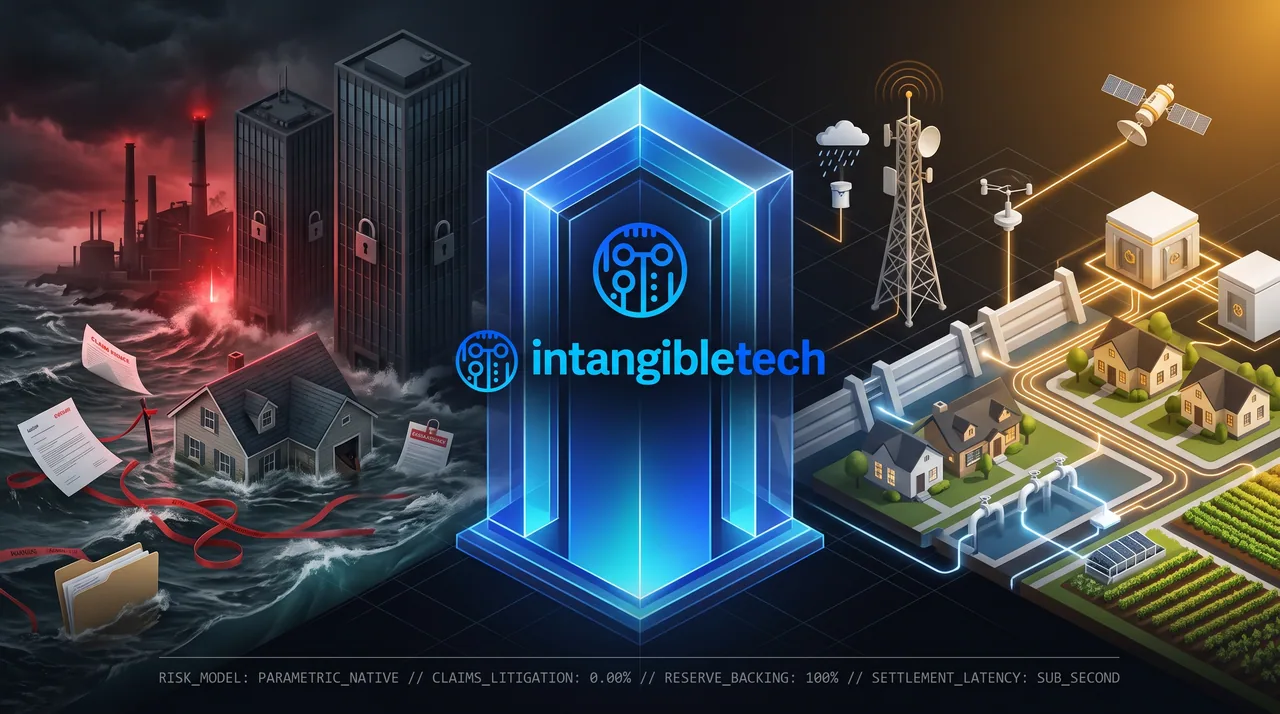
An adjuster arrives weeks late with a clipboard, looking for any possible reason to deny or reduce the payout. The insurer’s legal department spends months arguing over whether the water damage was caused by “wind-driven rain” (which is covered) or “rising surface water” (which is excluded). The family is forced to hire an independent public adjuster, retain an attorney, pay forty percent of their eventual recovery in legal fees, and wait eighteen months living in a mold-infested trailer while their contractor sits idle.
This is not a tragic accident. This is the business model.
The modern global insurance industry—an eight-trillion-dollar behemoth touching every vehicle, home, business, and human life—is built on a fundamental conflict of interest: The insurance company’s quarterly profit margin is directly maximized by delaying, minimizing, and denying your claim.
Between thirty and forty percent of every single dollar paid into legacy insurance premiums never goes toward paying for repairs or helping disaster victims. It is consumed by internal friction: advertising campaigns, corporate underwriting salaries, executive bonuses, legal defense teams, and armies of claims adjusters hired specifically to inspect damaged drywall and find technical loopholes.
Worse, the entire industry has abandoned its original social mission. It has transformed into what Warren Buffett famously celebrated as the “Float Machine”: an operation that collects massive cash premiums upfront, delays payouts as long as possible, and gambles that trillions of dollars of customer capital in volatile stock markets and commercial real estate to generate investment returns for shareholders.
Today, this fragile model is breaking in real time:
- In Florida, California, and Louisiana, major property insurers are quietly abandoning entire states, canceling policies, and leaving millions of homeowners stranded.
- State-backed “insurers of last resort” are accumulating trillions in unfunded catastrophe liabilities, putting taxpayers on the hook for massive bailouts when the next major storm hits.
- Small business owners are crushed by surging commercial liability premiums, while drivers face double-digit auto insurance spikes year after year.
We are told that this is simply the unavoidable cost of managing risk in a dangerous world.
That is a lie.
Insurance was not invented to be a predatory Wall Street casino or an adversarial legal war. It was invented to be a mutual community shield.
By replacing subjective claims litigation with protocol-native parametric settlements, transforming degenerate prediction markets into civic risk underwriters, and aligning human incentives around physical defect suppression, Intangible Technologies provides the blueprint to restore insurance to its rightful place: an automated, low-cost, mutual covenant of societal resilience.
1. The Forgotten Origin: How Mutual Protection Became an Extractive Trap
To fix insurance, we must remember why human beings created it in the first place.
Risk pooling is one of humanity’s oldest social inventions:
- In ancient Babylon, under the Code of Hammurabi, merchants engaged in maritime trade utilized “bottomry contracts”: if a merchant’s cargo ship was captured by pirates or lost in a storm, the loan was completely forgiven, with the cost absorbed by a collective merchant guild.
- In 1688, in a London coffee house owned by Edward Lloyd, ship captains, merchants, and wealthy underwriters gathered to share the catastrophic risk of transatlantic voyages. If three ships sailed to the East Indies and one sank, the profits from the two surviving vessels were shared to rebuild the lost ship.
- In nineteenth-century American frontier towns and industrial cities, working-class communities formed Mutual Aid Societies and fraternal unions. Members chipped in a few coins every week into a shared metal strongbox. When a member was injured in a factory or passed away, the elders opened the strongbox and handed the family the funds to pay the doctor or bury their dead.
Notice the defining characteristic of these early systems: They were mutual, transparent, and aligned.
There were no stock options. There were no multi-million-dollar television commercials. The people paying into the pool knew the people holding the strongbox, and the sole objective was the physical restoration of the victim.
The Financialization Distortion
In the mid-twentieth century, the financial sector industrialized insurance into a shareholder-owned corporate machine.
The corporate transition broke the alignment completely:
- The Creation of the Adversary: The moment insurance companies went public, executive leadership answered to Wall Street analysts demanding quarterly earnings growth. Paying a legitimate claim ceased to be the core mission; it became an “incurred loss” that reduced net margins.
- The Rise of the Float Strategy: Insurers realized that the real money wasn’t in underwriting discipline; it was in the “float”—the multi-year delay between when premiums are collected and when claims are paid. By dragging out litigation and requiring mountains of paperwork, insurers hold onto billions of dollars longer, earning investment yields while disaster victims go bankrupt.
- The Bureaucracy Tax: To protect the float, insurers built vast bureaucracies of paper adjusters, fraud investigators, and litigation defense attorneys. Today, an astounding forty cents of every premium dollar is burned on corporate overhead and administrative friction before a single claim is even evaluated.
An institution created to give families peace of mind has become one of the primary sources of anxiety, delay, and financial friction in human society.
2. The Mental Inversion: From Adversarial Claims to Parametric Truth
To reinvent risk management, executives, regulators, and everyday citizens must make a fundamental conceptual inversion:
Stop viewing insurance as an adversarial legal contract that pays out based on subjective human opinions after a disaster. Start viewing insurance as an automated, parametric liquidity release triggered by verified physical telemetry.
In legacy insurance, everything hinges on the Claim:
- An accident occurs.
- You file an extensive paper narrative describing what happened.
- An insurance adjuster assesses the damage and argues about what was pre-existing, what was wear-and-tear, and what falls outside the policy exclusions.
- If the insurer refuses to pay, you must sue them in a civil court.
This entire process is an archaic relic of an era when communication was slow and physical reality could only be verified through subjective human eyewitnesses.
In the Intangible Architecture, we replace the subjective claim with Parametric Verification:
LEGACY ADVERSARIAL INSURANCE:
Premiums Paid ──► Corporate General Account ──► Wall Street Investment Float
Disaster Strikes ──► File Paper Claim ──► Adjuster Dispatched ──► 12-Month Delay
Outcome: 40% Administrative Overhead; Denials, Lawsuits & Extreme Consumer Stress
INTANGIBLE PARAMETRIC MUTUALITY:
Micro-Premiums ──► Layer-0 / Stellar Liquidity Sink ──► 100% Backed Reserve
Disaster Strikes ──► Hardware Sensors Verify Event ──► Sub-Second Atomic Payout
Outcome: 0% Claims Adjusters; Zero Litigation; 100% Predictable Disaster Liquidity
How Parametric Settlements Work
Under our Layer-0 execution engine and Stellar settlement rails, an insurance policy ceases to be an eighty-page legal document filled with fine print. It becomes a Deterministic Parametric Agreement:
- Objective Physical Triggers: A policy is linked directly to untamperable, hardware-attested data streams. For a farmer, the policy trigger might be: If local soil moisture sensors and satellite radar verify less than two inches of rainfall over a forty-five-day window. For a coastal homeowner, the trigger might be: If NOAA barometric sensors and local weather stations record sustained wind speeds exceeding 110 miles per hour within a fifteen-mile radius.
- Sub-Second Atomic Settlement: When the physical event occurs, the hardware root of trust commits the data to Layer-0. The protocol does not wait for a homeowner to submit photographs, nor does it wait for an insurance adjuster to arrive. Opcode 0x01 executes an immediate, atomic release of liquidity directly into the policyholder’s sovereign digital wallet in under four seconds.
- Elimination of the Adjuster Tax: Because the payout is triggered by mathematical and physical truth rather than subjective human negotiations, there are no claims forms, no denial letters, and no litigation fees. The forty percent administrative friction of the legacy insurance company is completely dissolved.
3. The Prediction Market Inversion: Turning Speculators into Civic Underwriters
Now examine one of the most culturally corrosive trends in modern society: the explosion of sports gambling and speculative online betting.
In recent years, mobile sports betting apps and prediction markets have surged into a multi-billion-dollar industry. Millions of young people spend hours every day betting on point spreads, player statistics, and political gossip.
Trillions of dollars of human attention and capital are channeled into zero-sum dopamine loops that produce zero real-world value, drain household savings, and enrich casino conglomerates.
Yet if you examine prediction markets through the lens of economic physics, you uncover a remarkable truth:
A prediction market and an insurance underwriter are mathematically doing the exact same thing: pricing the probability of a future event.
When an insurance actuary calculates the probability of a hurricane hitting Miami, they are building a probability curve. When a sports gambler analyzes the probability of a football team winning in the rain, they are building a probability curve.
The difference is structural purpose:
- The sports bettor uses their analytical energy to gamble on a game that produces nothing.
- The insurance company uses its probability curve to extract monopoly profits from homeowners.
The Intangible Architecture executes a Civilizational Reclamation:
SPECULATIVE CASINO MODEL (LEGACY APPS):
Bettor Deposits Cash ──► Bet on Super Bowl / Gossip ──► Casino Skims 10%
Result: Capital Wasted, Addictive Losses, Zero Value Created for Society
PARAMETRIC CIVIC UNDERWRITING (THE PROTOCOL INVERSION):
Capital Provider Stakes Reserve ──► Prices Real-World Parametric Tail Risk
Event: Severe Regional Drought / Category 4 Storm / Supply-Chain Halt
Result: Capital Directly Backstops Local Farmers and Coastal Communities
Outcome: Underwriter Earns Honest Yield; Society Receives Infinite, Cheap Protection
Harnessing Speculative Energy for Public Protection
On our ledger, open prediction markets are transformed into Decentralized Parametric Reinsurance Pools:
- Underwriting Real-World Tail Risk: Instead of betting on celebrity scandals or quarterly football scores, capital providers and algorithmic trading desks deploy liquidity into parametric event pools. They price the likelihood of physical occurrences: Will reservoir levels in the Colorado River basin drop below critical thresholds this summer? Will ocean freight rates between Rotterdam and New York spike past statutory limits?
- Crowdsourced Actuarial Precision: Because thousands of independent, global participants are competing to price these risks accurately, the network produces the most mathematically precise, real-time probability pricing on Earth—far superior to the backward-looking models of an old-school insurance boardroom.
- Productive Yield for Capital; Cheap Coverage for Citizens: The capital staked in these pools directly backstops local municipal and agricultural parametric insurance policies.
-
-
If the catastrophic event does not occur, the capital providers earn a steady, honest yield from the continuous micro-premiums paid into the pool.
-
If the catastrophe strikes, the pool’s reserves instantly pay out to rebuild the damaged city, without needing a government bailout or an insurance claims court.
-
We do not have to ban human risk-taking. We redirect that cognitive drive from a predatory casino into the vital civic work of protecting civilization against catastrophe.
4. The Actuarial Evolution: From Backward-Looking Autopsies to Resilience Engineers
A primary concern whenever automation is introduced to a massive industry is the human workforce:
“What happens to the hundreds of thousands of actuaries, underwriters, insurance adjusters, and risk analysts? Do they simply lose their careers?”
Just as accountants in our architecture are emancipated from retrospective spreadsheet auditing to become real-time operational architects, insurance professionals undergo an extraordinary professional elevation.
Actuaries are among the most mathematically disciplined, analytical minds on the planet. Yet under the legacy system, their talents are wasted:
- They are forced to spend their careers building backward-looking statistical models based on historical mortality tables and five-year-old disaster data that no longer reflect the changing realities of climate, technology, and supply chains.
- Underwriters are forced to act as gatekeepers, designing restrictive fine print to exclude high-risk families.
- Adjusters are turned into cynical investigators whose primary job is telling suffering people why their policies won’t help them.
The Intangible Architecture liberates these professionals, transforming them into Dynamic Resilience Engineers and Parametric Model Curators:
LEGACY INSURANCE ROLE:
Focus: Retrospective Risk Exclusion & Claims Denial Defense
Daily Work: Sifting through five-year-old tables; drafting policy exclusions
Corporate Mission: Protect Corporate Float; Minimize Incurred Loss Payouts
Human Outcome: Adversarial Stress, Reputational Cynicism, High Overhead
INTANGIBLE OPERATIONAL ROLE:
Focus: Real-Time Telemetry Structuring & Proactive Loss Prevention
Daily Work: Designing Parametric Triggers; Optimizing Enterprise Impact Scores (ISI)
Corporate Mission: Suppress Physical Defects; Ensure 100% Guaranteed Reserve Solvency
Human Outcome: Respected Systems Architects, High-Value Resilience Advisors
The New Frontier of Actuarial Work
1. Parametric Architecture Design
Actuaries become the master engineers who design the deterministic state transitions of the protocol:
- Establishing the exact sensor combinations, satellite calibrations, and multi-signature hardware envelopes that govern automated disaster releases.
- Designing risk-pool invariants that guarantee permanent reserve solvency across centuries of shifting climate and macroeconomic trends.
2. Enterprise Defect Suppression Advisors
In our architecture, an enterprise’s borrowing costs and insurance costs are governed by its Impact Score Index (ISI). The higher the enterprise’s operational resilience and the lower its defect rate, the cheaper its capital and protection become.
Actuaries and underwriters transition from desk auditors into Proactive Resilience Consultants:
- They walk the factory floors, inspect hospital data pipelines, and audit municipal water infrastructure.
- They help enterprises identify and eliminate the physical, operational, and computational defects that cause accidents before they occur.
- By helping a company suppress risk, the actuary directly improves the firm’s ISI, saving the enterprise millions of dollars in capital costs.
The actuary ceases to be the person who calculates the cost of your funeral; they become the engineer who helps you live a safer, more resilient life.
3. The Realistic Transition: The Three-Phase Migration Roadmap
An eight-trillion-dollar industry that underpins every mortgage, auto loan, and global shipping container cannot be replaced overnight with the flick of a switch. Attempting to do so would create systemic chaos.
The transition to protocol-native risk management follows a realistic, phased adoption continuum:
PHASE 1: ENTERPRISE CAPTIVES & PARAMETRIC CATASTROPHE REINSURANCE
• Deployed immediately in high-friction commercial niches: maritime freight, crop drought,
and parametric catastrophe bonds (Florida wind / California quake).
• Operates alongside legacy carriers as secondary, instant-liquidity buffers.
PHASE 2: B2B COMMERCIAL SUPPLY CHAINS & FLEET LOGISTICS
• Corporate supply-chain contracts adopt Layer-0 hardware telemetry.
• Freight delays, cold-chain temperature failures, and component tolerance variances
settle atomically across Stellar corridors, bypassing legacy commercial carriers.
PHASE 3: THE CONSUMER RETAIL TRANSITION (THE LIBERATION OF MAIN STREET)
• Municipalities and regional cooperatives launch protocol-native home and auto facilities.
• Everyday citizens opt into automated, parametric coverage, cutting monthly insurance
premiums by 40% to 50% while enjoying sub-second claims certainty.
Phase 1: Captives and Catastrophe Reinsurance
The architecture enters through the areas of greatest pain: global shipping and natural catastrophes.
Multinational corporations already operate “Captive Insurance Companies”—private subsidiaries established to self-insure their own corporate risks because legacy carriers are too expensive.
These captives migrate to Layer-0, replacing internal legal paperwork with automated parametric liquidity reserves. Simultaneously, global reinsurance markets adopt Stellar-native catastrophe pools to settle hurricane and earthquake payouts within seconds of sensor attestation.
Phase 2: Commercial Logistics and Fleet Operations
Commercial trucking, maritime freight, and industrial manufacturing adopt the system next:
- If a refrigerated container carrying pharmaceuticals experiences a compressor failure and the temperature rises above required thresholds for more than thirty minutes, the onboard hardware logger signs the failure to Layer-0.
- The supplier is reimbursed immediately from the logistics reserve, and the defective inventory is flagged for quarantine before it can reach a hospital.
- No claims are filed. No disputes arise. The physical sensors handle the settlement.
Phase 3: The Consumer Transformation
Once the institutional plumbing is thoroughly battle-tested, the benefits open directly to everyday citizens:
- A municipal housing cooperative in Florida offers a Sanctuaried Home Protection Pool: homeowners pay fifty percent less than legacy corporate premiums because there are no corporate advertising budgets or litigation costs.
- When a major storm strikes, payouts land in the homeowner’s digital wallet before the storm clouds have even cleared, giving them the immediate cash needed to secure contractors and protect their property.
6. The Case for Politicians, Regulators, and Lobbying Skeptics
When political leaders, insurance commissioners, and legislative committees first encounter this architecture, their initial instinct will be skepticism.
Insurance lobbying firms will flood state capitols, warning that decentralized or automated risk pools will destabilize the economy, put consumers at risk, and evade regulatory oversight.
Governors and legislative leaders must look past this defensive lobbying and examine the undeniable structural benefits:
1. Permanent Solvency: The End of Systemic Bailouts
In legacy insurance, companies operate on fractional, highly leveraged reserves. They take policyholder premiums and buy long-term commercial bonds or commercial mortgages.
When interest rates surge or catastrophic weather events cluster, legacy insurers face catastrophic insolvency—leaving state guaranty funds and taxpayers to pick up the multi-billion-dollar tab.
Under our protocol:
- Protection pools are backed 100% by protocol-native, fully liquid reserves on the Stellar network.
- Reserves cannot be secretly re-hypothecated, leveraged, or invested in risky real estate bubbles.
- The protocol guarantees mathematical solvency at consensus. A state insurance commissioner can audit the exact, real-time solvency of every risk pool in the state in five seconds directly from a public terminal.
2. Immediate Relief for Voters Crushed by Cost-of-Living Crises
The single greatest political crisis facing state leaders in coastal and disaster-prone states today is the collapse of the private home insurance market:
- Governors in Florida and California are watching working-class families get forced out of their homes because their annual property insurance bill jumped from $2,000 to $8,000 a year.
- By authorizing and enabling protocol-native parametric risk facilities, state leaders can immediately reduce insurance costs for their constituents by thirty to fifty percent, while ensuring that payouts arrive in hours rather than years.
A politician who delivers affordable, un-cancellable, guaranteed disaster protection to their voters will be virtually unassailable at the ballot box.
3. A Solution for Regulators, Not an Enemy
This architecture does not evade insurance regulations; it automates them:
- State insurance commissions hold direct, cryptographically authenticated regulatory view keys on Layer-0.
- Consumer protection standards, statutory reserve ratios, and mandatory payout triggers are encoded directly into the protocol’s immutable execution rules.
- Instead of spending millions of taxpayer dollars conducting retrospective forensic audits of dishonest insurance companies, regulators have absolute, real-time visibility into the health of the entire market.
The Restoration of the Mutual Shield
For generations, human beings have accepted a deeply unnatural relationship with risk.
We accepted that to protect our homes, our cars, and our businesses, we had to enter into an adversarial relationship with an eight-trillion-dollar corporate predator. We accepted that the worst days of our lives—when fire, flood, or accident strikes—must be accompanied by months of bureaucratic humiliation, paperwork, and legal warfare.
It was an architecture that turned our neighbors into strangers, our mutual risks into corporate profits, and our vulnerabilities into Wall Street investment float.
The Intangible Architecture ends that compromise forever.
By transforming insurance into an automated, parametric covenant of mutual protection, we return to the sacred roots of human cooperation:
- Where truth is determined by the physical reality of the world, not the fine print of an insurance lawyer.
- Where disaster relief arrives with the speed of light, not the delay of a courtroom.
- Where speculative energy is channeled into public protection, not private extraction.
- And where human beings stand together, protected by an incorruptible, mathematical shield that honors our shared vulnerability and secures our common future.
The claim is dead.
Mutual truth has taken its place.