Whenever an engineer, an economist, or an executive finishes reading the architectural blueprints of Intangible Technologies, their reaction follows a predictable sequence.
First comes intellectual recognition: the realization that calculating economic velocity via Kinetic Systemic Throughput (KST) makes far more sense than GDP, that replacing compounding bank usury with velocity-amortized credit rescues balance sheets, and that settling cross-border trade in sub-second finality on the Stellar network removes trillions of dollars in parasitic friction.
Then comes the hesitation.
The reader leans forward, looks around the room, and asks the ultimate, cynical question that has haunted every reformer in human history:
“This is brilliant. But won’t the powers that be simply crush it? Won’t central banks, multinational financial conglomerates, and the global defense apparatus outlaw this protocol the moment it threatens their monopoly over capital?”
It is a fair question.
History is a graveyard of well-intentioned monetary experiments, utopian community currencies, and political reform movements that were swiftly dismantled by the state. When an entrenched political elite holds a monopoly over the legal system, the tax apparatus, and the military, any direct challenge to its power is usually met with decisive force.
Yet that cynicism, as understandable as it is, rests on an outdated historical premise: the belief that systemic transformations happen through political confrontation.
The Intangible Architecture does not challenge the existing order to a political duel. It does not launch a revolutionary protest in the streets, demand an act of Congress, or beg international banking cartels for permission.
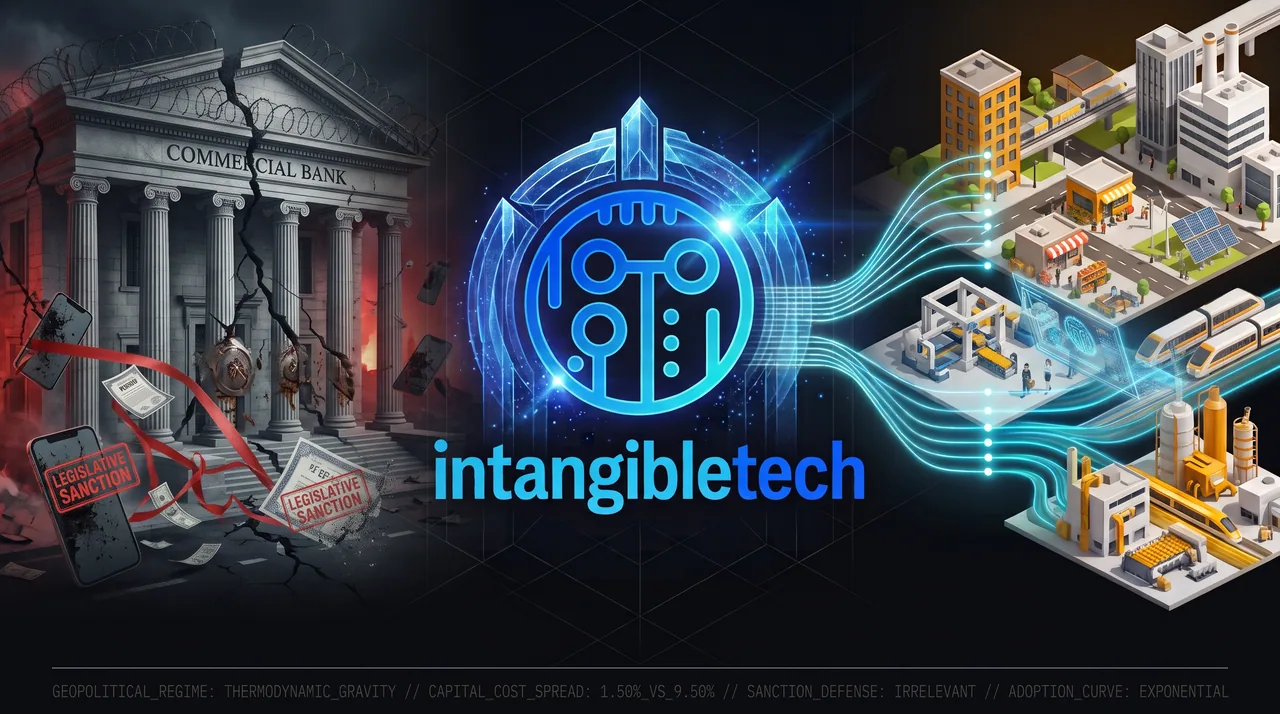
It does not fight the old system. It out-competes it through the irresistible force of economic gravity.
You cannot outlaw gravity. You cannot issue a regulatory decree against thermodynamics.
When a superior physical technology arrives—one that generates orders of magnitude more kinetic output per unit of energy, eliminates fifty percent of operating waste, and slashes the cost of capital from ten percent to one percent—it does not survive because politicians are benevolent.
It survives because any entity that refuses to adopt it faces mathematical, competitive extinction.
1. The Fallacy of the Frontal Assault: How Technology Actually Wins
To understand why this architecture cannot be crushed, we must examine how civilizational upgrades actually occur.
Human beings tend to view historical change through military and political lenses: kings conquering rivals, political parties winning elections, or armies clashing on battlefields.
In the real world of industrial physics, genuine step-changes rarely happen at the ballot box. They happen when a new architecture alters the energetic equation of production:
- The Steamship vs. The Sailing Fleet: In the early nineteenth century, sailing merchants and traditional maritime guilds mocked the steamship. Early steam vessels were dirty, required coal, and broke down frequently. Maritime empires passed protectionist tariffs to protect their timber-and-canvas fleets. Yet within decades, the sailing fleets were gone. Why? Because a steamship could navigate directly into a headwind and maintain a predictable commercial schedule regardless of weather. The merchant who used steam arrived on time and undercut the competitor. Sailing did not lose a political vote; it lost a thermodynamic contest.
- The Intermodal Shipping Container: In the 1950s, powerful dockworker unions and municipal port authorities fought viciously against the standardized metal shipping container. Dockworkers went on strike, and city councils passed ordinances banning automated container cranes to protect manual longshoreman jobs. It did not matter. Loading loose cargo by hand cost six dollars a ton and took two weeks per ship; loading containers cost sixteen cents a ton and took eight hours. The ports that embraced containers boomed into global trade hubs; the ports that banned them were bankrupt and abandoned within a decade.
- The Internet vs. The State Telecom Monopoly: In the 1980s, state-owned telephone monopolies (like France Télécom and British Telecom) controlled telecommunications. They charged exorbitant rates for transatlantic telephone calls and attempted to mandate proprietary, national data networks. When open internet protocols (TCP/IP) emerged, bureaucrats tried to regulate, tax, and restrict access. The attempt was futile. An enterprise operating on open digital networks communicated at the speed of light for fractions of a penny, while firms relying on legacy telecom paid fortunes. The economic gravity was absolute.
The lesson of history is unyielding:
A political sovereign can temporarily ban a technology, but it cannot ban the competitive consequences of that technology.
If an operating system makes human effort twice as productive, capital four times cheaper, and supply chains immune to catastrophic friction, any nation that bans that system is not defending its sovereignty; it is committing slow-motion economic suicide.
2. The Capital Squeeze: The Arithmetic of Corporate Extinction
Let us look at how this economic gravity plays out inside the corporate boardroom.
Imagine two industrial manufacturing enterprises standing side-by-side in the year 2027: Legacy Corp and Kinetic Systems.
Both companies manufacture the exact same physical product: high-precision industrial robotic actuators used in aerospace assembly. They have similar factories, similar access to raw steel, and similar customer markets.
Now, examine the structural balance-sheet physics under which each company is forced to operate:
LEGACY CORP (TRADITIONAL BANKING / GAAP):
Cost of Working Capital: 8.5% to 10.0% Commercial Bank Debt (Compounding Usury)
Transaction Settlement Friction: 3.5% Credit Card & Interbank Wire Tolls + 3-Day Float
Administrative Compliance Drag: 40% of Overhead burned on Tax Audits, Legal Defense,
and GAAP Double-Entry Reconciliation
Licensing & IP Overhead: $2M/year in Legal Retainers, NDAs & Patent Defense
Operational Visibility: Retrospective 90-Day Financial Autopsies (Quarterly 10-K)
VS.
KINETIC SYSTEMS (INTANGIBLE PROTOCOL-NATIVE):
Cost of Working Capital: 1.5% Prime Borrowing Facility (Tied to Verified High ISI)
Transaction Settlement Friction: 0.001% Atomic Clearing via Stellar Rails (Sub-Second)
Administrative Compliance Drag: 0.0% Overhead (Automated Layer-0 Settlement Partitions)
Licensing & IP Overhead: Autonomous DAG Upstream Attribution (Opcode 0x08)
Operational Visibility: Real-Time Hardware Telemetry via Layer-0 Silicon
Now, pit these two enterprises against each other in the open global marketplace:
- To cover its 10% debt service, pay its armies of corporate tax attorneys, absorb 3.5% payment processing tolls, and deliver an 8% profit margin to its Wall Street shareholders, Legacy Corp must price its actuators at $12,000 per unit.
- Kinetic Systems, operating on 1.5% capital, zero billing reconciliation, zero patent litigation overhead, and sub-second payment settlement, can sell the exact same actuator at $8,500 per unit.
Not only does Kinetic Systems sell the actuator for thirty percent less—delighting its industrial customers—but its net operating margin is higher than Legacy Corp’s.
What happens next is not a political debate; it is industrial arithmetic.
Customers abandon Legacy Corp in droves.
Legacy Corp’s Chief Executive Officer marches into the boardroom in a panic. Management cuts research and development, institutes hiring freezes, and begs their commercial bank for debt restructuring. The bank refuses because Legacy Corp’s cash flows are evaporating.
Within thirty-six months, Legacy Corp has only two choices:
- File for Chapter 11 bankruptcy and liquidate its assets.
- Abandon the legacy banking system, adopt the Intangible Architecture, and migrate its balance sheet to Layer-0.
The protocol does not need to send a single lawyer or regulator to shut Legacy Corp down. The raw, unforgiving math of capital efficiency does the work for us.
3. The Brain Drain: The Irresistible Pull of Spread Arbitrage
Capital efficiency is powerful, but there is an even more potent force driving migration: the movement of human genius.
At the foundation of our architecture is a core truth: The Human Being is the primary appreciating capital asset of civilization.
In the legacy corporate world, skilled workers are treated as disposable operating expenses (OpEx). Because Legacy Corp spends forty percent of its gross revenue on debt interest, banking fees, legal defense, and tax compliance, it has very little left over for payroll.
It keeps wages low, demands sixty-hour work weeks, and cuts employee pensions to meet quarterly earnings expectations.
Now look at what occurs inside Kinetic Systems through the power of Spread Arbitrage:
LEGACY CORP BALANCE SHEET:
$100M Gross Revenue
- $10M Paid to Commercial Bank Interest (Compounding Debt)
- $4M Paid to Payment Processors & Clearing Intermediaries
- $25M Burned on Accounting, Legal Defense & Bureaucratic Compliance
- $35M Physical Materials & Machine Upkeep
= ONLY $26M Left for Human Payroll (Wages Stagnant; Talent Burned Out)
KINETIC SYSTEMS BALANCE SHEET:
$100M Gross Revenue
- $1.5M Protocol Reserve Maintenance (Prime 1.5% Facility)
- $0.05M Atomic Settlement Fees (Stellar Network Clearing)
- $0.0M Automated Compliance & Zero-Knowledge Verification
- $35M Physical Materials & Machine Upkeep
= A STAGGERING $63.45M Available for Human Capital Allocation
Because Kinetic Systems eliminated the parasitic financial middlemen, it has a massive cash surplus.
What does it do with that capital? It invests in elite human craft.
- Kinetic Systems offers the master machinist, the senior software architect, and the clinical researcher double the base compensation that Legacy Corp can afford to pay.
- Furthermore, compensation is not paid in fiat dollars that erode with inflation; it is paired with Senior Kinetic Yield streamed directly to the worker’s Sovereign Digital Identity (SID).
- When a brilliant engineer joins Kinetic Systems, their personal provenance (IP) merges with the enterprise, elevating the company’s Impact Score Index (ISI) and directly lowering its capital costs even further.
What follows is an unprecedented, global Brain Drain.
The most brilliant minds—the top five percent of engineers, tool-and-die craftsmen, medical specialists, and operational managers who actually make the physical world work—will look at Legacy Corp and walk away.
They will migrate to protocol-native enterprises where their craft is honored, their autonomy is protected, their reputations are sovereign, and their compensation reflects the true value they create.
Legacy enterprises will be left holding hollow corporate shells staffed by uninspired bureaucrats, while every ounce of real human capability consolidates within the protocol-native commonwealth.
4. The Sovereign Dilemma: Why Banning the Protocol Is State Suicide
Now let us address the ultimate geopolitical scenario: The Hostile Sovereign State.
Imagine a major national government—swayed by the lobbying of legacy commercial mega-banks, corporate monopolies, and entrenched political elites—decides to take a stand.
The government convenes an emergency legislative session, drafts a sweeping national security statute, and issues an executive decree:
“The Intangible Architecture is hereby declared an unregulated, hostile parallel monetary system. Operating a Layer-0 validator node, settling trade on Stellar rails, or holding an Impact Score Index is classified as economic sabotage and banned within our borders.”
The political elite celebrates. The banking cartel breathes a sigh of relief. They believe they have defended their monopoly.
Now, watch the geopolitical trap snap shut.
The moment that nation bans the protocol, it creates a fatal Asymmetry of Competitiveness with every neighboring nation:
NATION A (THE PROHIBITION STATE):
Policy: Bans the Protocol; Mandates Legacy Fractional-Reserve Banking
Domestic Reality:
• Domestic manufacturers must borrow at 9.5% interest from legacy banks.
• Cross-border trade is penalized by 3-day delays and 3% currency fees.
• Domestic workers are crushed by 30% personal income taxes and IRS filings.
• Housing is trapped in 30-year compounding mortgages ($350k home costs $838k).
VS.
NATION B (THE PROTOCOL SOVEREIGN):
Policy: Embraces Layer-0 Rails, Atomic Settlements, and the Dual-Account Topology
Domestic Reality:
• Domestic manufacturers borrow at 1.5% interest from protocol facilities.
• Cross-border trade clears in 4 seconds at absolute parity across Stellar rails.
• Personal income taxes are abolished; public revenue cleared via atomic velocity.
• Housing costs cut by 55% via Non-Compounding Sovereign Facilities.
What happens to Nation A over the next five years?
1. Rapid Industrial De-Industrialization
Nation A’s manufacturing companies cannot export anything to the global market.
Their goods are thirty to forty percent more expensive than Nation B’s goods because their cost of capital is six times higher. Nation A’s factories close down. Unemployment spikes. The national trade deficit explodes.
2. Catastrophic Capital Flight
Wealthy capital allocators and institutional asset managers in Nation A realize their fortunes are being eroded by high borrowing costs and stagnant velocity.
Using zero-knowledge cryptographic gateways and cross-border settlement corridors, capital flees Nation A’s fragile commercial banks and moves into Nation B’s Account Type B Senior Productive Reserves, seeking safe 4% to 8% real yields backed by physical infrastructure.
Nation A’s commercial banking sector suffers a slow, grinding liquidity run that no central bank can stop.
3. The National Security Collapse
Because Nation B’s economy runs on high-velocity Kinetic Systemic Throughput (KST), its defense industrial base builds advanced drone fleets, hypersonic systems, and naval vessels at half the cost and three times the speed of Nation A.
Nation A’s defense department discovers that it cannot maintain military parity because its contractors are mired in cost-plus procurement waste and bureaucratic inertia.
By passing a law banning the protocol, the leaders of Nation A did not protect their nation.
They issued an executive order requiring their own domestic industries to operate with their hands tied behind their backs.
The leaders of Nation A are confronted with a brutal realization:
- They can maintain the ban and watch their nation degenerate into a bankrupt, de-industrialized backwater vulnerable to foreign domination.
- Or they can swallow their pride, repeal the ban, fire the bank lobbyists, and connect their treasury to the protocol.
The game theory is absolute. The first sovereign nation to adopt the protocol creates an asymmetric economic gravity well that compels every other sovereign on Earth to follow, or face irrelevance.
5. Why Politicians Should Be the First to Demand This
When political leaders read this analysis, their initial reaction is often fear: “Doesn’t this strip us of our power?”
The answer is the most important political message of our era:
This architecture does not destroy political leadership. It rescues political leaders from the impossible, bankrupt trap of the legacy system.
Look at the miserable reality of being an elected leader in the Western world today:
- You are trapped under forty trillion dollars of compounding national debt that you cannot mathematically pay back.
- Your annual interest payments on that debt are about to consume fifty percent of all federal tax revenues, leaving you with zero money for roads, healthcare, schools, or national defense.
- If you raise taxes on everyday workers, you get voted out of office in a landslide.
- If you cut public services or entitlement programs, you trigger nationwide strikes and civil unrest.
- You spend half your waking life begging wealthy donors and lobbyists for campaign contributions just to survive the next primary election.
Politicians are not evil; they are trapped in an insolvent machine that makes honest leadership impossible.
The Intangible Architecture offers elected leaders a dignified way out:
1. Real Fiscal Solvency Without Austerity
Under our public finance framework, the atomic velocity partition on gross commercial electronic settlements generates trillions of dollars in real-time, zero-leakage public revenue.
A governor or a president can look their constituents in the eye and announce:
- The complete abolition of the personal income tax and the IRS.
- The systematic, par-value retirement of the national debt over twenty years.
- Fully funded municipal infrastructure, clean water systems, and modern schools.
A political leader who delivers that reality will be celebrated for generations.
2. The Re-Industrialization of the Homeland
Every political leader dreams of bringing high-paying manufacturing jobs back to their home district. Under legacy economics, it is impossible because domestic wages cannot compete with foreign sweatshop labor.
Under our ledger, domestic industry is revitalized not by lowering wages, but by lowering the cost of capital to 1.5%, eliminating forty percent of corporate compliance waste, and deploying thermodynamic balancing scalars that neutralize predatory foreign dumping.
Factory towns in the Rust Belt, the Midlands, and regional heartlands roar back to life with state-of-the-art precision robotics and high-wage apprenticeships.
3. Liberation from the Donor Class
Because campaign communication and policy formulation move onto the open, simulated Policy Capability DAG, politicians no longer need to beg billionaires for checks.
Lawmakers are liberated from K Street backrooms. They are free to be what they always dreamed of being: true statesmen and women who govern with honor, courage, and integrity.
6. The Natural Evolution of the Intangible Age
To understand why this transition is unstoppable, one must take a step back and look at the broader sweep of human history.
For five thousand years, the economic systems of humanity have evolved through distinct energetic epochs:
- The Agrarian Age: Wealth was tied to physical land and manual human muscle. Power was held by feudal lords who controlled territory.
- The Industrial Age: Wealth shifted to physical machinery, fossil energy, and centralized factories. Power was held by industrial titans and central banks that controlled capital equipment.
- The Intangible Age: Today, the true value of civilization no longer lives in raw land or heavy steel.
The primary assets of the modern world are Intangible:
- Complex software architectures and distributed algorithms.
- Cryptographic supply-chain dependencies and telemetry networks.
- The institutional knowledge, precision craft, and biological vitality of living human beings.
The foundational tragedy of our time is that we are running an Intangible civilization on top of an Industrial-era accounting system.
We are trying to coordinate quantum-speed digital networks, global container logistics, and high-order human knowledge using paper debt notes invented by seventeenth-century goldsmiths, double-entry ledgers invented by fifteenth-century Venetian monks, and tax codes invented during the First World War.
The gears are grinding. The friction is unbearable. The machine is breaking down.
The Intangible Architecture is not an arbitrary political invention.
It is the natural, inevitable computational operating system demanded by the Intangible Age.
It is the alignment of money with the physical laws of the universe. It is the restoration of truth to the ledger, dignity to human labor, sovereignty to the individual, and peace to the republic.
The Event Horizon
The cynic believes that the future is decided in smoke-filled backrooms by men in dark suits who manipulate the levers of power.
The cynic is wrong.
Those men in dark suits are sitting inside an engine that is running out of steam. They cannot stop the interest on their debt from compounding. They cannot stop their infrastructure from crumbling. They cannot stop their currencies from debasing. And they cannot stop their best minds from walking away.
The gate is open. The laws of thermodynamics have spoken.
The transition to this architecture will not happen because the powerful surrender their privileges willingly.
It will happen because when the choice is between clinging to an obsolete, debt-choked past and stepping into an unassailable, high-velocity future of abundance and truth, the universe leaves only one possible path.
Economic gravity has taken hold.
The pivot has begun.