Inside the national security apparatus and the executive suites of the world’s tier-one clearing houses, a quiet clock is ticking.
It is not marked on public calendars, but every senior technologist knows its name: Q-Day.
Q-Day is the point in computational history when a cryptanalytically relevant quantum computer (CRQC)—a machine possessing sufficient fault-tolerant, error-corrected physical qubits—executes Shor’s Algorithm at scale.
When that threshold is crossed, the mathematical foundation that safeguards modern civilization collapses in seconds:
- The Rivest-Shamir-Adleman (RSA) public-key encryption that protects commercial bank wires, SWIFT transfers, and interbank liquidity lines is dissolved.
- The Elliptic Curve Cryptography (ECC, specifically secp256k1 and Ed25519) that secures Bitcoin, Ethereum, and modern digital wallets is rendered defenseless.
- The Diffie-Hellman key exchanges that encrypt classified diplomatic communications, military command channels, and enterprise SSL/TLS web traffic are cracked retroactively.
For decades, traditional financial institutions dismissed this threat as theoretical science fiction—a problem for the 2040s or 2050s.
That complacency is now an existential hazard.
Global quantum development has compressed timelines at an accelerating rate. Breakthroughs in neutral-atom processors, topological qubits, and silicon spin systems are advancing far faster than legacy IT upgrade cycles can respond.
Worse, state-sponsored intelligence agencies are actively running massive Harvest Now, Decrypt Later (HNDL) operations: vacuuming up petabytes of encrypted sovereign and corporate transaction traffic across transatlantic fiber cables today, storing it in massive data centers, and waiting for the quantum decryptor that will unlock those secrets tomorrow.
Faced with this reality, the traditional financial sector’s response has been predictable: every bank for itself.
JPMorgan Chase spends over eight hundred million dollars annually on proprietary cybersecurity. Bank of America, Citigroup, and HSBC burn billions more, each building isolated defensive moats, hiring competing security consultants, and hoarding zero-day patches behind corporate non-disclosure agreements. They are playing an exhausting, hyper-fragmented game of whack-a-mole against adversaries who share intelligence instantly.
Meanwhile, the cryptocurrency and Web3 landscape is caught in an even deadlier trap: architectural immobility.
On legacy networks like Bitcoin or Ethereum, transitioning to post-quantum cryptography requires hard-forking the entire blockchain, forcing millions of users to manually migrate assets to brand-new wallet addresses, and inflating transaction sizes to levels that choke network throughput.
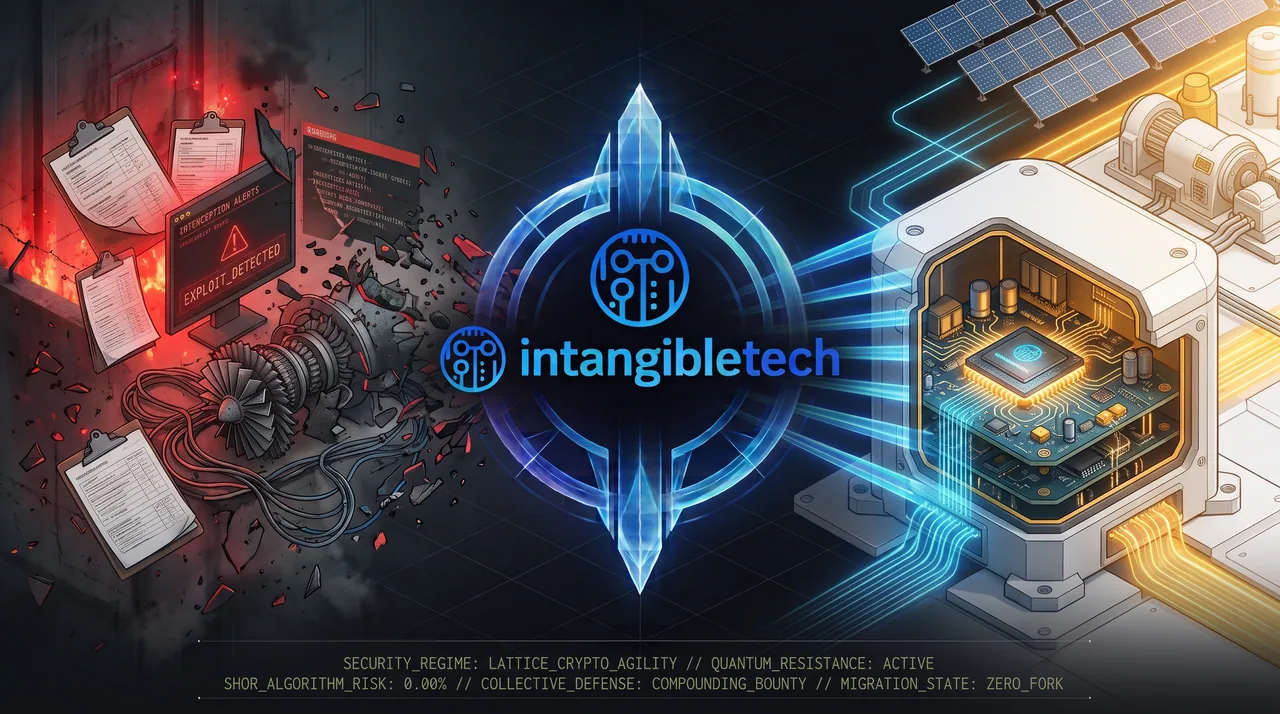
If the future global economy is to operate on a deterministic, protocol-native operating system, that operating system cannot merely be quantum-resistant on paper. It must be quantum-invulnerable by architectural design.
By embedding hardware-attested Crypto-Agility directly into the 128-byte state struct of Layer-0, coordinating seamlessly with the Stellar Network’s Quantum Preparedness Plan (QPP), and aligning global white-hat research through Opcode 0x08 Upstream Security Attribution, Intangible Technologies solves the quantum crisis at its foundation.
We do not wait for Q-Day; we render it mathematically powerless before it arrives.
1. The Anatomy of the Threat: Why Legacy Encryption Breaks
To build an unbreakable defense, we must first examine the exact physical and mathematical mechanics of the quantum threat.
Modern cryptography relies on a fundamental mathematical asymmetry: certain operations are easy to perform in one direction, but exponentially difficult to reverse using classical binary computers.
- RSA: Multiplying two large prime numbers together (pq=N) takes a fraction of a millisecond. Factoring that 2048-bit composite number N back into its constituent primes takes thousands of years of classical supercomputing time.
- Elliptic Curve Cryptography (ECC): Adding a point to itself along an algebraic curve (Q=kP) is computationally trivial. Finding the scalar multiplier k given only points P and Q (the Elliptic Curve Discrete Logarithm Problem) is classical suicide.
Classical binary computers process information using bits that exist strictly as 0 or 1. To factor a massive number, a classical computer must evaluate potential solutions sequentially or through structured sieves.
A quantum computer operates on qubits, which leverage the quantum mechanical principles of superposition and entanglement:
CLASSICAL BRUTE-FORCE COMPLEXITY:
Problem: Factoring RSA-2048 or Solving Ed25519 Discrete Log
Classical Algorithm: General Number Field Sieve (GNFS)
Time Complexity: Sub-exponential (~2^112 operations for 2048-bit RSA)
Real-World Time: Billions of compute years (Functionally Impossible)
(Arrival of Fault-Tolerant Qubits)
QUANTUM BRUTE-FORCE COMPLEXITY:
Problem: Exact Same Mathematical Formulation
Quantum Algorithm: Shor’s Algorithm (Period-Finding via Quantum Fourier Transform)
Time Complexity: Polynomial (~O(n^3) operations)
Real-World Time: Evaluated in Minutes to Hours (Complete Systemic Decapitation)
By exploiting quantum interference, Shor’s algorithm transforms an intractable mathematical problem into a polynomial-time calculation.
Once a quantum computer achieves roughly four thousand stable, error-corrected logical qubits, every elliptic-curve key and RSA certificate on Earth is rendered obsolete.
The Forgotten Threat: Grover’s Algorithm and Symmetric Encryption
Many executives mistakenly believe that only public-key cryptography is affected.
They forget Grover’s Algorithm, which provides a quadratic speedup for searching unsorted databases:
- Grover’s algorithm effectively halves the security strength of symmetric ciphers and hash functions.
- AES-128 is reduced to 64 bits of security—rendering it trivial to break.
- SHA-256 collision resistance is pressurized.
To survive in the post-quantum era, an architecture cannot simply swap out one signature scheme; it must upgrade its entire cryptographic pipeline: enforcing AES-256, SHA-384, and SHA-512 as baseline invariants while replacing vulnerable public-key math with high-dimensional lattice cryptography.
2. The Thought Inversion: From Static Fortresses to Dynamic Crypto-Agility
To understand how the new economy protects itself, chief information security officers, bank directors, and systems architects must execute a foundational mental inversion:
Stop viewing cryptographic security as a permanent, static wall that you build once and leave alone. Start viewing cryptography as a dynamic, modular, and continuously evolving biological immune system.
In the legacy enterprise world, security is brittle:
- An organization hard-codes RSA-2048 or Ed25519 into thousands of database schemas, point-of-sale terminals, and firmware chips.
- When an algorithm is compromised, upgrading it is a multi-year organizational nightmare requiring massive software overhauls, database schema migrations, and potential network downtime.
In the Intangible Architecture, the protocol is engineered around a core systems property: Crypto-Agility.
Crypto-agility means the underlying state machine never assumes that any single cryptographic algorithm will last forever. The system is designed from day one to hot-swap cryptographic primitives at consensus without halting the network, without corrupting state history, and without forcing users to migrate their balances to new addresses.
LEGACY BLOCKCHAIN / BANKING TRANSITION:
Architecture: Hard-coded signature schemes (e.g., ECDSA on Bitcoin/Ethereum)
Upgrade Path: Contentious Hard Forks, network splits, and manual fund transfers
The User Burden: Every citizen/institution must move funds to new addresses or lose them
Downtime Risk: Catastrophic coordination failure; systemic network halts
INTANGIBLE CRYPTO-AGILE LAYER-0:
Architecture: Algorithm-Agnostic State Envelopes & Modular Verification Engines
Upgrade Path: Consensus-level algorithm activation via policy node updates
The User Burden: Zero (Account identity is structurally decoupled from signing keys)
Downtime Risk: Zero (Continuous, sub-second execution across algorithm generations)
Consider how this agility is engineered directly into our 128-Byte Cache-Aligned State Struct:
┌────────────────────────────────────────────────────────┐
│ BYTE 00 - 01 : Algorithm Identifier (Algo-ID: 16-Bit) │ ── Dynamic Signer Slot
│ BYTE 02 - 31 : Sovereign Digital Identifier (SID-240) │ (Decoupled Identity)
│ BYTE 32 - 47 : Account Type A Balance (UInt128) │
│ BYTE 48 - 63 : Account Type B Balance (UInt128) │
├────────────────────────────────────────────────────────┤
│ BYTE 64 - 79 : Impact Score Index Vector (ISI-128) │ ── Thermodynamic State
│ BYTE 80 - 95 : Attestation Telemetry Hash (SHA-384) │ (Quantum-Safe)
│ BYTE 96 - 111: Provenance Lineage Nonce (UInt128) │
│ BYTE 112 - 127: Modular Cryptographic Extension Vector│ ── PQC Signature Proof
└────────────────────────────────────────────────────────┘
Look at the power of the two-byte Algorithm Identifier (Algo-ID):
- 0x0001: Classical Ed25519 (Legacy compatibility)
- 0x0002: NIST FIPS 204 ML-DSA-44 (Primary lattice-based post-quantum signature)
- 0x0003: NIST FIPS 204 ML-DSA-65 (High-security lattice signature)
- 0x0004: NIST FIPS 205 SLH-DSA (Stateless hash-based signature / SPHINCS+)
- 0x0005: Hybrid Mode (Ed25519 + ML-DSA dual-attestation)
When consensus adopts a new cryptographic standard, the ledger does not fork. The network simply enables the new Algo-ID.
The node’s bare-metal execution pipeline instantly routes the incoming transaction through the corresponding hardware-accelerated verification subroutine, executing the state transition without missing a single block.
3. The Layer-0 and Stellar Synergy: Sovereign Identity Meets Native Key Rotation
A natural question arises from enterprise architects evaluating our distributed infrastructure:
“How does this Layer-0 architecture align with the public settlement rails of the Stellar Network? If Stellar is handling final cross-border currency clearing, how do the two layers coordinate quantum defense?”
The alignment is seamless, because both layers share the exact same foundational philosophy: the structural separation of Account Identity from Signing Keys.
In June 2026, the Stellar Development Foundation unveiled its landmark Quantum Preparedness Plan (QPP).
Stellar recognized what every other public blockchain missed: on networks like Bitcoin or Ethereum, your account address is a hash of your public key. If you need to change your signature scheme, you must create a new address and manually transfer all your assets, smart contracts, and history to that new address.
On Stellar—and within Intangible Layer-0—your account is a permanent, persistent state entity; the signing key is simply an authorized administrator of that entity:
INTANGIBLE LAYER-0 (THE ENTERPRISE ENGINE):
• Enforces 128-byte static cache execution.
• Utilizes TPM 2.0 and Secure Enclaves with Kyber/Dilithium support at the physical sensor bus.
• Executes zero-knowledge validity proofs using lattice-based STARKs (Collision-resistant).
(Sub-Second Parity Clearing)
STELLAR SETTLEMENT NETWORK (THE PUBLIC SETTLEMENT RAIL):
• Uses native `set_options` operations to attach Post-Quantum Signers (ML-DSA-44/65).
• Users add quantum-safe keys WITHOUT changing public addresses, balances, or histories.
• Employs Native Hybrid Signing during the multi-year transition window.
• Leverages CAP-77 Consensus Quorum Freeze mechanisms to halt quantum-vulnerable accounts.
The Power of Phased Migration Without Address Changes
Consider what this means for a major commercial bank, an aerospace manufacturer, or an everyday citizen:
- The Account Address Never Changes: A company does not need to update its invoice systems, banking partners, or supply-chain smart accounts. Its Sovereign Digital Identity (SID) remains immutable.
- Native Key Upgrades via set_options: When an enterprise upgrades its security posture, it issues a single transaction adding an ML-DSA-65 post-quantum signer to its account while removing its legacy Ed25519 key.
- The Hybrid Safety Net: During the ongoing transition period, the network supports Hybrid Signatures. A transaction requires verification from both a classical key and a post-quantum key. For an attacker to forge a transaction, they would have to break both classical discrete logarithms and multi-dimensional lattice vector problems simultaneously.
The enterprise balance sheet is shielded across both private execution and public settlement, operating with total institutional continuity.
4. Threats You Aren’t Thinking Of: Beyond Shor’s Algorithm
Most discussions regarding quantum security begin and end with Shor’s algorithm breaking public-key cryptography.
Yet for systems engineers responsible for running a global economic operating system, that is only one of four catastrophic vulnerabilities that must be countered:
THREAT 1: THE “HARVEST NOW, DECRYPT LATER” (HNDL) TIME-BOMB
• Adversaries intercept and store encrypted enterprise trade secrets and sovereign data today.
• PROTOCOL DEFENSE: Mandatory Post-Quantum Key Encapsulation (ML-KEM / Kyber-768)
enforced on all network transit corridors; forward secrecy guaranteed at consensus.
THREAT 2: LATTICE MATHEMATICAL OBSOLESCENCE (ALGORITHMIC COLLAPSE)
• Modern PQC standards (NIST ML-DSA) rely on lattice math that is relatively young.
What if a novel mathematical proof breaks lattice cryptography in five years?
• PROTOCOL DEFENSE: Dual-Engine Heterogeneous Signing (Lattice + Stateless Hash-Based).
Hash-based signatures (SLH-DSA) rely strictly on SHA-2-512, which requires no new math.
THREAT 3: QUANTUM-ASSISTED SIDE-CHANNEL & FAULT INJECTION
• Attackers use quantum annealing or algorithmic side-channel analysis to monitor
electromagnetic leakage and power consumption on physical TPM edge chips.
• PROTOCOL DEFENSE: Active Tamper-Mesh Zeroization + Constant-Time Silicon Execution.
Any physical or electromagnetic anomaly vaporizes internal registers in milliseconds.
THREAT 4: THE DORMANT ACCOUNT PARADOX
• Billions in capital sit in abandoned accounts or long-term cold reserves using legacy keys.
On Q-Day, quantum attackers sweep and drain those un-migrated accounts.
• PROTOCOL DEFENSE: CAP-77 Protocol-Enforced Account Quarantine. Un-upgraded legacy keys
are automatically moved into a time-locked recovery state before Shor threshold activation.
Look at the second threat vector: The Risk of Algorithmic Obsolescence.
What happens if the global cryptographic community standardizes on lattice cryptography, and five years from now a brilliant mathematician discovers a classical shortcut that solves the Learning With Errors (LWE) problem?
If you bet everything on a single algorithm, civilization is once again vulnerable.
The Intangible Architecture deploys Heterogeneous Cryptographic Parity:
- Mission-critical operations—such as multi-billion-dollar treasury allocations and municipal vault transactions—are required to use Dual-Family Cryptography.
- The transaction is signed using a high-speed Lattice Scheme (ML-DSA) and a conservative, mathematically battle-tested Stateless Hash-Based Scheme (SLH-DSA / SPHINCS+).
- Stateless hash-based cryptography relies solely on the security of collision-resistant hash functions like SHA-512, which are fundamentally immune to Shor’s algorithm.
Even if an adversary achieves an unprecedented mathematical breakthrough against lattice geometry, the hash-based anchor holds firm. The fortress remains unbreached.
5. The Collective Immune System: Ending the $15 Billion Bank Cyber Waste
Now examine the profound social and economic transformation that occurs when cybersecurity is freed from the corporate boardroom.
In legacy banking, cybersecurity is treated as a proprietary, zero-sum corporate expense:
- JPMorgan, Citigroup, and Wells Fargo spend vast fortunes annually building separate, redundant cybersecurity teams.
- When JPMorgan discovers a critical zero-day vulnerability in an interbank wire protocol, it patches its own servers in secret.
- It does not share the code with regional community banks or credit unions, because in legacy finance, a rival bank’s vulnerability is a competitive advantage.
- Small community banks and regional utilities cannot afford multi-million-dollar cybersecurity budgets, leaving them wide open to state-sponsored ransomware cartels and cyber warfare.
This is an absurd, dangerous way to protect the vascular system of civilization.
In the Intangible Architecture, cybersecurity is inverted from an isolated corporate cost center into an Open-Source, Compounding Public Immune System:
THE FRAGMENTED CORPORATE CARTEL:
Architecture: Proprietary, siloed IT departments; redundant internal security teams
Cost: $15 Billion+ spent annually on duplicative, non-communicative defenses
Vulnerability: High (Adversaries target the weakest regional link; zero-days hoarded)
Human Dynamic: Security treated as an unquantified expense line item; Burned-out staff
THE PROTOCOL COLLECTIVE IMMUNE SYSTEM:
Architecture: Open-Source Formal Verification & Global Capability DAG
Cost: Zero duplicative overhead; Defenses compound globally at consensus
Vulnerability: Zero (A patch applied anywhere hardens the entire network instantly)
Human Dynamic: White-hat cryptographers earn Senior Security Yields via Opcode 0x08
How the Collective Defense Works
1. Instantaneous Global Immunity
In our architecture, every commercial bank, credit union, municipal utility, and small business runs on the exact same open, formally verified Layer-0 bare-metal protocol stack:
- When a security researcher or an engineer at a university laboratory discovers a cryptographic edge-case, side-channel leak, or optimization vector, the fix is not buried in a private corporate silo.
- The update is submitted as a public, formally verified Security Capability Node on the Dependency DAG.
- The moment consensus merges the node, every single institution on Earth—from the largest sovereign wealth fund to the smallest neighborhood bakery—is instantly immunized against that attack vector in the exact same millisecond.
Security stops being an unfair privilege reserved for Wall Street mega-banks; it becomes an ambient, universal guarantee of the network.
2. Monetizing the White-Hat via Opcode 0x08
Why would the world’s most brilliant cryptographers, security researchers, and reverse-engineers contribute their discoveries to the public protocol rather than selling them to private exploit brokers or authoritarian foreign intelligence services?
Because the Intangible Architecture provides them with a vastly more lucrative, legally bulletproof, and perpetual economic incentive.
Under our monetary physics, when an independent researcher or academic institution develops an algorithm optimization, post-quantum primitive, or zero-day defense:
- The contribution is registered with their Sovereign Digital Identity (SID) on the Dependency DAG.
- The protocol calculates the massive systemic loss that was averted by closing that vulnerability: the Defect Suppression Yield.
- Through Opcode 0x08 (Atomic Upstream Attribution), a microscopic, non-dilutive fraction of the global kinetic transaction volume (Vt) flowing safely across those rails is programmatically routed directly into the researcher’s sovereign vault.
A brilliant mathematician who engineers an optimized post-quantum verification routine that accelerates throughput and hardens the global banking system does not receive a flat, one-time fifty-thousand-dollar corporate bounty.
They earn a perpetual, compounding, senior royalty stream that can generate millions of dollars in clean, transparent yield for the rest of their life.
The world’s greatest mathematical minds are economically aligned with the protection of humanity.
The incentives of the protocol transform every hacker, researcher, and cryptographer into an active guardian of the global commons.
The Unshakeable Bastion
For sixty years, digital civilization has lived on borrowed time.
We constructed the most magnificent information and economic network in human history—connecting billions of minds, coordinating trillions of dollars in real-time commerce, and managing the critical infrastructure of our species—on top of an encryption foundation that was always destined to have an expiration date.
We knew that one day, the physics of computation would catch up to the math of our ciphers.
And now, as the dawn of the quantum age approaches, the institutions of legacy finance look upon that horizon with dread: knowing that their siloed banks, their brittle blockchains, and their paper-thin corporate perimeters cannot withstand the coming storm.
We do not fear the quantum horizon. We welcome it.
The Intangible Architecture proves that human ingenuity does not have to be outpaced by its own tools.
By anchoring our economic operating system to bare-metal crypto-agility, uniting private execution with Stellar’s battle-tested post-quantum settlement rails, neutralizing unseen attack vectors at the silicon layer, and turning the defense of civilization into an open, yield-bearing commonwealth of human genius, we build a future that can never be broken:
- Where no state-sponsored quantum supercomputer can loot the savings of a family or the treasury of a nation.
- Where cryptographic upgrades happen with the quiet, effortless elegance of a heartbeat.
- Where every bank, enterprise, and citizen shares in the impenetrable protection of an open, compounding immune system.
- And where the ledger of human trust stands as it was always meant to stand: not as a fragile wall awaiting its breach, but as an eternal, unshakeable bastion of mathematical and thermodynamic truth.
Q-Day is coming.
The shield is raised.
And the global economy is finally secure.