When the financial world and the Web3 sector talk about Automated Market Makers (AMMs), their imagination stops at a single, narrow use case: the decentralized casino.
In 2018, when early decentralized finance protocols popularized constant-product liquidity pools, they were celebrated as a clever way to trade volatile crypto tokens without relying on a centralized order book. To crypto traders, an AMM is a retail swap counter where you trade Token A for Token B. To Wall Street trading desks, an AMM looks like an inefficient, toy exchange plagued by arbitrage bots, sandwich attacks, and impermanent loss.
Both sides missed the point.
They looked at one of the most elegant mathematical mechanisms developed in digital history and treated it like a slot machine in a digital arcade.
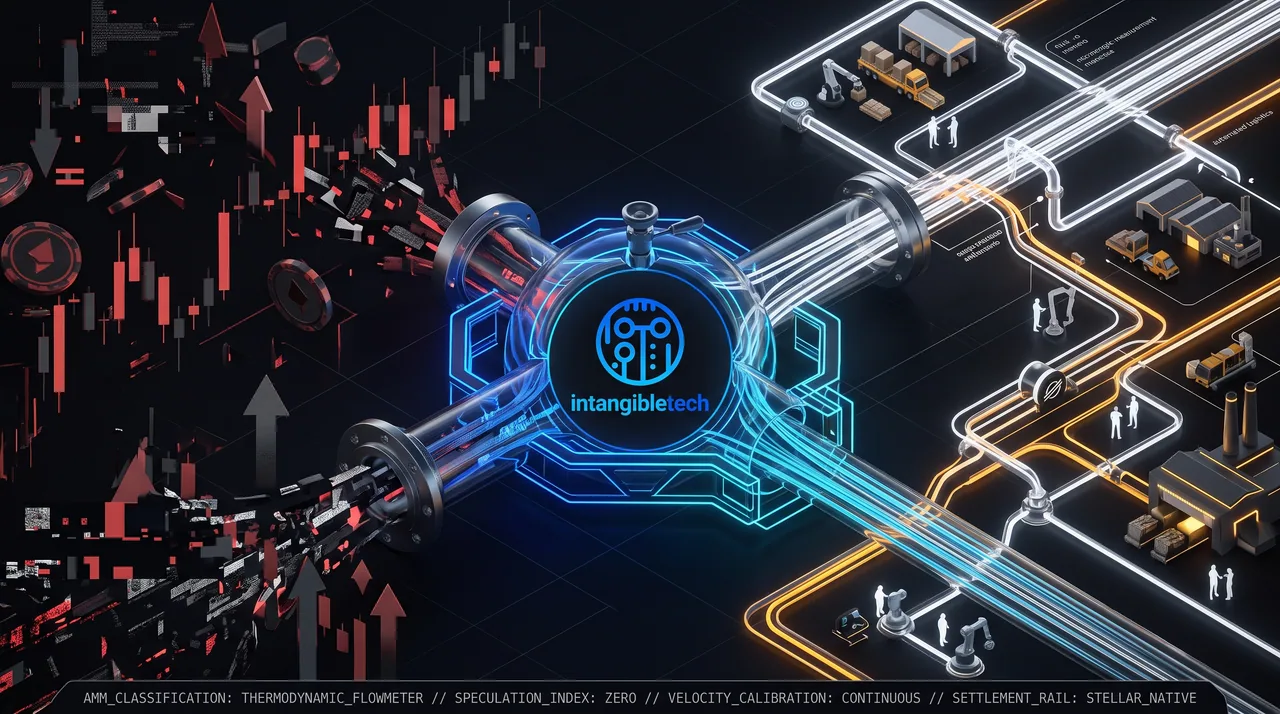
When we architected Intangible Technologies, we did not look at an AMM as an exchange for speculative trading. We recognized it as something entirely different: a thermodynamic flowmeter.
To understand how our financial operating system makes human craft liquid, eliminates compounding debt, and anchors macroeconomic solvency, you have to execute a fundamental conceptual inversion:
Stop thinking about an Automated Market Maker as a trading floor. Start thinking about it as a scientific measurement instrument built directly into the plumbing of the economy.
The Thought Inversion: The Economic Venturi
In mechanical engineering and fluid dynamics, there is an indispensable physical device known as a Venturi tube.
A Venturi tube is a pipe with a carefully calibrated constriction in the middle. When a fluid flows through the pipe, its velocity must increase as it passes through the narrow throat, causing a corresponding drop in fluid pressure. By placing a simple pressure gauge at that constriction, an engineer can calculate the exact flow rate, density, and kinetic energy of the liquid moving through the system—without interrupting the flow, without inserting mechanical paddles, and without contaminating the fluid.
The Venturi tube is not an obstacle to the water; it is a passive transducer that translates physical motion into observable data.
In the Intangible Architecture, every native Automated Market Maker pool functions as an Economic Venturi.
When an enterprise purchases industrial titanium, when a consumer buys groceries, or when a hospital settles an invoice for diagnostic equipment, the transaction clears across native Layer-0 and Stellar liquidity corridors.
The AMM pool is not there so day traders can bet on price movements. The liquidity pool is positioned in the commercial pipe as a calibrated constriction.
As real-world commerce passes through that pool, two critical things happen simultaneously:
- Frictionless Conversion: The buyer’s working stablecoin converts into the supplier’s preferred currency in milliseconds at mathematical par, eliminating the extractive float of legacy banking networks.
- Kinetic Telemetry Harvest: The invariant of the pool instantly registers the exact volume, frequency, and directional force of the economic energy moving through the corridor.
The AMM ceases to be a speculative market. It becomes the sensory organ of the macroeconomy—a live, un-falsifiable speedometer measuring the kinetic metabolism of human civilization.
How the Inversion Powers the Rest of the Machine
The moment you stop viewing an AMM as a retail exchange, the entire macroeconomic framework falls into place. This single conceptual pivot unlocks the core mechanisms of our architecture:
1. From an Unobservable Ghost to an Observable Velocity Scalar
For more than a century, economists recognized that money velocity was essential to economic health, yet they could never measure it. Money was trapped in private bank databases and physical pockets. Central banks turned velocity into an imaginary number: an estimated quarterly GDP figure published ninety days late, divided by an estimated money supply.
Because our AMMs sit directly on the settlement rails, velocity ceases to be an unobservable statistical ghost.
Every time value passes through an AMM reserve, the transaction is timestamped on bare-metal silicon. The protocol continuously calculates the exact ratio between gross transactional throughput and active reserve depth.
Velocity becomes an objective, millisecond-level telemetry scalar. For the first time in financial history, corporate borrowing rates, sovereign budgets, and liquidity allocations can be algorithmically programmed to respond to real-time economic motion rather than delayed political guesses.
2. The Kinetic Debt Burn (Velocity Amortization)
In legacy finance, debt is an adversarial contract. A business borrows money, and the bank attaches a compounding interest clock that runs relentlessly, whether the factory is operating or shut down by a storm.
Under our ledger, we use the AMM’s micro-turnover fee as an automated energy tap.
When an enterprise draws working capital, that credit is not governed by compounding usury. Instead, as general commerce moves through the protocol’s liquidity pools, the non-negotiable turnover fee (roughly thirty basis points) is harvested at consensus.
A dedicated portion of that turnover routes directly toward burning down the principal balance of outstanding enterprise debt.
Because the enterprise is an active node producing real goods and circulating payroll, its very participation in the network generates the velocity that retires its obligations. Debt ceases to be an extractive trap designed to foreclose on physical property; it becomes a self-liquidating operational bridge that amortizes in lockstep with real-world production.
3. Powering Kinetic Systemic Throughput (KST)
We previously articulated why Gross Domestic Product (GDP) is a broken compass that rewards destruction and ignores human capability. We introduced Kinetic Systemic Throughput (KST) as the thermodynamic replacement.
How does the network calculate KST without relying on self-reported government surveys?
It relies on the AMM network. The baseline of KST is the real-time velocity of verified commercial settlements passing through these pools.
By combining that verified volume with hardware-attested defect suppression and human apprenticeship metrics—while subtracting physical entropy and waste—the protocol calculates net societal productivity in real time. The AMM provides the objective baseline of real-world turnover upon which the rest of the macroeconomic governor operates.
4. Rewarding Human Intangibles Without Diluting Corporate Invoices
When business leaders first hear that human craft, software architecture, and mentorship generate streaming daily yield on our ledger, their instinctive fear is that the protocol will siphon away their customer revenues.
The AMM inversion resolves that concern completely.
When a customer buys an enterprise’s product, the enterprise receives its full commercial proceeds to fund operations and pay base wages. The streaming yield that rewards registered intangible modules does not come from company invoices; it comes from the independent liquidity turnover fee captured inside the AMM pool through which the settlement cleared.
We are not taking money out of the business’s pocket; we are repurposing the tiny payment-processing toll that legacy credit card networks historically siphoned into private bank profits, and redirecting that kinetic energy back to the creators, architects, and educators whose foundational work made the commerce possible.
Why Stellar: The Only Ledger Built for Native Fluidics
Could this architecture run on Ethereum, Solana, or an enterprise Layer-2 network?
No. And the reason comes down to the fundamental physics of how AMMs are implemented across different blockchains.
GENERAL-PURPOSE SMART CONTRACT BLOCKCHAINS (ETHEREUM / L2s / SOLANA):
• AMMs are third-party application contracts (Uniswap, Raydium, etc.)
• Toxic Order Flow / MEV: Searcher bots front-run, sandwich, and exploit trades
• Gas-Auction Volatility: A network spike turns a $0.05 fee into an $80 barrier
• High Exploitation Surface: Billions lost to flash-loan smart contract hacks
THE STELLAR ARCHITECTURE (PROTOCOL-NATIVE / CAP-0038):
• AMMs are compiled directly into the core C++ consensus engine
• Zero Application-Level MEV: Deterministic ledger closes eliminate sandwiching
• Predictable Sub-Cent Cost: Transactions execute for fractions of a penny
• Native Multi-Hop Path Payments: Autonomous cross-currency routing at consensus
On general-purpose smart-contract chains, an AMM is an external, user-deployed contract. Because those networks operate on open, unconstrained execution environments, they suffer from fatal structural defects:
- Maximal Extractable Value (MEV): Independent searcher bots continuously monitor the transaction pool, front-running commercial payments and executing “sandwich attacks” that skim profit from users. You cannot run corporate supply-chain settlements on rails where predatory bots artificially manipulate your execution price.
- Gas-Auction Volatility: When a speculative NFT project or meme coin launches, network congestion spikes transaction fees through the roof. An enterprise cannot build its real-time payroll or factory inventory clearance on a system where settlement fees can jump by a factor of one thousand without warning.
- Smart Contract Vulnerability: Because these AMMs rely on complex, Turing-complete code, they are chronically vulnerable to reentrancy bugs, flash-loan manipulation, and administrative key compromises.
Stellar’s creators made a vastly superior architectural decision.
Under Protocol 18 (CAP-0038), Stellar implemented Automated Market Makers directly into the native protocol core.
- Native Engine Optimization: On Stellar, an AMM is not an external smart contract; it is a native, pre-compiled primitive built into the C++ consensus layer. It requires no virtual machine overhead and carries zero contract exploit risk.
- Deterministic Ledger Closes: Under the Stellar Consensus Protocol, transactions within a ledger are processed deterministically. There is no gas bidding war, and there is no front-running or sandwiching of commercial settlements.
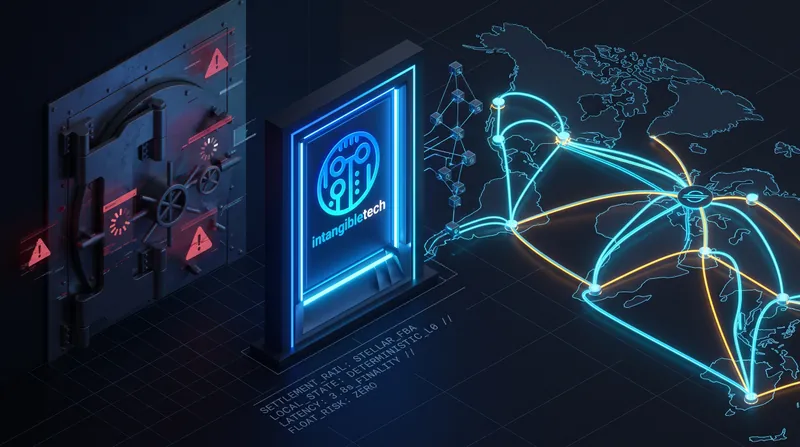
- Integrated Path Payments: Stellar features native pathfinding at the consensus level. If a settlement requires converting Japanese Yen to US Dollars, the ledger autonomously discovers whether the most liquid route is through an order book, an AMM pool, or a multi-hop corridor across Euro reserves—and executes the entire swap atomically in under four seconds.
Stellar did not build an AMM to host an arcade. It built a rock-solid, mathematically deterministic clearing mechanism.
By pairing our high-speed, bare-metal Layer-0 state machine with Stellar’s native AMM pools, we created a closed, frictionless loop: local micro-operations execute in nanoseconds, and global settlement clears across native liquidity corridors with zero intermediary risk.
Old Finance vs. Applied Economic Physics
For five hundred years, financial theory has operated on a worldview rooted in law, accounting, and institutional authority.
Traditional finance treats money as an accounting abstraction—a system of legal claims on paper assets, mediated by closed banking cartels that profit from opacity, delayed settlement float, and information asymmetry. In that world, an exchange is an extractive tollbooth designed to collect fees from trading volume.
Our architecture approaches capital through the lens of applied physics and systems engineering.
To an engineer:
- Human ingenuity, software code, and precision manufacturing are real forms of work that coordinate energy to lower systemic entropy.
- Financial ledgers should not be mutable private databases that hide truth; they should be transparent, deterministic instruments that measure reality.
- An Automated Market Maker is not a place to gamble; it is the transducer that connects the digital ledger to the physical velocity of the real world.
When you treat an AMM as a scientific instrument:
- The transaction fee ceases to be an extractive toll and becomes an auto-amortizing engine that burns down corporate debt.
- Liquidity reserves cease to be speculative chips and become productive capital that preserves purchasing power while earning stable, honest yield.
- Economic velocity ceases to be an unmeasurable ghost and becomes the observable heartbeat of civilization.
We did not build Intangible Technologies to create another trading platform.
We built it because the modern world can no longer afford to run a supersonic, interconnected industrial civilization on the blind, extractive accounting of the past.
By transforming the Automated Market Maker into an un-falsifiable instrument of measurement, we have laid the foundation for an economy that rewards those who build, preserves the wealth of those who save, and aligns the financial plumbing of our world with the physical laws of nature.