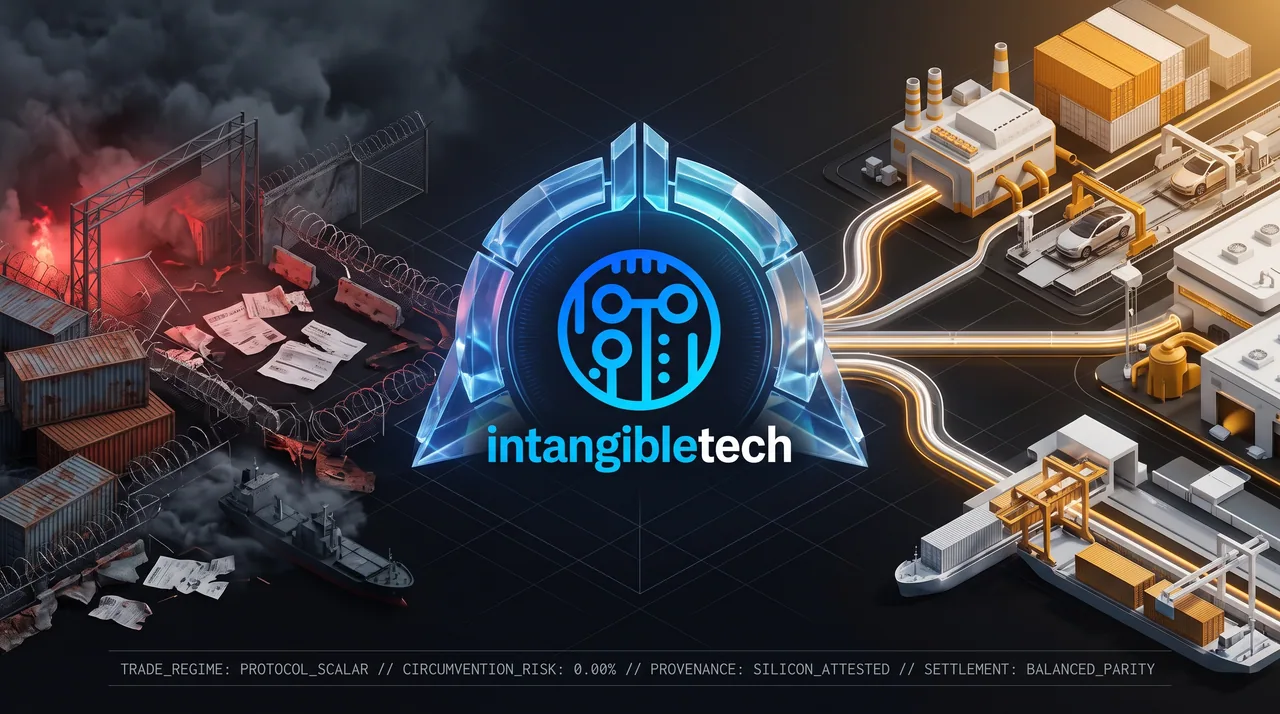
Whenever a nation confronts a geopolitical adversary or watches an aggressive foreign competitor flood its domestic market with state-subsidized goods, political leaders reflexively reach for the only two weapons in the historical armory: tariffs and sanctions.
The public rhetoric surrounding these tools is familiar. A president stands behind a podium to announce a 100% tariff on foreign electric vehicles to “save domestic manufacturing.” A congressional coalition passes a sweeping sanction package to cut a hostile regime off from international banking, promising to starve its war machine.
The intent sounds resolute. The real-world execution is a structural failure.
Under legacy economics, tariffs and sanctions are blunt, seventeenth-century sledgehammers swung in a twenty-first-century interconnected world:
- Tariffs Are an Unacknowledged Tax on Domestic Families: When a government slaps a 25% or 100% tariff at the shipping dock, the foreign exporter does not write a check to the national treasury. The domestic importer pays it. The cost cascades straight down the supply chain, inflating consumer prices at the retail checkout counter, stifling technological adoption, and triggering retaliatory tariffs that crush domestic farmers and exporters.
- Legacy Sanctions Leak Like a Sieve: Modern international trade is routed through an opaque labyrinth of shell companies, flag-of-convenience cargo vessels, and multi-jurisdictional transshipment hubs. When the West cut Russian banks from the SWIFT messaging network, trade did not stop; it simply migrated to shadow tanker fleets, intermediary trading hubs in third-party nations, and gray-market settlement rails.
- The Collateral Damage Fallacy: Broad economic embargoes routinely fail to dislodge entrenched authoritarian elites, who redirect state resources to insulate themselves, while ordinary citizens—families trying to buy food and medicine—are pushed into desperate economic deprivation.
Why are sovereign states trapped between the toothless theater of paper sanctions and the self-inflicted inflation of tariff wars?
Because the modern international monetary architecture operates on an all-or-nothing binary switch: either an open, un-monitored firehose of capital, or a blunt, severed pipe.
Governments lack a calibrated, programmable instrument of economic statecraft.
Intangible Technologies replaces this blunt machinery with Protocol-Native Trade Equilibrium Variables.
By moving trade governance from physical border checkpoints into the cryptographic clearing rails of Layer-0 and the Stellar network, sovereign nations preserve total authority over their economic borders. They can enforce surgical, un-evadable economic consequences against bad actors, defend their domestic industrial base against predatory foreign dumping, and build an incorruptible, phased bridge toward genuine, zero-friction global commerce.
1. The Thought Inversion: Trade Policy as a Programmable Physics Variable
To master economic statecraft in the computational age, leaders must execute a fundamental mental inversion:
Stop viewing tariffs and sanctions as physical barricades erected at maritime ports or bureaucratic lists held at central banks. Start viewing trade controls as real-time friction scalars within the monetary settlement engine.
In classical physics, an electrical engineer does not protect a delicate computational circuit from a voltage surge by building a concrete wall in front of the server rack. The engineer installs variable resistors, diodes, and capacitors directly into the circuit board. These components modulate current, filter noise, and redirect dangerous surges into grounded sinks—protecting the system while keeping the power on.
Modern international commerce is an electrical circuit.
When a sovereign nation connects its economy to our distributed operating system, it does not surrender its borders to a libertarian free-for-all. It gains an unprecedented level of programmable sovereign control.
Instead of waiting for an imported product to physically arrive in a shipping container at a port—where customs agents must manually inspect paperwork and collect paper duties—trade policies are encoded as Autonomous Protocol Policy Levers.
The protocol’s settlement layer continuously references the sovereign nation’s democratically established regulatory policy vector.
When an international transaction attempts to clear, the protocol evaluates the origin, counterparty provenance, and physical supply-chain lineage of the goods. If the trade touches an industry or entity targeted for domestic protection or national security sanctions, the system does not need a customs raid to intervene.
The protocol automatically applies a calibrated friction scalar at consensus—programmatically adjusting settlement costs, liquidity pool reserves, or capital splits in milliseconds.
The nation’s borders become an active, intelligent shield.
2. Surgical Precision: Multi-Tiered Sanctions from Nation to Node
The most glaring flaw of legacy sanctions is their catastrophic lack of granularity. Banning an entire country from an international clearing network punishes millions of innocent workers and creates vast geopolitical friction, while doing little to dismantle the specific corporate and state entities driving aggression.
Under the Intangible Architecture, the enforcement of economic consequences becomes radically surgical and multi-tiered:
TIER 1: SOVEREIGN LEVEL (Macro-Systemic Disconnect)
• Applied to rogue states violating international treaties or territorial sovereignty
• Autonomous settlement isolation: Native AMM corridors throttled; reserve conversion halted
• Sinks all outbound state capital into escrow pending verified geopolitical de-escalation
TIER 2: INDUSTRIAL / SECTORAL LEVEL (Strategic Balancing)
• Applied to foreign industries engaged in predatory state dumping or critical security risks
• Imposes dynamic thermodynamic scalars that offset artificial state subsidies
• Directs imported turnover fees directly into domestic workforce apprenticeship vaults
TIER 3: CORPORATE NODE LEVEL (Entity-Specific Neutralization)
• Applied to conglomerates utilizing forced labor, intellectual property theft, or cyber-espionage
• Silicon-level blacklisting: The corporate entity’s Sovereign ID and cryptographic nodes are frozen
• Upstream and downstream counterparties face immediate down-graph credit rating penalties
TIER 4: MUNICIPAL / REGIONAL LEVEL (Targeted Geographic Defense)
• Applied to specific regional ports or industrial zones violating environmental or labor baselines
• Leaves the rest of the foreign nation’s civilian commerce untouched, minimizing broad humanitarian harm
Consider the power of this multi-tier architecture for foreign policy:
Isolating the Bad Actor Without Starving a Population
If a foreign conglomerate is caught using forced labor or engaging in industrial espionage, a national government does not have to ban all trade with that nation.
The sovereign administration issues an update to its domestic protocol policy vector:
- The specific conglomerate’s Sovereign Digital Identity (SID) and all associated capability nodes on the Dependency DAG are flagged with a Restricted Integrity Marker.
- The conglomerate’s transactions are barred from clearing through the nation’s domestic Layer-0 settlement rails.
- Counterparties that continue attempting to route business with that entity face automated downgrades to their own Impact Score Index (ISI), raising their corporate borrowing costs across the network.
The bad actor is economically isolated from the domestic market in seconds. Concurrently, independent small businesses, agricultural exporters, and ordinary citizens in that same foreign nation continue transacting freely, preventing broad humanitarian devastation and reducing diplomatic escalations.
3. The Chinese EV Dilemma: Solving Industrial Protectionism
To understand how this operates in practice, examine the defining industrial trade battle of our time: the rise of Chinese Electric Vehicles.
Globally, Chinese automakers have achieved massive production scale, producing high-tech, highly efficient electric vehicles at price points under $15,000. Consumers around the world are eager to buy them.
Yet in the United States and Europe, policymakers face an acute structural dilemma:
- The domestic auto industry—Detroit and its hundreds of thousands of union autoworkers, engineers, and regional component suppliers—cannot compete with vehicles subsidized by hundreds of billions of dollars in foreign state balance sheets.
- If Western governments allow these vehicles to flood the market unrestricted, domestic manufacturing facilities will shutter, institutional tool-and-die mastery will be lost, and the nation will become dependent on a foreign power for critical transportation infrastructure.
- But if governments simply slap a blunt 100% border tariff on these vehicles, domestic consumers are denied affordable, clean transportation. Everyday families are forced to pay $45,000 to $60,000 for domestic alternatives, slowing down the green transition and driving persistent consumer inflation.
How does the Intangible Architecture solve this crisis without resorting to inflation-inducing trade bans?
A domestic administration configures three specific, programmatic variables on the protocol:
1. The Thermodynamic Parity Scalar (Absorbing Foreign Subsidies)
Instead of an arbitrary, politicized 100% tax, the government deploys an automated Thermodynamic Parity Scalar.
The protocol’s macroeconomic telemetry engine evaluates the actual cost differential created by foreign non-market subsidies and state-funded energy grids. It applies a precise friction coefficient to incoming vehicle purchases:
- If a vehicle costs $12,000 to produce in an overseas subsidized plant but would require $22,000 in a fair, unsubsidized domestic facility, the protocol applies a dynamic $8,000 parity scalar at the point of commercial settlement.
- The imported vehicle enters the domestic market at a fair, competitive price point (e.g., $20,000)—still highly affordable for the American family, but no longer predatory dumping that undermines domestic assembly lines.
2. The Domestic Industrial Re-Investment Split
This is where legacy trade policy breaks down and our architecture shines.
In the old system, tariff revenues vanish into the general federal budget black hole, funding federal bureaucracy while displaced factory workers receive meager unemployment checks.
Under our protocol, the entire yield harvested by the Thermodynamic Parity Scalar is programmatically partitioned into a dedicated Domestic Industrial Transition Fund:
- Every time an American consumer purchases an imported EV, thousands of dollars flow directly into municipal industrial vaults in Michigan, Ohio, and Indiana.
- These funds are earmarked for zero-interest tooling facilities for domestic battery plants, capital upgrades for domestic manufacturing cells, and verified apprenticeship programs for domestic autoworkers.
- The foreign product is allowed to compete, but the very act of importing that product directly finances the modernization of domestic manufacturing.
3. Silicon-Attested Data Sovereignty Enclaves
Beyond economics, modern electric vehicles are rolling sensor networks equipped with high-resolution cameras, LIDAR, and continuous telemetry pipelines that present genuine national security risks.
Under our architecture, foreign vehicles must operate through secure, air-gapped Execution Enclaves:
- The vehicle’s onboard telemetry runs inside a Trusted Platform Module (TPM 2.0) that satisfies domestic cryptographic specifications.
- The vehicle proves on Layer-0 that it is operating safely and maintaining required engineering standards using Zero-Knowledge Validity Proofs—without streaming private domestic location telemetry, camera feeds, or driving habits back to a foreign server.
The result is a total policy victory:
- Everyday citizens get access to modern, affordable transportation.
- Domestic autoworkers and factories are protected from predatory dumping.
- Domestic industrial infrastructure is capitalized by foreign competition.
- National security and data privacy are preserved by hardware-enforced cryptography.
4. System-Wide Dynamic Equalization: Eliminating the Need for Bailouts
In legacy economics, when an unexpected shock hits international trade—a sudden currency collapse, an export ban on critical rare-earth minerals, or a shipping corridor closure—governments scramble to assemble chaotic emergency legislative backstops: billion-dollar agricultural bailouts, special industry subsidies, and emergency tariff waivers.
These reactionary backstops arrive months late, misallocate billions in public capital, and distort market signals.
In the Intangible Architecture, the system eliminates the need for manual political bailouts through Dynamic Variable Equalization:
- International Trade Shock Occurs (e.g., Foreign Export Ban or Mineral Shortage)
- Layer-0 Telemetry Detects Velocity Drop (Vt) & Supply-Chain Bottlenecks
- PROTOCOL SYSTEM VARIABLES AUTOMATICALLY REBALANCE:
├── Sectoral Borrowing Limits for Affected Domestic Producers Expand
├── ISI Defect Penalties for Domestic Alternative Sourcing are Relaxed
├── Reserve Liquidity Corridors Automatically Deepen on Stellar Rails
└── Parity Scalars on Non-Essential Competing Imports Programmatically Elevate
- Domestic Economy Stabilizes in Real Time with Zero Congressional Debt Packages
Because our economic operating system measures kinetic velocity (Vt), the Impact Score Index (ISI), and Kinetic Systemic Throughput (KST) on bare-metal silicon, the network senses supply-chain stress in milliseconds.
When a vital industrial input becomes scarce:
- The protocol automatically lowers credit spreads for domestic firms manufacturing domestic substitutes, making capital cheaper overnight without congressional legislation.
- The system temporarily widens the reserve liquidity corridors for alternative trade routes across the Stellar network.
- As domestic alternatives scale up and physical throughput stabilizes, the balancing variables gradually decay back to their normal resting states.
The economic engine maintains equilibrium dynamically, acting like an automated industrial autopilot rather than an economy steered by panicked emergency committees.
5. Anti-Circumvention: Defeating the Shadow Economy Through Game Dynamics
The immediate critique from seasoned trade lawyers and national security analysts is predictable:
“This sounds elegant in theory, but in the real world, bad actors will simply circumvent your protocol variables. They will ship the components through Vietnam or Mexico, set up a local shell company, slap a new label on the product, and evade your balancing scalars.”
In the legacy financial system, that critique is entirely accurate. Transshipment and trade fraud are rampant because legacy customs enforcement relies on paper manifests and disconnected customs databases.
Under the Intangible Architecture, transshipment evasion is mathematically impossible.
Evasion is defeated through the synthesis of Hardware Roots of Trust and Down-Graph Economic Game Theory:
1. Silicon-Level Component Provenance
In our architecture, an imported product is not an anonymous piece of metal; it is an active node on the network’s Dependency Directed Acyclic Graph (DAG):
- Critical components—lithium battery packs, electric motors, transmission controllers, microchips—are registered at the factory floor with immutable cryptographic signatures embedded in silicon.
- A vehicle chassis stamped in a subsidized foreign plant carries a permanent, hardware-attested cryptographic hash that cannot be scraped off or forged with paper documents.
- When that car arrives at a third-country assembly plant in Mexico or Southeast Asia, the local plant cannot erase the origin hash without breaking the cryptographic integrity of the final vehicle assembly.
If the component’s root origin traces back to a restricted or scalar-penalized foreign node, the protocol applies the balancing scalar regardless of where the final assembly bolt was tightened.
2. Down-Graph Slashing (The Incorruptible Game Dynamic)
What stops an intermediary company in a third-party nation from lying about component origins to help a foreign partner smuggle goods?
The protocol’s multi-layered game theory makes trade fraud economic suicide.
To transact on our settlement rails, every enterprise maintains an authenticated Sovereign Digital Identity (SID) and an active Impact Score Index (ISI):
- If an intermediary firm facilitates transshipment fraud by falsifying supply-chain origin metadata, the bilateral counterparty verification engine detects the mathematical discrepancy between physical sensor logs and reported manifests.
- The moment trade evasion is verified by consensus, the protocol executes Down-Graph Slashing:
-
-
The intermediary firm’s ISI is slashed across all operating tiers.
-
Its borrowing costs on its multi-million-dollar working capital lines instantly surge from 1.5% to 12% or higher.
-
Its senior executives’ personal provenance scores face permanent cryptographic downgrades.
-
No commercial logistics firm or manufacturing conglomerate will risk a ten-percentage-point spike in capital costs across its entire balance sheet just to collect a small bribe for laundering someone else’s car parts.
The economic cost of getting caught vastly exceeds the potential reward of the crime. Honest compliance becomes the only mathematically viable strategy.
6. Harmonization with the Parity Engine: The End of Currency Devaluation Warfare
In legacy trade battles, tariffs face an inevitable counter-attack: monetary debasement.
When a nation imposes a 20% tariff on a trading partner’s exports, the foreign central bank simply runs its domestic printing presses, devaluing its national currency by 20% against the dollar. Overnight, the foreign goods become 20% cheaper on international markets, completely neutralizing the tariff while impoverishing the foreign working class and destabilizing international foreign exchange markets.
In our operating framework, this dynamic is eradicated by The Parity Engine:
- As established in our cross-border settlement architecture, international settlements clear across native Automated Market Maker (AMM) liquidity corridors on the Stellar network.
- Exchange rates between sovereign currencies reflect real, observable thermodynamic output (Vt) and kinetic commercial turnover, rather than artificial central bank manipulation.
- If a foreign government attempts to print excess fiat to intentionally depress its currency, the protocol’s liquidity pools detect the artificial reserve inflation immediately. The exchange rate recalibrates at consensus in seconds, neutralizing the manipulation.
A sovereign nation’s trade policies and balancing scalars remain structurally effective because foreign rivals can no longer hide behind monetary devaluation warfare.
Trade competition is forced out of the currency shadows and onto the transparent field of real-world productivity, engineering precision, and operational craft.
7. The Teleological Horizon: The Path to True Free Trade
This brings us to the ultimate philosophical objective of the Intangible Architecture:
“If we build such powerful sovereign controls, aren’t we simply creating a more efficient form of global protectionism? Won’t this trap humanity in endless economic balkanization?”
We must be unambiguous about our destination: The ultimate, long-term goal of the Intangible Architecture is zero-friction, universal free trade.
The tragedy of the twentieth-century “free trade” experiment was that it was not free trade at all. It was an asymmetric corporate distortion.
Multinational corporations exploited disparities in environmental regulations, currency manipulation, and state-subsidized sweatshop labor to destroy domestic manufacturing communities, while claiming that the resulting corporate profits represented “market efficiency.”
True, honest free trade cannot exist on a tilted, corrupted playing field.
The trade variables within our protocol are not permanent prison walls; they are calibrated balancing bridges:
PHASE 1: THE PROTECTIVE SHIELD
Sovereign states deploy protocol balancing scalars to defend domestic industries
against predatory state subsidies, non-market dumping, and sweatshop arbitrage.
PHASE 2: CONVERGENCE & ALIGNMENT
Foreign competitors realize they cannot bypass scalars through evasion or currency wars.
To lower their export friction, they invest in genuine defect suppression, clean energy,
and authentic labor dignity, raising their own Impact Score Index (ISI).
PHASE 3: ZERO-FRICTION PARITY
As foreign operational, ecological, and labor standards achieve authentic thermodynamic balance,
the protocol’s balancing scalars automatically decay toward zero.
True, frictionless, non-exploitative free trade is permanently achieved.
When a foreign nation knows that its exports face balancing scalars solely because of artificial state dumping or environmental entropy drag, its path to expanding market access is clear:
- Eliminate the predatory subsidies.
- Clean up its industrial supply-chain emissions.
- Raise the living standards and verified provenance of its workforce.
As the foreign economy brings its operations into authentic thermodynamic equilibrium, the protocol’s balancing scalars programmatically wind down to zero.
Protectionism ceases to be a permanent, corrupt political handout lobbied by domestic monopolies. It becomes an automated, self-retiring training wheel that lifts international trade to the highest common denominator of human dignity and engineering excellence.
The Sovereign Awakening
For generations, sovereign nations have been presented with a false and bitter choice.
We were told we must either surrender our economic sovereignty to an unaccountable, borderless financial elite that hollows out our industrial towns and offshores our national security—or retreat into isolationist tariff wars that fuel runaway domestic inflation, strain diplomatic alliances, and impoverish our citizens.
It is a choice designed by architects who could imagine only physical border barricades and paper debt instruments.
The Intangible Architecture ends this false dichotomy.
By transforming trade governance into an un-falsifiable, protocol-native balancing engine, we deliver a civilization where:
- Democratic legislatures and elected leaders hold unbreakable, programmable authority over their economic borders.
- Domestic workers and manufacturers are permanently shielded from predatory non-market dumping.
- Consumers are liberated from inflationary trade taxes and granted access to world-class global innovation.
- Bad actors and human-rights abusers are surgically isolated without starving civilian populations.
- And international commerce evolves from an arena of currency warfare into a transparent, self-equalizing commonwealth of free, sovereign peoples.
The blunt tools of the past have failed us.
It is time our nations took up an architecture worthy of their sovereignty.