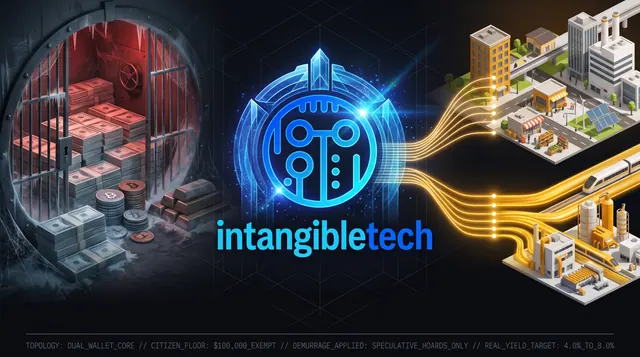
In December 2017, I received a brutal, unforgettable masterclass in the illusion of financial control.
The cryptocurrency markets were in the middle of a historic bull run. Prices were climbing exponentially by the hour, and like millions of other participants, I had capital on the line. As the market approached its parabolic peak, I decided to take risk off the table. I logged into Coinbase to execute my trades, and hit a brick wall.
My account was completely locked.
There was no human emergency desk to call, no operational transparency, and no recourse. My support tickets vanished into automated email queues while asset prices peaked, rolled over, and cratered. By the time access was restored weeks later, the market had collapsed, taking my hard-earned profits with it.
That experience was painful, but it delivered a profound technical awakening.
Most people in that situation simply directed their anger at a single company. But as an enterprise technologist who had spent years auditing financial database mismatches and fragile supply-chain connections inside Fortune 50 companies like GE (a journey chronicled in Why I Created Intangible Technologies), I saw the real truth: The crypto industry had not disrupted legacy finance at all. It had simply rebuilt the worst bottlenecks of 1970s commercial banking and painted a slick Silicon Valley skin over the top.
These platforms were operating as custodial gatekeepers. They managed customer funds on internal, off-chain relational databases, settling transactions on private servers, and masking multi-day clearing float behind polished user interfaces. If moving your value requires the permission of an intermediary’s centralized server, you don’t own a sovereign digital asset—you own an IOU on someone else’s fragile database.
That realization cured me of retail crypto hype forever. I stopped caring about speculative tokens and began evaluating distributed ledger technology from a ruthless systems-engineering perspective:
Which architecture possesses the consensus discipline, predictability, and foundational primitives required to anchor real-world, enterprise-grade economic infrastructure?
That search led me directly to the Stellar network. And while the rest of the technology sector spent the next decade chasing complex smart-contract virtual machines and speculative tokens, I realized that Stellar had quietly built the only distributed clearinghouse capable of serving as an unshakeable global anchor of truth.
The Engineering Beauty of Pragmatism
In enterprise architecture, there is a dangerous tendency to confuse unnecessary complexity with technical superiority.
When Ethereum introduced general-purpose, Turing-complete smart contracts, the tech sector assumed every financial function on Earth would soon run on the Ethereum Virtual Machine (EVM). But when examined through the lens of institutional risk and high-throughput reliability, the structural flaws of that model became glaringly obvious:
- Writing unconstrained, arbitrary code to handle financial balances creates an infinite attack surface for reentrancy bugs, flash-loan exploits, and multi-million-dollar hacks.
- Volatile gas-auction fee markets mean that a network surge can turn a five-cent settlement into an eighty-dollar fee, completely destroying operational predictability.
- Forcing every node to process every line of arbitrary script guarantees chronic state bloat and computational bottlenecks.
Stellar’s creators made a fundamentally different, remarkably disciplined architectural choice. They understood what enterprise CFOs and systems engineers know intuitively: Money does not need an unconstrained, speculative world computer. Money requires a deterministic, bulletproof transaction engine with sub-second finality and predictable costs.
Instead of forcing developers to write error-prone smart contracts for basic financial operations, Stellar built the essential primitives of institutional commerce directly into the core protocol:
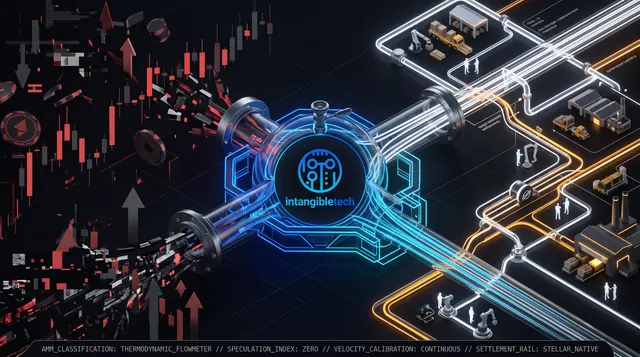
- Native Automated Market Makers (AMMs): Liquidity pools on Stellar are not fragile third-party contracts; they are compiled directly into the consensus engine, allowing seamless, algorithmic asset conversion with zero smart-contract risk.
- Native Compliance and Clawbacks: While early crypto anarchists championed lawless irreversibility, Stellar acknowledged institutional reality. By providing native primitives for asset clawbacks, regulated trustlines, and cryptographic authorization, Stellar created an environment where regulated banks, enterprises, and sovereign entities can legally operate.
- Disciplined, Non-Disruptive Upgrades: Anyone who has observed the hard forks, ideological civil wars, and broken network upgrades across other blockchains understands why major enterprises hesitate to build on them. Stellar functions with the stability of mission-critical enterprise software. Through formal Core Advancement Proposals (CAPs), protocol upgrades are rigorously vetted, voted on by validator quorums, and deployed on a predictable cadence that never breaks backward compatibility or halts the ledger.
Consensus Built for Institutions: Why FBA Beats Proof-of-Stake
The foundational genius of Stellar lies in its consensus model: the Stellar Consensus Protocol (SCP), which implemented the first practical Federated Byzantine Agreement (FBA).
Most modern public blockchains run on Proof-of-Stake (PoS). But from an economic and governance standpoint, Proof-of-Stake is simply an algorithmic recreation of an oligopoly.
In a Proof-of-Stake network, validation authority is determined by capital accumulation. The more capital you stake, the more control you have over transaction sequencing, and the more network fees you extract. It is a system where the wealthiest balance sheets dictate consensus, leaving network security vulnerable to financial capture if an adversary simply borrows enough capital to control the validator threshold.
Federated Byzantine Agreement operates on an entirely different, highly democratic physics:
- Quorum Slices Over Capital Hoards: In SCP, validation authority cannot be bought with money. Instead, every validator independently specifies which other institutional validators it trusts based on verified performance, legal jurisdiction, and operational accountability. These independent choices form overlapping networks of trust called “quorum slices”.
- Deterministic, Sub-Second Finality: Rather than relying on probabilistic block confirmations, mining races, or centralized sequencer checkpoints, quorums reach mathematical agreement in three to five seconds. When a ledger closes on Stellar, it is mathematically final. There are no chain reorganizations, no rollbacks, and no ambiguity.
- Zero Energy Waste: SCP achieves Byzantine fault tolerance without burning national power grids or requiring millions of dollars in continuous inflationary capital subsidies.
It is a governance and security model that sovereign institutions and commercial enterprises can rely on: a decentralized network where authority is grounded in operational accountability rather than financial plutocracy.
Why We Rejected Layer-2s to Build Layer-0
As the limitations of early blockchains became clear, the Web3 industry settled on a standard workaround: Layer-2 (L2) networks.
The L2 playbook is predictable: when a base layer is too slow or expensive, you construct a secondary network sitting on top of it—using optimistic rollups, zero-knowledge proofs, or payment channels to batch transactions off-chain before settling them back down.
For high-frequency enterprise operations, the Layer-2 path is fundamentally flawed:
- The Centralized Sequencer Trap: The vast majority of L2s rely on a single, centralized sequencer to order transactions. If that sequencer experiences an outage or chooses to censor an enterprise’s transactions, operational continuity breaks down.
- Fragile Cross-Chain Bridges: L2s require locking capital in smart-contract bridges. These bridges have become the single largest vector for multi-billion-dollar hacks in computational history.
- Added Architectural Bloat: Stacking an abstraction layer on top of an already congested base layer does not eliminate operational friction; it merely adds another layer of administrative overhead, latency, and fee uncertainty.
We took the exact opposite direction. Instead of building a fragile Layer-2 above the blockchain, we went down to bare-metal hardware to build Layer-0.
A Layer-2 is an off-chain network that asks a base layer for permission. Layer-0 is the physical, high-performance execution engine that runs locally inside the enterprise, synchronizing directly with the consensus layer.
By building Layer-0, we severed our reliance on slow internet round-trips for internal operations, allowing enterprises to execute millions of transactions per second on bare metal while using Stellar strictly as the immutable, global notary.
Why Layer-0 Isn’t Just “Another Database”
This brings us to the core philosophical question:
“If Intangible Technologies argues that legacy relational databases are the root cause of enterprise mismatches, why isn’t our Layer-0 engine just another database that can be manipulated or corrupted?”
To answer this, we must examine why legacy databases fail.
Inside enterprise giants like GE or P&G, the systems that manage operations—SAP, Oracle, Microsoft SQL—are built on mutable, siloed relational tables. In a traditional corporate database:
- Records Can Be Falsified or Overwritten: A database administrator with root credentials can execute an UPDATE or DELETE statement, altering past financial liabilities, inventory counts, or production logs.
- Silos Cause Disconnects: Two different departments run two different database instances. When System A records a shipment and System B fails to receive the batch message, the systems drift out of sync. The resulting discrepancy requires human forensic audits and manual journal entries to fix.
- They Measure Output Post-Mortem: Traditional databases only record what happened after a batch process runs, giving management a delayed, backward-looking view of reality.
Here is why Layer-0 cannot be falsified, corrupted, or desynchronized:
- Append-Only Immutability: There is no UPDATE command in our architecture. Once an operational event or credit transition is recorded, it is permanent. The only way to alter a balance is to post an offsetting transaction, preserving an unbroken, forensic audit trail of every nanosecond of operations.
- Silicon-Level Enclave Security: Operational telemetry—machine runtime hours, automated payments, supply-chain handoffs—is signed directly inside Hardware Roots of Trust (TPM 2.0 chips and Secure Enclaves). Even if a malicious corporate actor has physical access to the server, they cannot falsify the data because the signing keys never leave the encrypted hardware enclave.
- Global Mathematical Synchronization: A Layer-0 instance does not live in an isolated vacuum. At regular intervals, the local state engine compiles thousands of transactions into a cryptographic Merkle root. That root is notarized directly onto the Stellar ledger.
If an enterprise attempted to falsify its internal Layer-0 ledger to inflate its balance sheet, the local state root would mathematically clash with the immutable proof previously anchored to the Stellar blockchain. The system would instantly flag the discrepancy at the protocol level.
Layer-0 delivers the raw speed of bare-metal computing alongside the absolute, tamper-proof finality of a global public blockchain.
Architectural Symmetry: How Our Opcodes Match Stellar’s Core
The power of this architecture stems from the technical unison between our Layer-0 engine and Stellar’s native protocol design.
We did not build an awkward software bridge or an interpretive scripting wrapper. Our Layer-0 engine was designed from the ground up to mirror the exact architectural physics of the Stellar network.
Stellar achieves its speed because it rejects virtual machine bloat, using a compact, pre-compiled set of native transaction operations. We adopted the exact same engineering discipline for Layer-0:
- Fixed 128-Byte Memory Alignment: Our account states and ledger transitions are compiled into fixed, 128-byte cache-aligned memory structs. They require zero dynamic memory allocation and fit directly into CPU registers, allowing our state machine to execute calculations in 4 nanoseconds.
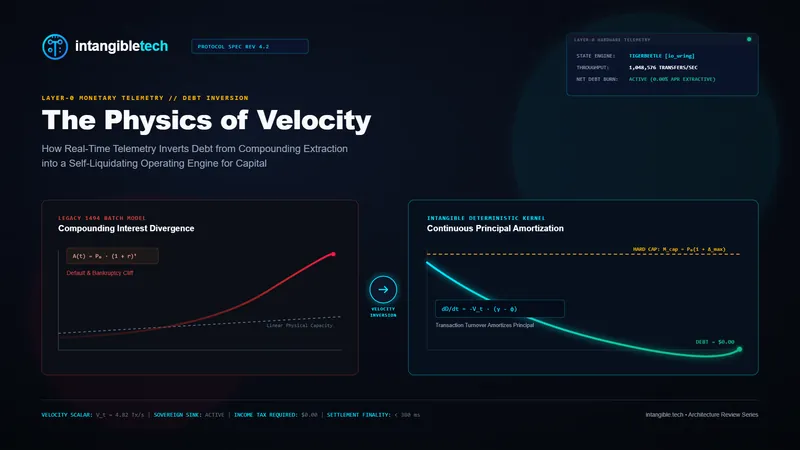
- Pre-Compiled Financial Opcodes (0x01 through 0x08): Instead of executing unpredictable, gas-burning smart contracts, our Layer-0 engine operates on eight mathematically verified, pre-compiled operations. These opcodes handle atomic tax splits, dynamic velocity calculations, continuous debt amortization, and mentorship provenance directly at the silicon level—the mathematical mechanics of which are detailed in The Physics of Velocity.
- Seamless Protocol Translation: Because our Layer-0 opcodes share the same deterministic design philosophy as Stellar’s native operations, translating a local Layer-0 settlement into an anchored Stellar transaction requires zero serialization overhead or complex cryptographic mapping.
Layer-0 acts as the high-speed operational transmission, and Stellar acts as the unyielding global drive shaft. They operate in synchronized harmony, forming a single, continuous financial fabric.
Eradicating the $4 Trillion Cross-Border Float
The most immediate macroeconomic breakthrough of anchoring Layer-0 to Stellar is the complete eradication of foreign exchange (FX) settlement friction.
In the modern global economy, cross-border commerce is paralyzed by the Correspondent Banking System.
When an American manufacturer buys precision parts from a supplier in Germany or Japan, the payment does not clear in real time. It moves through a fragile chain of intermediary clearinghouses, central banks, and SWIFT messaging networks. Because these institutions rely on disparate databases that take days to reconcile, commercial banks must maintain massive, pre-funded capital balances in foreign currencies sitting idle in overseas accounts—known as Nostro and Vostro accounts.
Globally, over $4 trillion in capital is permanently frozen in Nostro/Vostro accounts simply to protect banks against the risk of multi-day clearing float. That is $4 trillion of productive capital locked out of the global economy, accompanied by an extractive 2% to 4% toll skimmed on currency conversions.
Stellar eliminates this friction natively through Atomic Path Payments and Native Multi-Currency AMMs:
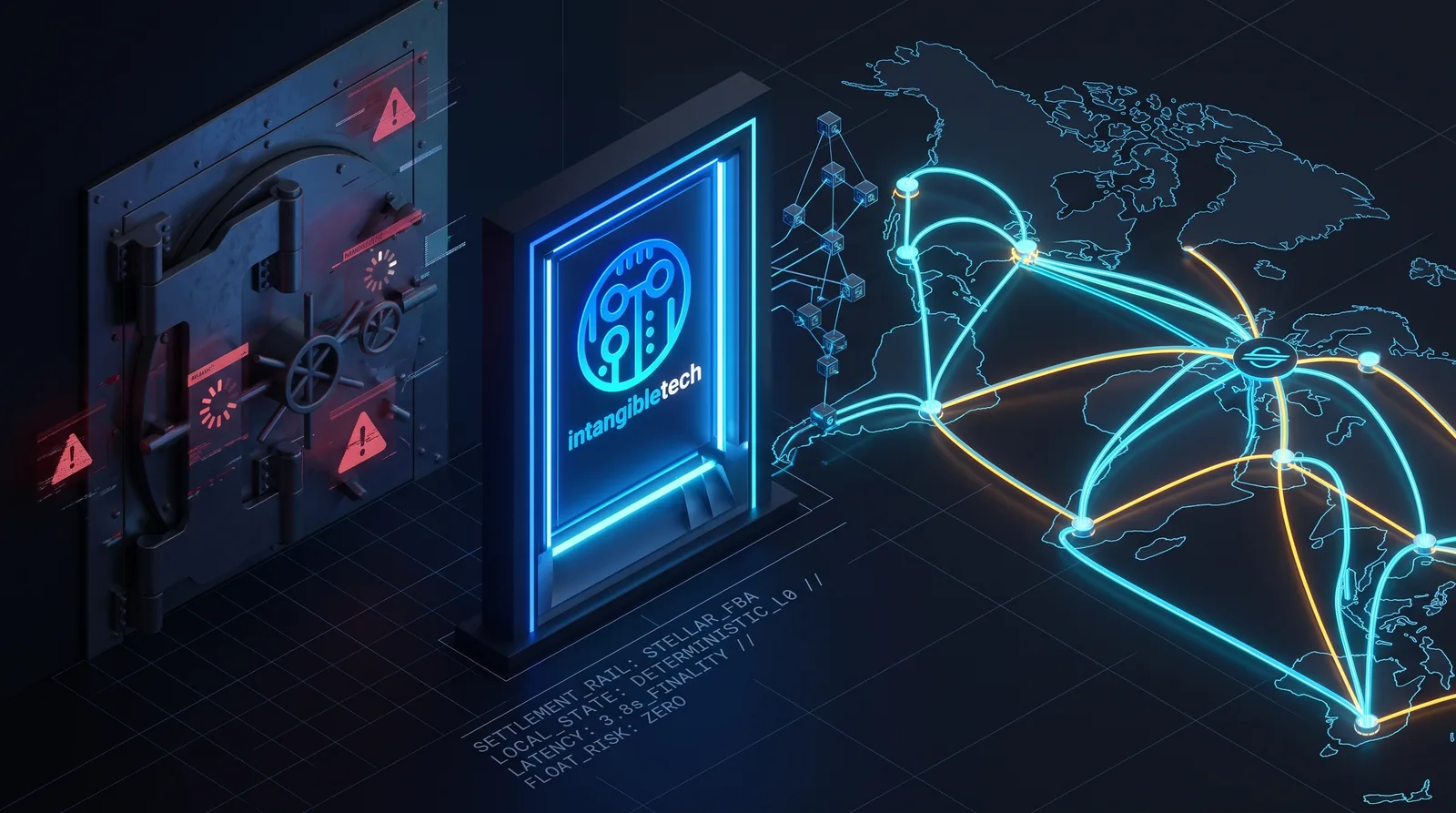
- Frictionless Liquidity Routing: If an enterprise in the United States needs to settle with a supplier in Tokyo, Stellar’s consensus engine atomically discovers the most liquidity-efficient path across its native order books and AMMs in a single transaction. It can route from US Dollar stablecoins through Euro reserves into Japanese Yen, completing the entire conversion and settlement in under four seconds.
- Zero Counterparty Float: The cross-border payment and the foreign exchange conversion happen simultaneously or they do not happen at all. There is zero settlement delay, zero counterparty risk, and zero reason for enterprises to keep billions in idle foreign reserve accounts.
- Sub-Cent Transaction Economics: International commerce is liberated from banking cartels, reducing settlement costs from expensive wire fees down to fractions of a cent.
By pairing our local Layer-0 factory and enterprise engine with Stellar’s native FX rails, a manufacturer can scan a shipping container at a dock in Munich and settle the invoice in real-time yen with zero float, zero reconciliation overhead, and zero exchange markup.
Beyond the Gimmick: Why This Is Not “RWA Tokenization”
In the technology world today, significant capital is flowing toward what venture funds call “Real-World Asset (RWA) Tokenization.”
Major financial institutions claim they are revolutionizing the economy by taking legacy financial instruments—subprime auto loans, compounding corporate debt, commercial real estate titles—wrapping them in ERC-20 smart contracts, and trading them on blockchain exchanges.
This is a cosmetic distraction.
Taking an extractive, 9% compounding debt liability, wrapping it in a digital token, and trading it on a secondary market does not fix the underlying economic machine. It does not prevent corporate bankruptcies, it does not lower the cost of living for working families, and it does not make software systems more reliable. It is simply applying digital lipstick to a decaying, 500-year-old accounting model—a flawed structure we dismantle in The Dissolution of the Share.
Intangible Technologies is not a tokenization platform.
We did not build an asset token to trade on an exchange. We engineered an open operating protocol that replaces the underlying accounting physics of capital itself:
- We do not trade speculative debt tokens; we use transaction velocity to invert debt into a self-liquidating, continuously amortizing asset.
- We do not rely on centralized crypto custodians; we use hardware telemetry and Stellar’s immutable notary to turn verified human craft and systems reliability into spendable balance-sheet working capital.
- We do not build fragile, multi-layered L2 rollups; we deploy bare-metal Layer-0 state machines that settle locally in microseconds and anchor globally in seconds.
The Path Forward
Looking back at that December day in 2017—staring at a locked screen while a centralized platform held my capital hostage—I never could have anticipated the architectural journey it would ignite.
That frustration stripped away the superficial illusions of the cryptocurrency industry. It forced me to look beneath the marketing whitepapers and seek out genuine engineering truth. It led me to understand the profound necessity of bare-metal database determinism, hardware-attested operational integrity, and the pragmatic brilliance of the Stellar Consensus Protocol.
We do not need more centralized gatekeepers pretending to be financial innovators. We do not need more fragile Layer-2 networks stacking complexity on top of broken foundations.
We need an open, deterministic financial operating system—one that combines bare-metal speed with an unshakeable global anchor of truth, eliminating extractive middlemen and aligning our economic ledgers with real human craft.
(To explore how this Layer-0 architecture bridges into existing enterprise systems and legacy machinery today, see The Pragmatic Horizon.)
That is what we engineered. And that is the foundation upon which the next economy will be built.