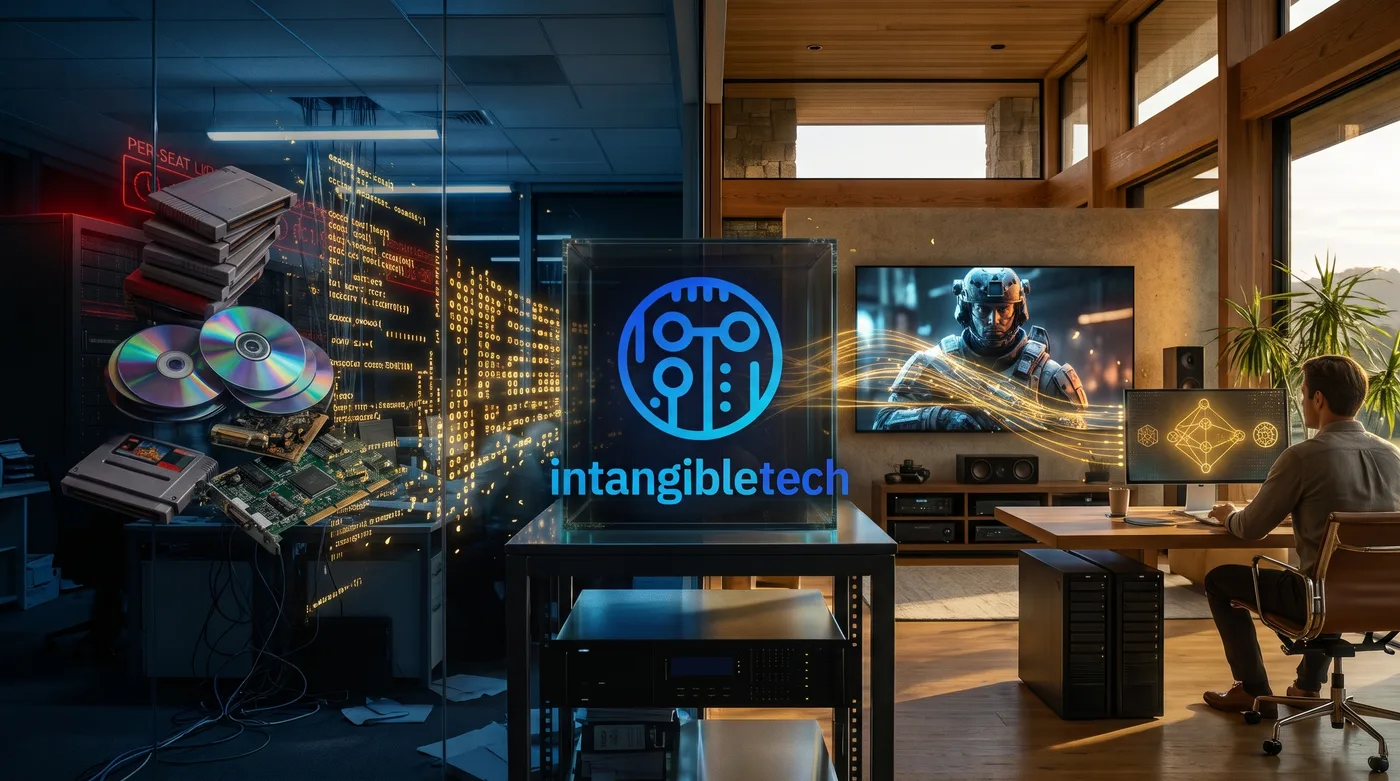
A few weeks ago, after finishing a long sprint of architectural writing, I sat down in my living room in front of a 77-inch OLED display, booted up my desktop PC, and launched Gears of War: E-Day.
Watching that franchise return to its horror-tinged roots in native 4K with ultra-low latency and custom .ini tweaks reminded me why I fell in love with PC gaming in the first place. Naturally, as soon as the nostalgia hit, I wanted to go back and replay the original Xbox 360 trilogy, specifically Gears of War 2 and Gears of War 3.
There was just one problem. Despite Microsoft having a multi-trillion-dollar market cap and owning the Xbox ecosystem outright, they never ported Gears of War 2 or 3 to the PC. For nearly two decades, those masterpieces were left trapped inside aging 2005 PowerPC console silicon. In the traditional corporate world, bringing them to modern PCs would require greenlighting a twenty-million-dollar remaster budget, assembling a hundred-person studio, and waiting three years.
Except I didn’t have to wait three years. I didn’t even have to wait three weeks.
In the time it takes a corporate steering committee to schedule a kickoff meeting, a tiny group of underground developers used static recompilation tools and a few dollars’ worth of AI compute credits to translate the original Xbox 360 executable binaries directly into native x86 PC code. Suddenly, games that a trillion-dollar corporation left stranded for eighteen years were running natively on bare-metal PC hardware, complete with unlocked 120+ frame-per-second framerates, ultrawide monitor support, raw mouse-and-keyboard input, and modern shader pipelines.
If you only casually follow technology, it is easy to dismiss that story as a neat hobbyist trick for nostalgic gamers.
If you are a software executive, a chief architect, or an institutional investor, that story should send a cold shiver down your spine.
What is happening right now in the gaming underground is the canary in the coal mine for the entire global software industry. The combination of deterministic binary lifters and frontier AI coding models has quietly triggered a Binary Singularity: the moment where compiled machine code (the raw 1s and 0s that software companies have relied on for fifty years to hide their trade secrets and lock users into hardware ecosystems) can be effortlessly reverse-engineered back into clean, portable source code in an afternoon.
From Nintendo Switch 2 releases running on iPhones and PCs within days of a hardware exploit, to modders cracking Nvidia’s proprietary DLSS 5 locks to run across older GPUs and competing AMD silicon, to nimble startups spinning up clean-room clones of Adobe’s flagship creative suite, the walls around software intellectual property are crumbling.
Here is why the legacy corporate playbook of walled gardens, artificial hardware locks, and courtroom lawsuits is already dead, and how the Intangible Architecture provides the only viable economic model to protect creators, reward the underground, and monetize a future where every piece of software runs natively on everything.
1. The Great Console Illusion and Why Gabe Newell Already Won
To understand why the walls are falling so fast in gaming, you first have to look at the history of the hardware itself.
Twenty-five years ago, a video game console was an exotic, alien supercomputer. When Sony built the PlayStation 2 and PlayStation 3, or when Nintendo and Silicon Graphics engineered the Nintendo 64, they designed custom silicon from scratch. The PS3’s infamous Cell Broadband Engine used a complex network of Synergistic Processing Elements that behaved nothing like a home computer. Back then, a game built for a console physically could not run on a standard PC without heroic engineering effort.
Over the last fifteen years, that architectural divergence vanished.
Today, a PlayStation 5 and an Xbox Series X are simply mid-range AMD desktop PCs packaged in plastic shells for the living room, while the Nintendo Switch 2 is an ARM-based mobile tablet powered by an Nvidia system-on-chip. Because designing custom CPU architectures became prohibitively expensive, console makers quietly standardized on the exact same x86 and ARM instruction sets that power every laptop, desktop, and smartphone on earth.
Yet while the hardware converged into commodity PC parts, the business model remained stuck in 1995: sell the box at a loss, lock the operating system behind cryptographic keys, and extract a 30% toll on every piece of digital software sold inside the walled garden.
Even worse, corporate hubris has begun actively degrading the customer experience inside those walls, a textbook example of platform enshittification:
- Sony’s Walled-Garden Whiplash: After briefly tasting massive high-margin revenue by releasing PlayStation hits on PC, Sony rattled its core community by pulling back toward console exclusivity, forcing mandatory PSN account tethers on single-player games, and aggressively pushing a digital-only hardware future where players own no physical media and remain at the total mercy of a single storefront’s pricing.
- Artificial GPU Gatekeeping: On the PC hardware side, Nvidia introduced breathtaking neural rendering breakthroughs like DLSS 5, but attempted to lock the latest frame-generation and transformer features exclusively to its newest RTX 50-series graphics cards to force expensive hardware upgrades.
Every time an executive board tries to trap consumers with artificial scarcity, they forget the foundational law of digital economics articulated over fifteen years ago by Valve co-founder Gabe Newell:
“Piracy is almost always a service problem and not a pricing problem. If a pirate offers a product anywhere in the world, 24/7, purchasable from the convenience of your personal computer, and the legal provider says the product is region-locked, will come to your country three months after the US release, and can only be bought in a physical store, then the pirate’s service is more valuable.”
Valve built the Steam empire by treating players like adults and offering a service more convenient than piracy. Better yet, with Proton (Valve’s open-source compatibility layer that translates Windows DirectX system calls into Vulkan graphics instructions on the fly), Valve proved that an entire operating system catalog of tens of thousands of Windows PC games could run seamlessly on Linux handhelds like the Steam Deck without developers having to rewrite a single line of code.
Microsoft saw the same writing on the wall. Microsoft’s “Play Anywhere” strategy, treating Xbox not as a plastic box under your television, but as a unified software fabric spanning cloud, desktop PC, living-room console, and portable handhelds, is the only rational economic endgame. When AAA games cost $200 million to produce, restricting your total addressable market to a single subsidized plastic box is financial suicide. You want to write the software once and deploy it across the largest possible install base on earth.
When corporations refuse to offer that universal access, the underground simply builds it without their permission.
Within months of Sony tightening its walled garden and pushing digital-only lock-in, hackers and open-source contributors accelerated PlayStation 4 translation layers (shadPS4) to the point where stubbornly locked masterpieces like Bloodborne were running natively on PC at 60+ frames per second. Within days of the Switch 2 suffering a low-level exploit, its flagship games were not just running on desktop PCs; they were being vastly improved with native 4K rendering, machine-learning upscaling, and ultra-low-latency frame generation. Today, the objectively best place to experience the newest Legend of Zelda isn’t even on Nintendo’s hardware; it is on a high-end PC (or compiled down to run natively on an Apple Silicon iPhone), just as modders bypassed Nvidia’s driver locks within weeks to make DLSS 5 wrappers run across older GeForce cards and even competing AMD Radeon GPUs, often with fewer ghosting artifacts than the official implementation.
2. Under the Hood: From Slow Emulation to Bare-Metal AI Recompilation
Why is this happening so much faster today than it did ten years ago? Because the technical mechanism has evolved from Emulation to AI-Accelerated Static Recompilation.
For non-technical executives, it is critical to understand the difference between these two concepts, because that difference is what breaks traditional software IP law.
What Is a ROM and How Does Traditional Emulation Work?
Every video game consists of two distinct parts: the Executable Code (the engine and logic instructions) and the Assets (the 3D models, textures, music, and dialogue). Historically, both were burned onto a physical cartridge chip or optical disc known as ROM (Read-Only Memory).
In traditional Emulation, if you want to play a Nintendo 64 or Xbox 360 game on your modern PC, you run a software program called an emulator. While you play the game, the emulator acts like a simultaneous human translator at the United Nations: every single millisecond, it reads an instruction meant for an old 1996 MIPS processor or a 2005 PowerPC chip, translates what that instruction means on the fly, and asks your modern Intel or AMD processor to mimic that behavior.
Because translating every instruction in real time while the game is running takes enormous computing power, traditional emulation is heavy, introduces input lag, and struggles with complex modern systems.
The Leap to Static Recompilation (Decomps & Recomps)
Over the last few years, brilliant low-level engineers pioneered a far more radical approach: Decompilation and Static Recompilation.
Instead of translating the old game slowly while you play it, static recompilation treats the old console binary like a zip file to be unpacked and permanently rewritten before you ever launch the game:
- Lifting Binary to Intermediate Representation: A tool reads the raw machine code (the compiled 1s and 0s on the Xbox 360 or N64 file), maps out every function jump and memory register, and converts the assembly instructions directly into structured C or C++ source code.
- Swapping the Hardware Hooks: The old console calls (like instructions aimed at the Xbox 360’s custom Xenos graphics chip) are systematically mapped to modern, bare-metal PC APIs like DirectX 12, Vulkan, or Apple’s Metal.
- Compiling to Bare Metal: A standard modern compiler compiles that generated C++ code into a brand-new, native executable file (
.exeon Windows, or an app binary on macOS/iOS).
When you click play on a statically recompiled game, like the underground PC ports of The Legend of Zelda: Ocarina of Time, Majora’s Mask, or the recent Xbox 360 Gears of War recompilations, you are no longer emulating anything. Your computer is executing native bare-metal machine code at full speed, as if the original studio had written the PC port from scratch in 2026. Because the code is now open C++, modders can effortlessly inject ray tracing, 240Hz frame interpolation, widescreen camera math, and custom assets.
Enter the AI Multiplier
Five years ago, decompiling a single Nintendo 64 game by hand required a team of twenty obsessive reverse-engineers working for three years to manually translate assembly functions into matching C code.
Today, frontier AI models have turned that three-year marathon into an automated pipeline.
At its core, translating obscure PowerPC or ARM assembly instructions into clean, documented, human-readable C++ is a deterministic pattern-matching and language-translation problem. That happens to be the exact domain where Large Language Models and specialized coding agents excel. An underground developer can now feed ten thousand unnamed assembly functions from an old game binary into an AI pipeline alongside a symbolic execution verifier, spend twenty dollars in API credits, and wake up the next morning to a fully structured, human-readable C++ codebase.
The Evolution of Software Liberation: Emulation vs. Static Recompilation vs. AI-Lifted Bare Metal
3. The Legal Earthquake: Why Copyright Cannot Stop Mathematical Compilers
This brings us to the legal crisis that corporate general counsels are completely unprepared for.
For decades, software companies relied on a two-layer shield to protect their products: Copyright Law (which protects the literal written expression of source code and artistic assets) and Binary Obfuscation (compiling that human-readable source code into unreadable 1s and 0s before shipping it to customers).
Under long-established US legal precedent, most notably Sony Computer Entertainment, Inc. v. Connectix Corp. (2000) and Sega v. Accolade (1992), reverse-engineering a system for interoperability and running an emulator is completely legal, provided no proprietary copyrighted code or BIOS files are distributed by the emulator maker.
Here is how the underground decomp and recomp community threads that legal needle with surgical precision:
- When a team releases a native PC recompilation of Zelda or Gears of War 2, they do not distribute a single pixel of art, a single note of music, or a single byte of the studio’s original ROM.
- Instead, they release an empty, clean-room mathematical compiler script.
- To use it, the player must supply their own legally owned copy of the original game file (their personal ROM dumped from their own disc or cartridge). The script verifies the user’s local file, extracts the music and 3D models on the user’s own hard drive, stitches them into the newly compiled native PC engine locally, and outputs a playable PC game.
The Streisand Effect of Nintendo’s War on Yuzu and Ryujinx
Look at what happened when Nintendo sent aggressive legal teams to shut down the centralized Switch emulators Yuzu and Ryujinx. Corporate executives cheered those takedowns as a decisive victory for intellectual property enforcement.
In reality, those lawsuits triggered a massive Darwinian leap in the underground community.
Why? Because centralized emulator teams hosting websites, Patreon accounts, and shared Discord servers were easy legal targets, especially when careless developers shared decryption keys or pre-release builds. By crushing centralized emulators, corporate lawyers inadvertently pushed the brightest minds in the scene toward decentralized static recompilation scripts and automated AI lifters.
You can sue a corporation running a commercial emulator website. How do you sue an open-source mathematical equation on GitHub that teaches a local AI model how to convert PowerPC assembly into C++ on a user’s private computer? You can’t, any more than Hollywood could sue the math behind the MP3 compression algorithm in 1999.
Beyond Gaming: The Coming Wave of Clean-Room SaaS Clones
If you think this phenomenon is limited to video games, look across the broader enterprise and creative software landscape.
For twenty years, SaaS giants like Adobe, Autodesk, and legacy ERP vendors have operated like digital landlords. They stopped innovating at the core, wrapped decades-old C++ codebases in cloud subscription walls, raised prices every year, and assumed their customers could never leave because rebuilding fifty million lines of complex image-processing or CAD logic from scratch was too expensive for a startup.
AI-assisted reverse engineering destroys that moat overnight.
An independent engineering team no longer needs to steal Adobe’s proprietary source code (which would be illegal copyright infringement). Instead, they can observe the exact input-output behavior, shader math, and binary instruction flows of a compiled desktop application, use automated AI synthesis to write clean-room, mathematically equivalent Rust or C++ implementations from scratch, and ship a native, bloat-free competitor in six months for a fraction of the cost.
And before any executive suggests that Big Tech will stop this by putting “safety guardrails” inside ChatGPT or Claude so they refuse to decompile binaries, understand that the modding and security community does not rely on censored web chatbots. They run fine-tuned, open-weight coding models locally on their own consumer GPUs. You cannot put a corporate guardrail on bare-metal math running offline in someone’s home office.
4. The Cultural Blueprint: 1990s Hip-Hop Sampling, TikTok, and the Remix Economy
We have seen this exact movie before in another industry, and the historical parallel shows us the only way out.
In the late 1980s and early 1990s, hip-hop producers armed with Akai MPC samplers began taking two-second drum breaks and soul hooks from 1970s vinyl records and re-engineering them into entirely new musical masterpieces. Soon after, Napster and MP3s dissolved the physical distribution moat of the plastic CD.
How did the legacy record labels respond? With pure legal warfare. They sued teenagers, tried to outlaw digital audio players, and locked sample clearances behind Byzantine legal fees that killed creative velocity. By fighting the technology, the music industry lost half its revenue over fifteen years.
What finally saved and grew the music industry to historic heights? First, Steve Jobs and Spotify proved Gabe Newell’s rule by making legal streaming faster and easier than piracy. Second, platforms like TikTok and YouTube turned the “remix” from a crime into an automated revenue engine. Today, when a teenager in a bedroom speeds up an old Fleetwood Mac or 1990s R&B track, layers a new beat over it, and posts it on TikTok, Content ID and automated licensing rails identify the underlying root stem and stream micro-royalties back to the original rights holders while boosting the original song up the global charts.
The gaming and enterprise software industries are standing in their 1999 Napster moment right now.
Think back to my experience playing the community-built Xbox 360 Gears of War recompilation on my PC. Why on earth would Microsoft view the developers who built that native PC port as criminals or adversaries? Those developers took an eighteen-year-old dormant asset sitting in Microsoft’s vault generating $0.00 on PC, and, for zero corporate R&D expenditure, turned it into a pristine, modern PC showcase that deepens fan loyalty right as Gears of War: E-Day launches!
The only reason Microsoft, Nintendo, Sony, and enterprise software giants fight the modding and recompilation community is that legacy accounting and copyright law have no automated mechanism to verify root ownership and split revenue across derivative code.
The Recompilation Inversion: From Legal Warfare to Protocol-Native Remix Yield
5. How the Intangible Architecture Protects Brands While Unleashing the Underground
At Intangible Technologies, we recognized early on that in an era of AI-driven binary fluidity, you cannot protect intellectual property by hiding 1s and 0s inside a black box. When any binary can be lifted to source code in hours, security through obscurity is dead.
To protect brands, studios, and enterprise software creators without throttling the future of universal compute, you have to shift protection from hiding the code to cryptographically anchoring the provenance and liquidity of execution.
Here is how the Intangible Architecture solves the Binary Singularity across both gaming and enterprise software:
1. Turning Modders and Recompilers into On-Chain Force Multipliers
Imagine how Gears of War 2, Bloodborne, or a classic Zelda title works when wired into our 3-Primitive OS and Directed Acyclic Graph (DAG):
- Root IP Provenance: Microsoft or Nintendo registers the official, canonical game assets and root binary signature as an immutable parent node () on the ledger.
- Permissionless Derivative Nodes: When a brilliant underground team builds an AI-assisted static recompilation that brings that Xbox 360 game to native Windows, Linux, or iOS, or when a modder builds an ultra-clean universal DLSS 5 shader injector, they do not have to hide in the shadows. They register their recompilation module as a Child Capability Node () attached to the studio’s root DAG.
- Frictionless Player Authentication & Atomic Royalty Splits: As a player, I don’t have to hunt down sketchy pirate websites or manually dump physical Xbox 360 discs with a soldering iron. I open my digital storefront, pay $29.99 for the official Gears of War 2 entitlement anchored to my Sovereign Digital Identity (SID), and select the community-built “Native 4K PC Recomp” branch.
- The Automated Market Maker (AMM) Split (
Opcode 0x08): At the exact millisecond of my purchase, the studio’s balance-sheet AMM clears the transaction according to the pre-compiled DAG royalty partition:
Eighty-five percent of the revenue flows directly into Microsoft’s Reserve Cash pool, pure, 100%-margin profit on an eighteen-year-old game they didn’t have to pay a single internal engineer to port. The remaining fifteen percent streams automatically as Senior Kinetic Yield directly into the sovereign wallets of the open-source developers who built and maintain the recompilation engine.
Overnight, the underground community stops being a legal threat and becomes a decentralized, self-funding R&D division that keeps a company’s entire historical catalog immortal across every future hardware architecture on earth.
2. How Hardware Enclaves Protect Enterprise SaaS (Solving the “Adobe Clone” Problem)
What about B2B and enterprise software? If a competitor can use AI to reverse-engineer the user interface and local binary math of an enterprise application, how do software brands protect their core value?
Under our architecture, an enterprise software vendor’s true moat is no longer the static UI code running on a laptop; it is Hardware-Attested Execution and Impact Score Index (ISI) Integration:
- Confidential Enclave Core: While local UI and workflow extensions can be openly modded and customized by users, the proprietary AI weights, actuarial risk models, and commercial settlement pipelines run inside Confidential Hardware Enclaves attested at the silicon level. A copycat can clone the buttons on a screen, but they cannot clone the cryptographic root-of-trust connecting that software to the global settlement ledger.
- Provenance as Balance-Sheet Value: In a commercial setting (whether an engineering firm running CAD simulations, a hospital running diagnostic imaging, or a studio producing commercial media), output generated through official, enclave-verified software carries an immutable cryptographic signature (
Opcode 0x06) of authenticity and defect-suppression provenance. A pirated or unverified knockoff cannot generate the cryptographic attestations required to lower a corporation’s insurance premiums and borrowing spreads on the ledger. Honest commercial users choose the authentic platform not because of annoying DRM pop-ups, but because verified provenance directly lowers their cost of capital.
6. The Mental Inversions Required for the Universal Compute Era
For executives, investors, and policymakers trying to make sense of where software is heading over the next five years, surviving the Binary Singularity requires three fundamental mental inversions:
- Inversion 1: Everything Is Already a PC Game (Hardware Is Just a Viewport). Stop thinking of “Console,” “PC,” “Mac,” and “Mobile” as separate software worlds. Underneath the plastic casing, every modern device speaks the same foundational math. Between Valve’s Proton, Apple’s Game Porting Toolkit, and AI-driven static recompilation, the era of paying $70 to rent a game locked to one television box is ending. Consumers are demanding Sovereign Entitlements: if I buy a piece of software once, my verified identity should unlock the right to execute that software across my living-room OLED, my office workstation, and my handheld on an airplane, with the community free to optimize the binary for whichever silicon I own.
- Inversion 2: Source Code Is No Longer a Secret; Provenance and Velocity Are the Moat. For fifty years, software companies treated compiled binary files like locked bank vaults. AI has given every teenager with a graphics card a thermal lance that opens those vaults in minutes. Clinging to closed-source binary obscurity or suing fans who modernize old code is like trying to hold back the ocean with a broom. The companies that dominate the next decade will be those that anchor their brand value in protocol-native provenance, letting their community extend, port, and remix their engines while capturing automatic liquidity yield on every transaction in the graph.
- Inversion 3: The Underground Community Is Your Most Valuable Unpaid R&D Lab. When a group of passionate developers spends their weekends porting an eighteen-year-old Xbox 360 classic to run natively on modern PCs, or making a next-generation neural upscaler run smoothly on older graphics cards, they are not stealing from you. They are demonstrating where your product roadmap failed to meet customer demand. Give those builders a clean, protocol-native royalty rail, and they will turn your dormant back-catalog into a perpetual cash-flow machine.
Conclusion: Building for the Builders
There is something deeply inspiring about watching a small team of independent engineers, armed with twenty dollars of AI compute and sheer love for the craft, accomplish in a few weeks what multi-billion-dollar corporate bureaucracies claimed was too hard or unprofitable to do for nearly twenty years.
Just as we saw in the corporate workplace, where layers of middle-management theater choke out real product thinking, the legacy software and gaming industries have become trapped by their own extractive financial models. They spend hundreds of millions of dollars building artificial walls, only to watch a new generation of AI-assisted tools walk right through them.
We do not need more invasive kernel-level DRM, more anti-consumer hardware locks, or more courtroom takedowns against software preservationists.
We need an economic operating system that matches the physics of modern compute. By anchoring intellectual property in cryptographic provenance and wiring Automated Market Makers directly into the software dependency graph, Intangible Technologies makes peace between the boardroom and the underground.
Creators get protected. Studios get paid on dormant catalogs they couldn’t afford to modernize. Modders and recompilation engineers earn real, life-changing yield for their brilliance. And players get what they should have had all along: the freedom to run the art they love, at peak performance, on any machine they own.