Every time a foundational technology emerges, the first instinct of incumbent institutions is to commit the Horseless Carriage Error: they take the exact physical artifact of the old world and bolt it directly onto the new medium.
When the relational computer database arrived in the 1960s and 1970s, humanity had a historic opportunity to redesign money as a real-time thermodynamic state machine. Instead, software engineers under tight deadlines simply digitized the parchment—translating Luca Pacioli’s 1494 Venetian double-entry ledger pages directly into isolated SQL tables maintained separately by thousands of private banks. When consumer fintech apps arrived fifty years later, they painted a sleek, sixty-frame-per-second mobile interface over that exact same 1973 mainframe plumbing, while the underlying banks still settled asynchronously in multi-day batches.
Today, we are watching the exact same failure of imagination play out across the intersection of Wall Street and Web3 under the banner of Real-World Asset (RWA) Tokenization and Tokenized Equities.
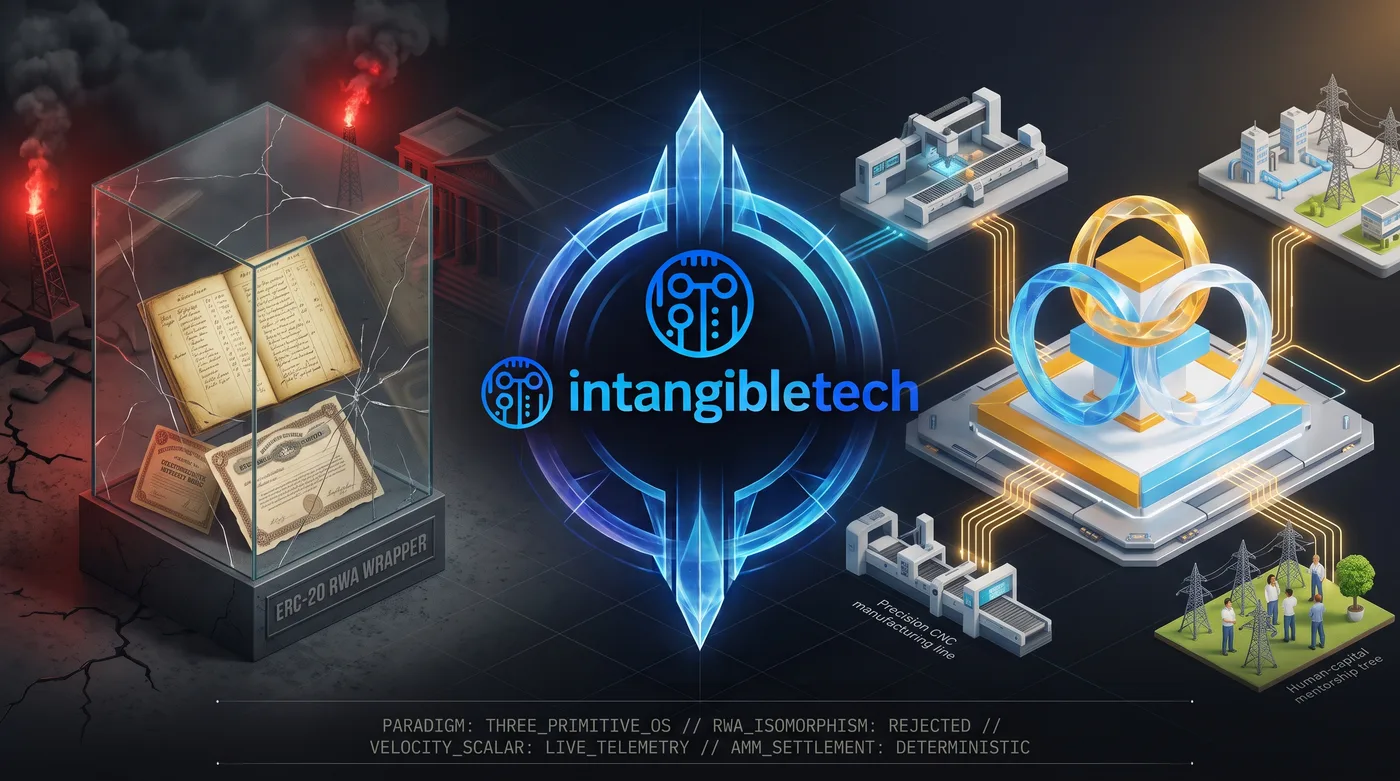
Walk into any institutional digital-asset summit today, and you will hear executives from the world’s largest asset managers—championing products like BlackRock’s BUIDL, Ondo Finance, and tokenized stock wrappers—declare that the future of finance has arrived because we can now wrap a U.S. Treasury bill, a private credit loan, or a share of corporate stock inside an ERC-20 smart contract.
If you evaluate this trend through the disciplined lens of enterprise product management and systems architecture, a sobering truth becomes clear:
RWA tokenization and tokenized equities are not a financial revolution; they are architectural isomorphism—putting lipstick on a 1494 pig.
Wrapping an extractive, compounding debt instrument or a speculative secondary-market stock certificate inside a blockchain token changes where the database is hosted, but it leaves the broken accounting physics of the underlying asset completely untouched. You have not solved the problem; you have merely allowed hedge funds to trade fifteenth-century scarcity logic twenty-four hours a day.
True product architecture never asks, “How do we copy-paste our legacy paper processes onto a new technology?” True product architecture zooms out, examines the fundamental technical capabilities of the new medium, and asks: “Given what this technology makes mathematically possible for the first time in history, how do we redefine the intended outcome itself?”
When you stop trying to mint a single speculative token and instead examine how data and value actually transact through deterministic ledgers and Automated Market Makers (AMMs), a profound realization emerges:
The answer is not a token. The answer is an entire economic operating system built around a Three-Primitive Balance Sheet—where Cash, Stock, and Credit interact continuously inside an Automated Market Maker to turn commercial velocity into an active physical force.
1. The RWA & Tokenized Equity Illusion: Why Digitizing the Artifact Fails
To understand why the current institutional consensus around RWAs and tokenized equities is a dead end, we must examine what happens when you wrap a legacy financial instrument inside a blockchain token without changing its underlying mathematical rules.
In legacy finance, our economy is crippled by three structural bugs inherited from 1494 batch accounting:
- Exponential Compounding Usury: Money is issued as interest-bearing debt where total repayment obligations grow exponentially over time, guaranteeing that debt claims eventually outpace the linear growth of the real physical economy and force periodic systemic defaults.
- The Secondary Equity Casino: Buying a corporate stock on the NYSE or NASDAQ does not give you a direct claim on the cash flow a company generates today, nor does your money go into the company’s productive working capital. You are buying a static claim in a secondary auction priced on subjective Discounted Cash Flow (DCF) narratives and quarterly Earnings Per Share (EPS) manipulation.
- Retrospective Batch Blindness: Because banks and corporate ERP systems sit in disconnected SQL silos, neither the market nor the government can measure the real-time velocity of money or the physical durability of assets without waiting months for manual retrospective audits.
Now ask yourself: Which of these three structural bugs is fixed when you “tokenize” a real-world asset or a share of stock on Ethereum or Solana?
Not a single one.
- Tokenized Debt Preserves Compounding Extraction: Wrapping a 5.25% U.S. Treasury bill, a corporate bond, or a rent-seeking single-family rental portfolio inside an ERC-20 token does not change its thermodynamic nature. A tokenized loan still demands compounding interest from the borrower, still ignores whether a factory is pausing for retooling, and still profits from debtor distress. Worse, as seen in the global push for Treasury-backed stablecoins (like USDT and USDC), when citizens in developing nations convert local value into dollar tokens, the corporate issuer buys U.S. Treasury bills—pocketing 100% of the sovereign interest yield while passing 0% yield and 100% of dollar inflation onto the user.
- Tokenized Equities Keep Investors Trapped in the “Sell-Down” Casino: Putting an Apple or Tesla stock certificate on a blockchain does not connect the investor to the company’s daily commercial cash flow. A retiree holding tokenized non-dividend stocks is still trapped in the anxiety of the “4% rule”—forced to sell off their underlying principal shares to another speculator during market crashes just to pay for groceries and healthcare. Meanwhile, corporate executives remain incentivized to lay off senior engineers, cut R&D, and take on debt to execute share buybacks that artificially inflate the token ticker.
- The Off-Chain Enforcement Cliff: RWA tokens suffer from a fatal split-brain contradiction. The token trades on a blockchain, but the actual customer payments, supply-chain invoices, and property titles remain trapped off-chain in legacy bank databases. The moment an off-chain borrower defaults or a title is disputed, the smart contract is powerless, and enforcement collapses back into multi-year, expensive 1494 paper courts.
THE RWA / TOKENIZED EQUITY ILLUSION
- 1494 Artifacts in ERC-20 Code: Wraps compounding debt & secondary stock tickers inside vulnerable smart contracts without fixing their extractive math.
- Zero Connection to Live Velocity: Disconnected from daily commercial cash flow; retirees remain forced to sell down principal shares to fund living costs.
- The Off-Chain Enforcement Cliff: Customer payments and property titles remain in legacy SQL silos—collapsing back into multi-year paper litigation upon default.
THE INTANGIBLE 3-PRIMITIVE OS
- Native AMM Balance-Sheet Triad: Replaces the static corporate balance sheet with Primary Reserve Cash (Type A/B), Velocity Entitlements, and Self-Amortizing Credit Bonds.
- Live Velocity Yield & Debt Burn: Real-time commercial turnover (Vt) streams daily cash yield to investors and burns down principal debt (Mcap) automatically.
- Consensus-Level Determinism: Enforces atomic tax settlement, hardware-attested telemetry depreciation, and instant judicial restitution clawbacks at Layer 0.
2. The Product Architect’s Inversion: Discovering the Hidden Variable of Velocity
How do we escape the RWA trap? By approaching the problem not as a Wall Street broker looking for a faster way to trade old paper, and not as a Web3 promoter looking to launch a speculative governance token, but as a Principal Product and Systems Architect examining the physics of the underlying data pipeline.
In enterprise product management, when a digital transformation fails, it is almost always because leadership tried to layer agile software rituals on top of a batch-processing data architecture that cannot see operational reality in real time.
Zoom out and look at what a unified, identity-bound distributed ledger and an Automated Market Maker (AMM) actually do at the data layer.
In the old world of siloed commercial bank databases (where JPMorgan Chase’s SQL server cannot see Bank of America’s SQL server in real time), Money Velocity (V)—the speed at which a dollar moves from hand to hand across the economy—was an unmeasurable ghost. Economists could never observe velocity directly; they had to estimate it backward months after a quarter ended by dividing estimated Gross Domestic Product by the money supply. Because velocity was a lagging ninety-day historical guess, you could never use velocity as an active variable inside a live financial contract.
Now look at what happens when commerce settles across a unified, deterministic state machine where every participant binds to a verified Sovereign Digital Identity (SID) and every enterprise operates through an on-chain Automated Market Maker liquidity pool:
- The ledger knows the exact dollar size of the active reserve liquidity pool at every millisecond.
- The ledger knows the exact volume of verified commercial transactions moving through that pool every second.
- The ledger knows the exact holding duration a dollar sits idle in an account before circulating again.
Suddenly, Velocity (Vt) is no longer a theoretical ghost. It emerges as a live, observable, millisecond telemetry scalar—a digital speedometer measuring the exact rate of capital turnover across every pool in the economy.
Once a product architect realizes that Velocity (Vt) and Hardware-Attested Telemetry are now live, trustworthy state variables on the ledger, the entire 500-year-old edifice of corporate accounting inverts:
- Mental Inversion 1 (From Static Snapshots to Continuous Flow): You no longer need quarterly 10-Q reports or subjective stock valuations to guess if a business is healthy; you can wire investor returns and credit amortization directly to the live commercial velocity flowing through the company’s settlement pool every second.
- Mental Inversion 2 (From Extractive Interest to Velocity Amortization): You no longer need to charge borrowers punitive compounding interest over time to compensate lenders; the continuous stream of micro-fees generated by high-velocity commercial turnover through the AMM pool can actively pay down and extinguish principal debt in real time.
- Mental Inversion 3 (From Disposable OpEx to Appreciating Intangible Capital): You no longer have to treat human workers, teachers, and engineers as a disposable operating expense (OpEx) to be slashed during layoffs; you can track the longitudinal velocity their skills and mentorship generate across the dependency graph and book human capability as an appreciating balance-sheet asset.
3. Not One Token, But an Operating System: The Three-Primitive Corporate Balance Sheet
When executives first hear about a blockchain-based economic framework, their conditioned reflex is to ask: “So are you launching an Intangible Tech coin that everyone has to buy?”
The answer is no. Minting a speculative platform altcoin is the original sin of Web3—it turns infrastructure into a volatile casino.
Intangible Technologies does not issue a speculative native token. Instead, we provide the deterministic economic operating system. When a real-world company—whether a mid-sized Ohio precision machine shop, a regional hospital network, or a global manufacturer—plugs into this operating system, its traditional balance sheet is replaced by an Enterprise AMM Reserve Pool governed by Three Distinct Functional Primitives:
The Enterprise AMM Settlement Triad
Replacing static 1494 accounting silos and isolated RWA tokens with three continuously interacting balance-sheet primitives governed by real-time velocity (Vt).
Primary Reserve Cash (Account Type A & B)
1:1 regulated stablecoins and sovereign reserves for instant sub-second clearing. Account Type A protects working cash up to Efloor at 0% decay while applying lazy demurrage (λ) to idle hoards; Account Type B locks 0% decay (λB = 0) and earns 4–8% real productive yield.
Velocity Entitlements (Sshare)
Permanent on-chain ownership stake in the enterprise's AMM settlement reserve. Streams daily cash yield in primary currency directly from commercial pool turnover (Vcorp × τpool − Δexec) so investors never have to sell down principal.
Velocity-Amortized Bonds (Mcap)
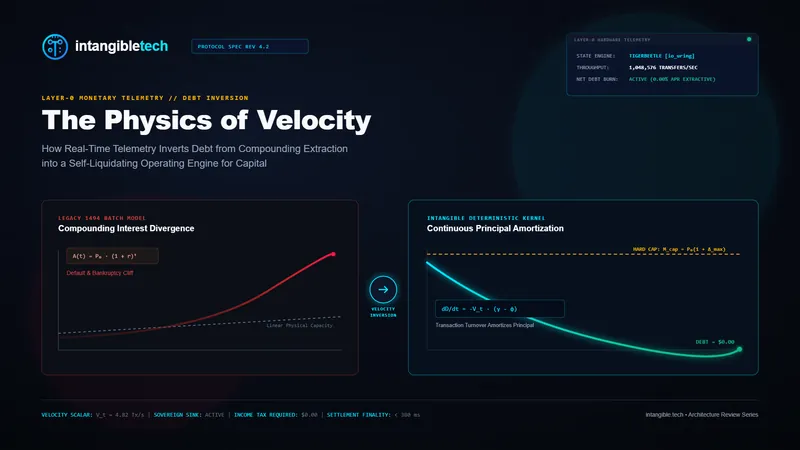
Non-compounding working capital & retooling credit facilities bounded by a hard Cumulative Dollar Cap (Mcap). Burned down to $0.00 automatically by continuous pool velocity (dD/dt = −γD × Vt) with faster turnover boosting investor IRR.
Primitive 1: Primary Reserve Cash (Account Type A & Account Type B)
Instead of holding money in disconnected commercial bank checking accounts that take three days to clear via ACH or SWIFT, the enterprise transacts in regulated, 1:1 reserve-backed digital cash (such as commercial bank stablecoins USD:Chase, USD:Citi, or sovereign reserves) split across a Dual-Account Monetary Topology:
- Account Type A (Liquid Velocity Checking): Used for instant, sub-second payroll, supplier settlement, and customer checkout. Balances up to a statutory operational exemption floor (Efloor—$100,000 for individual citizens, or 45 days of verified payroll and supplier OpEx for active businesses) experience 0.00% decay. However, idle excess cash hoarded above the exemption floor is subject to continuous Liquidity Decay (Demurrage, λ) evaluated lazily at the nanosecond of transfer, which sweeps dormant cash hoards into the public Citizen Dividend pool.
- Account Type B (Long-Horizon Productive Vault): Any citizen or corporation can escape Account Type A demurrage at any millisecond by sweeping surplus cash into Account Type B (Opcode 0x03). Inside Account Type B, decay is strictly zero (λB = 0), and capital earns steady, real productive yield because Account Type B deposits directly capitalize the nation’s high-impact industrial, infrastructure, and retooling credit pools.
Primitive 2: Velocity Entitlements (“The New Stock”)
Under our architecture, corporate stock is rescued from the secondary-market gambling casino and restored to operational reality:
- Rather than a detached paper ticker traded on the NYSE, a company’s stock is a direct, on-chain ownership stake (Sshare) in the enterprise’s primary Automated Market Maker settlement reserve.
- Whenever customers buy the company’s products, license its intellectual property, or pay for its services, those transactions do not bypass the shareholders—they settle directly through the company’s AMM pool.
- That commercial velocity (Vcorp) generates continuous protocol turnover fees (τpool). After deducting the company’s transparent operating overhead ratio (Δexec), the net cash yield streams directly into shareholders’ digital wallets in primary currency every single day.
- The Game-Changer: Investors and retirees never have to sell down their principal shares to buy groceries or fund retirement. Their principal remains 100% intact as a permanent productive anchor while they live off the daily velocity yield of real-world commerce. Even better, a CEO can no longer fake growth through debt-fueled share buybacks or mass layoffs—because firing skilled engineers immediately detaches their intangible multiplier from the balance sheet and shrinks daily yield distributions within twenty-four hours.
Primitive 3: Velocity-Amortized Bonds (“Credit-as-an-Asset”)
The third primitive replaces compounding bank loans, corporate junk bonds, 25% APR credit cards, and predatory Net-90 invoice factoring:
- When an enterprise borrows working capital, finances a new five-axis CNC machine via a Parametric Retooling Vault, or extends credit to a buyer, the ledger mints a restricted, non-speculative Accounts Receivable / Credit Bond (
AUTH_REQUIRED/ClaimableBalance). - This bond cannot be flipped by retail speculators on a crypto exchange. Instead, it sits inside the Automated Market Maker reserve pool with a hard, un-breachable Cumulative Dollar Cap (Mcap)—guaranteeing that total repayments can never compound into an infinite debt trap, regardless of how long repayment takes.
- As general commercial transactions (Vt) flow through the enterprise’s AMM pool, a pre-compiled micro-slice of that turnover continuously burns down the outstanding principal balance of the bond (dD/dt = −γD × Vt) until it hits zero and automatically extinguishes itself.
- The IRR Miracle: Because the total dollar payout is capped at Mcap, the bond has a velocity maturity rather than a rigid calendar maturity. When a factory upgrades its tooling and doubles its production velocity, the bond pays off in half the time—skyrocketing the investor’s annualized Internal Rate of Return (IRR) into the double digits while liberating the manufacturer from debt years ahead of schedule!
4. How the Ecosystem Branches Out: One Settlement, Three Systemic Cascades
Once you understand that every enterprise operates on this Three-Primitive AMM Triad (Cash, Velocity Stock, and Self-Amortizing Credit Bonds), look at what happens the moment a single customer payment or B2B invoice (Vk) clears through that pool.
In the legacy world, a payment is a dead, isolated event that sits in a bank clearing queue for two days before an accountant manually reconciles it at the end of the month.
In the Intangible Operating System, a single commercial checkout clearing through the AMM triad acts as an atomic trigger that branches out simultaneously across three real-time macroeconomic cascades:
One Commercial Checkout (Vk) → Three Simultaneous Cascades
- Opcode 0x01 Atomic Tax Split: Partitions τnat + τstate + τmuni (~1% total) directly to National, State & Municipal vaults—100% tax-cleared forever.
- ISI Rate Modulation: Adjusts borrowing rate (re) & tax discount via live ISI ∈ [0.000, 1.000].
- KST & Citizen Dividend (0x08): Updates real-time Kinetic Systemic Throughput and streams non-inflationary Citizen Dividends.
- Continuous Depreciation (dA/dt): TPM 2.0 hardware enclaves update physical book value A(t) and maintenance escrows in real time.
- Instant Tier-1 Supplier Paydown: Extinguishes Net-90 invoice factoring by settling upstream machine-shop payables atomically.
- Opcode 0x05 Grace Windows: Freezes debt accrual at 0.00% during verified factory retooling or family parental leave.
- Workforce Skill Appreciation: Compounds personal Intangible Human Capital (Ahuman / IN) and daily operating yield across the team.
- Apprentice & Educator Royalties: Enforces ISIsuccession ≥ 0.20 and streams lifelong upstream royalties to mentors & K–12 teachers.
- Double-Sided Patent Duplication: Streams simultaneous velocity royalties from licensed manufacturers with zero litigation friction.
Branch 1: The Public Civic & Macroeconomic Stabilization Cascade
- The Continuous Atomic Tax Engine (Opcode 0x01): At the exact microsecond the customer’s payment settles into the enterprise pool, the protocol automatically partitions a tiny, uniform basis-point split (τnat + τstate + τmuni, typically around 1% total across the broad $500T+ settlement base) directly into the sovereign hardware vaults of the National Treasury, the State Treasury, and the local Municipality. Every dollar that lands in a worker’s or merchant’s wallet is 100% tax-cleared forever, abolishing the entire April 15th IRS filing bureaucracy, offshore Cayman tax shelters, and Wall Street municipal bond extortion in a single stroke.
- Dynamic Credit & Tax Discounts via the Impact Score Index (ISI): The exact tax split (τ(ISIk)) and commercial borrowing rate (re) applied to that transaction are modulated automatically by the enterprise’s Impact Score Index (ISI ∈ [0.000, 1.000])—a tamper-proof composite of Product Durability (Ddurability), Workforce Vitality (Llabor), and Ecological Efficiency (Rregen). A company building twenty-five-year modular appliances and paying living wages unlocks 0.25%–0.50% borrowing costs and a 50% settlement tax discount, making high durability and ethical labor more profitable on Day One than planned obsolescence.
- The Master Parameter (KST) & Citizen Dividend (Opcode 0x08): The transaction’s verified volume, velocity turnover, speculative filter (σk), and social impact weight (ωk) feed directly into the nation’s real-time replacement for archaic GDP: Kinetic Systemic Throughput (KST). Surplus velocity fees and idle-hoard demurrage stream continuously out of the Sovereign Velocity Pool into every liveness-verified citizen’s wallet as a non-inflationary Universal Citizen Dividend.
Branch 2: The Physical Hardware & Supply-Chain Cascade
- Continuous Telemetry Depreciation (dA/dt): Legacy GAAP accounting allows tech giants and factories to stretch hardware depreciation across arbitrary five-year straight-line schedules on paper, hiding the reality that 24/7 AI GPU clusters running at 95°C degrade in eighteen months. On our ledger, physical machines and server racks equipped with Trusted Platform Modules (TPM 2.0) stream cryptographically signed runtime hours and thermal stress directly to the protocol. As the enterprise fulfills orders, its physical book value (A(t)) adjusts dynamically in real time while automatically funding a maintenance reserve escrow per operational cycle.
- Eradicating Net-90 Invoice Factoring: When the enterprise ships goods or receives raw materials from a Tier-1 machine shop, the small supplier never has to wait ninety days to get paid or sell its invoices to predatory factoring brokers at a 10% haircut. Verified delivery triggers instant primary liquidity from the AMM pool, while downstream retail checkouts automatically amortize the payable bond in the background.
- Retooling & Biological Grace Windows (Opcode 0x05): If the factory pauses production for five months to install clean robotics—or if a household pauses wage labor for pregnancy and infant bonding—hardware and medical enclaves activate Opcode 0x05, freezing debt amortization and interest accrual at 0.00% so neither the upgrading manufacturer nor the young family ever faces a technical default.
Branch 3: The Intangible Human Capital & IP Attribution Cascade
This third branch is the namesake of Intangible Technologies—making the invisible human and intellectual engines of civilization mathematically visible and liquid on the balance sheet:
- Workforce Provenance & The Death of the Layoff Incentive: Every engineer, nurse, machinist, and product manager whose Sovereign Digital Identity is attached to the product’s Capability Dependency Graph receives an automatic attribution flow that compounds their personal Intangible Human Capital Score (Ahuman / IN) and daily operating yield. Even preventative roles—such as a cybersecurity architect who prevents breaches or a disciplined product manager who prunes a bad $5M feature early—are rewarded via Loss-Mitigation and Pruning Multipliers, permanently making it unprofitable for AI or executives to discard human talent.
- Apprentice Succession Gates & Lifelong Educator Royalties: To qualify for prime-tier (0.25%–1.5%) capital, an enterprise must maintain an active Institutional Succession Index (ISIsuccession ≥ 0.20) by linking junior apprentices to senior mentors (
KNOWLEDGE_PARENT) on-chain. As those apprentices and students generate economic velocity throughout their adult careers, longitudinal attribution trees route fractional, non-dilutive royalties back to their senior mentors, their K–12 classroom teachers, and their youth athletic coaches. - Double-Sided Patent & Brand Duplication: Under legacy accounting, an idle patent locked in a corporate filing cabinet to block competitors is booked as an asset, while licensing it is a legal nightmare. On our ledger, an idle patent with zero commercial velocity has a balance-sheet value of $0.00. When an inventor licenses a patent or brand token to fifty manufacturers via Double-Sided Ledger Duplication, the intangible asset appears simultaneously on both the creator’s and the manufacturers’ balance sheets—streaming automatic daily velocity royalties from all fifty AMM pools back to the innovator with zero litigation friction.
5. How the Industry Must View Distributed Ledgers: Deterministic Physics Over Smart-Contract Casinos
For a Web3 founder or a traditional finance CTO reading this, a final technical question naturally arises:
“If this entire three-primitive operating system and its branching cascades run on distributed ledger technology, why hasn’t Ethereum, Solana, or Wall Street’s RWA chains built this already?”
Because the blockchain industry spent the last decade building general-purpose, Turing-complete virtual machines (like the EVM) designed to let anonymous developers upload arbitrary scripts, whereas a global financial operating system requires deterministic, pre-compiled state-machine physics.
When you allow arbitrary user-uploaded smart contracts on the base financial layer, you invite the Halting Problem and an infinite combinatorial attack surface—resulting in over $10 billion drained through reentrancy bugs, flash-loan oracle manipulations, and bridge exploits. No Fortune 500 CFO or sovereign treasury will ever put their core balance sheet on a virtual machine where a missing mutex lock in a Solidity script can vaporize their liquidity in twelve seconds.
Intangible Technologies works within the foundational paradigms of distributed ledgers, but applies them with strict systems-engineering discipline across a formal hardware-to-settlement stack:
- Zero Base-Layer Smart Contracts (8 Pre-Compiled Opcodes): We strip arbitrary Turing-complete smart contracts off the core monetary layer entirely. Just as a physical CPU executes fixed hardware instructions (
ADD,MUL) without letting a user program rewrite the silicon microcode, our accounting kernel executes all macroeconomic behaviors—atomic tax splits (0x01), lazy demurrage (0x02), vault locks (0x03), dynamic credit with hard Mcap ceilings (0x04), retooling/biological grace (0x05), telemetry updates (0x06), oracle bond slashing & revenue garnishment (0x07), and citizen dividend streaming (0x08)—exclusively through Eight Pre-Compiled, Formally Verified Financial Opcodes. - Bare-Metal Cache Sympathy (The 128-Byte TigerBeetle Kernel): Instead of bloated relational SQL tables or gas-auction virtual machines, every Account and Transfer is packed into an exact 128-byte binary struct that fits neatly into two 64-byte L1 CPU cache lines with static memory allocation at boot. A single pinned core processes vectorized batches at over 1,000,000 atomic financial state transitions per second with zero garbage-collection jitter.
- Federated Byzantine Finality & Native AMMs (Stellar Protocol Physics): For interbank multi-currency clearing, cross-border path payments, and native Automated Market Maker reserve pools, the architecture leverages the deterministic design philosophy of the Stellar Consensus Protocol (SCP)—achieving immediate two-to-five-second atomic finality without Proof-of-Work energy waste or Proof-of-Stake oligarchic capture.
- Sovereign Identity with Asymmetric Zero-Knowledge Privacy & Native Clawbacks: Every wallet is anchored to a 2-of-3 Biometric Hardware Enclave Quorum where existing retail banks (Chase, Wells Fargo, local credit unions) and card networks (Visa, Mastercard) evolve from predatory debt-trap operators into insured Cryptographic DevOps Guardians and 3-Second AI Fraud Interdictors. Individual citizens enjoy 100% zk-SNARK cryptographic privacy over their personal purchases, government treasuries operate in a 100% public glass box, and consensus-level Restitution & Clawback primitives reverse verified theft without hard-forking the network or harming innocent downstream merchants.
Stop Digitizing the Parchment. Start Governing the Flow.
For five hundred years, humanity accepted a tragic compromise at the heart of capitalism.
Because Luca Pacioli’s 1494 parchment ledger could only count static piles of gold and disconnected batch receipts, we built an economy that worshiped what it could easily count—compounding bank interest, quarterly cost-cutting, disposable plastic junk, and secondary stock tickers—while remaining completely blind to the things that actually keep civilization alive: the durability of our craft, the wisdom of our teachers, the vitality of our workforce, the stability of our families, and the health of our physical world.
Today, the proponents of Real-World Asset tokenization and tokenized equities ask us to take that exact same five-hundred-year-old blindfold, wrap it inside a cryptographic token, and call it progress.
We can do infinitely better.
When we stop asking how to drag legacy financial artifacts onto a blockchain, and instead use deterministic state machines, hardware enclaves, and Automated Market Makers to make real-time velocity and human capability the core primitives of the balance sheet, the war between Wall Street and Main Street ends:
- Corporate stock stops being a speculative lottery ticket and becomes a daily stream of honest cash flow from verified production.
- Debt stops being a compounding trap designed to bankrupt the borrower and becomes a self-amortizing asset retired by the kinetic energy of trade.
- And human beings stop being disposable operating expenses on a quarterly spreadsheet, taking their rightful place as the primary appreciating capital of the global economy.
The primitives are already built. The math is proven. It is time to stop tokenizing the past and start running the operating system of the future.