Recently, a post on Reddit’s r/corporate forum captured a quiet crisis that almost everyone in the modern workforce feels, yet almost nobody in a boardroom is willing to say out loud.
The author was an early-thirties professional who had just climbed into a mid-level corporate role at a global company generating several billion dollars a year in revenue. For the first time in their career, their position gave them direct visibility across the entire spectrum of the enterprise, from frontline workers at the bottom all the way up to Senior Vice Presidents and Executive Leadership at the top.
Instead of finding a master plan at the summit, they experienced psychological vertigo. Executive leadership was completely out of touch with the reality of how the work actually got done. Worse, the middle of the company was packed with layers of people trying to do the least amount of real work possible while manufacturing fake problems just to look busy.
“Maybe I’m just naive, but this seems so soul sucking I don’t know how people do it,” the employee wrote. “On paper I have such a good position, but I feel so exhausted after playing make believe 40 hours a week.”
In a moment of accidental poetry, directly underneath that raw confession sat a sponsored advertisement from enterprise software giant SAP: “Connect your business with one solution: where AI and data work end to end to help you grow faster…”
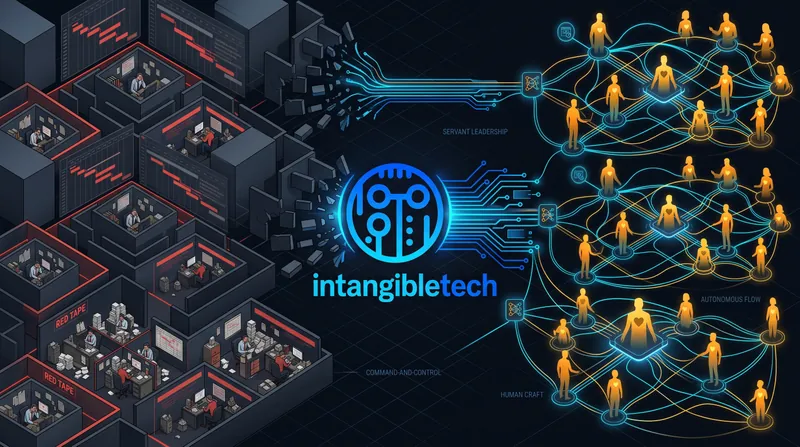
You could not stage a more honest portrait of modern capitalism. On one side sits a multi-billion-dollar software industry claiming our global economy is already seamlessly digitized, automated, and connected. On the other side sits the human reality: millions of smart, capable people staring at glowing screens at 9:00 PM, spiritually hollowed out from acting as human duct tape between broken processes and political fiefdoms.
We are approaching a civilizational tipping point. Workers across banking, accounting, consulting, technology, and operations are burning out at historic rates. At the exact same moment, the arrival of generative AI and the push toward 24/7 tokenized financial markets are accelerating the machine clock to nanosecond speed. People are terrified that a 24/7 economy combined with AI hyper-vigilance will erase the last remaining boundaries around their evenings, their marriages, and their sanity.
Under our current financial and information architecture, they are right to be terrified. If you bolt 24/7 market rails and high-speed AI onto a 1930s batch-accounting system, you do not get liberation. You get a faster treadmill.
What if the problem is not that our machines are moving too fast, but that our economic plumbing isn’t actually connected at all?
When we designed the blueprint for Intangible Technologies, we started from a radical premise: 24/7 infrastructure should never mean 24/7 humans. In fact, wiring the global economy into a truly continuous, self-verifying Layer-0 machine ledger is the only way to finally abolish performative busywork, dismantle corporate politics, and slow human work back down to a healthy biological pace of family and community life.
1. The “Digitized Paper” Lie and the Human API Trap
Ask an average executive or policymaker today, and they will tell you that the global economy is fully digitized. After all, everyone works on laptops, communicates on Slack or Teams, logs into cloud ERPs like SAP or Workday, and uses AI copilots.
As a systems architect, when I look under the hood of the global economy, I do not see a connected digital network. I see digitized paper.
Over the past forty years, we took 15th-century double-entry bookkeeping, paper invoices, quarterly audit binders, and hierarchical org charts, and we simply rendered them on glass screens. Company A keeps its financial truth locked inside its private ERP database. Company B keeps its truth locked inside a completely different database. Their banks, auditors, suppliers, and regulators all maintain their own separate, siloed ledgers.
None of these databases natively trust, verify, or settle state with one another in real time.
Because the machines cannot verify shared reality between organizations, human beings are forced to act as the biological API layer holding the global economy together.
Think about what white-collar professionals actually do for eighty percent of their week. They do not spend their days inventing better products, mentoring junior talent, or solving deep structural problems. They spend their days reconstructing the past across disconnected silos:
- Exporting CSV files from one database, scrubbing formatting errors in Excel, and uploading them into another system.
- Chasing down status updates across five departments to build a slide deck for a Vice President, who will summarize that deck into another deck for an SVP.
- Sitting in alignment meetings to argue over whose spreadsheet contains the real numbers.
- Pulling eighty-hour fire drills at the end of every month and quarter to manually reconcile cash flows, invoices, and compliance filings that drifted out of sync over the previous ninety days.
Now, inject generative AI into this broken architecture. Because the underlying ledgers still do not share a single cryptographic source of truth, AI does not eliminate the reconciliation trap. It multiplies it. One person can now use an LLM to generate a fifty-page strategy memo, ten thousand lines of unverified code, or a hundred compliance queries in thirty seconds, which ten other exhausted humans now have to read, verify, debug, and politically navigate.
We gave every participant in the corporate bazaar a megaphone, while still forcing human beings to carry the messages by hand between walled gardens.
Why "Digital" Is Not Connected: The Batch Dam vs. Laminar Flow
2. Inside the Up-or-Out Pyramid: Lessons from Ernst & Young and the Corporate C-Suite
This isn’t a theoretical problem for me. I lived inside the gears of this machine from both sides: first inside the Big Four accounting and advisory world at Ernst & Young (EY), and later in corporate product and technology leadership.
In a previous Codex monograph, we examined the economic distortion of the billable hour and why charging for audit and consulting time rather than verified utility penalizes efficiency. Looking back at my time at EY, however, the damage of that model went far deeper than pricing mechanics. It shaped the entire psychology of daily life.
When your firm sells hours and “deliverables” inside an opaque information market, the work quickly detaches from real-world impact. I remember working brutal, late-night stretches not because we were solving a life-or-death operational crisis for a client, but because we needed to produce visible output to justify our existence on the engagement. You formatted another hundred-slide deck, built another complex appendix, and turned minor revisions around at 11:00 PM simply to prove that the team was burning hours.
Worse, your entire life existed at the arbitrary whim of the Partner. Because the Partner controlled the client relationship, the billing narrative, and the internal performance ratings, reality was whatever the Partner said it was on a Tuesday afternoon. If a Partner changed their mind about how a framework should look at 4:30 PM on a Friday, an entire pyramid of managers, seniors, and associates cancelled their weekend plans with their families to rebuild the artifact from scratch. You couldn’t push back with objective data, because there was no objective scoreboard. The Up-or-Out pyramid required the bottom layers to absorb the chaos so the top layer could extract the margin.
When I transitioned out of advisory and into corporate product and engineering leadership, I hoped that building inside an enterprise would replace performative output with genuine product thinking.
Instead, I ran into the exact same wall described by that thirty-something employee on r/corporate.
I worked under senior executives who were so insulated by layers of middle-management theater that they had zero visibility into how our systems actually worked or where our customers were actually hurting. Whenever my teams tried to apply true product thinking (pruning dead features, fixing foundational architectural debt, or designing around real user workflows), we hit a political buzzsaw.
In a legacy corporation, middle managers do not get promoted by eliminating friction; they get promoted by growing their headcount and defending their budget turf. Solving a root technical problem cleanly in two weeks actually threatened the people whose careers depended on managing that problem for two years. Brilliant engineers and product builders were sidelined for telling inconvenient truths, while political operators who knew how to paint red metrics green on an executive steering-committee slide got promoted.
3. Deconstructing the “Dark Rules” of Corporate Survival
If you want to understand how deeply this dysfunction has poisoned the soul of the modern workforce, look at another viral thread circulating on r/DarkCorporate titled “The Dark Rules of Corporate Survival”.
The post opens with an indictment that millions of workers now accept as gospel: “The corporate world was never a meritocracy. Because competence is only one currency. And majority of the time, it’s the least valuable one.”
The author lists thirteen unwritten rules for surviving inside a modern company:
- Never confuse hard work with visibility: The person doing the work and the person getting credit for it are often two completely different people.
- Learn to manage egos and know when to remain silent: Being right means very little when you embarrass someone powerful. Some leaders ask for honesty because they value it; others ask because they want to know whether you are a threat.
- Control the narrative: A mediocre employee with excellent self-promotion becomes a rising star while a brilliant builder gets fired.
- Keep evidence, not expectations: Corporate memory becomes remarkably selective the moment promotions, bonuses, or accountability are on the table.
- Stop assuming incompetence gets punished: Incompetence with powerful political protection can survive for years, while competence without protection becomes the easiest scapegoat when something goes wrong.
- Recognize that loyalty is a one-way contract and develop the ability to walk away: Never sacrifice your life for an organization that will replace you with a spreadsheet entry, and build transferable leverage that corporate politics cannot take away.
The post ends with what it calls the darkest rule of all: “The person who deserves to win and the person who knows how to win are not always the same person.”
Why are these thirteen dark rules true in almost every major corporation, consulting firm, and bank on earth today?
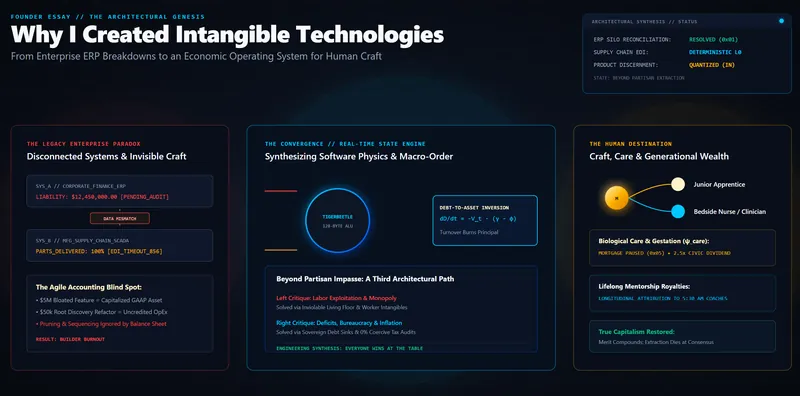
Most people blame human greed or bad leadership. As an architect, I look deeper: corporate politics is the direct mathematical byproduct of an attribution and truth vacuum.
Think about what legacy accounting can actually see. A traditional balance sheet and income statement can see aggregate revenue, aggregate payroll expense, and quarterly profit. It is completely blind to who actually created the value inside the building.
Because a legacy ERP cannot cryptographically verify which engineer prevented a catastrophic outage, which product manager pruned a wasteful workflow, or which senior machinist mentored four apprentices to cut factory defect rates in half, the system creates a vacuum. And in a truth vacuum, narrative replaces reality.
When the ledger is blind, the loud self-promoter who spends thirty hours a week managing upward perception beats the quiet master builder who spends forty hours fixing the engine. When the ledger has no permanent memory, a politically connected Partner or SVP can steal credit for a subordinate’s breakthrough in Q1 and blame that same subordinate for an executive failure in Q3.
How the Intangible Architecture Breaks the Dark Rules
To restore meritocracy and rebalance the Partner/Employee dynamic across every industry, you cannot rely on HR workshops or leadership slogans. You have to replace subjective corporate memory with cryptographic attribution:
- Ending Stolen Credit via Soulbound Provenance (Fixing Rules #4, #6, and #8): In the Intangible Architecture, every contributor operates through a hardware-attested Sovereign Digital Identity (SID). When an architect designs a software module, a consultant re-engineers a supply-chain node, or a veteran worker mentors an apprentice, that contribution is registered on the enterprise’s Directed Acyclic Graph (DAG) via
Opcode 0x08with Immutable Causal Lineage. A Partner or VP cannot strip a junior builder’s name off a slide deck and claim the credit in a boardroom. As downstream transactions flow through that builder’s work, the protocol automatically routes both verified reputation and microscopic velocity yield directly to the creator’s wallet. Corporate memory stops being “selective” at bonus time because the ledger pays out in real time. - Stripping Political Cover from Incompetence (Fixing Rules #1, #3, #5, and #12): Today, an incompetent executive with powerful sponsors can hide for years by sanitizing status reports and blaming frontline staff when things break. On our glass-box ledger, operational reality is streamed every 3 seconds via Confidential Oracle Coprocessors. If a politically favored leader mismanages a division, ignores engineering warnings, or drives away high-impact talent, the node’s Impact Score Index (ISI) drops automatically. That drop immediately widens the company’s borrowing spread on its credit pools. A CEO or board can no longer indulge favoritism, because protecting an incompetent friend carries an instant, visible interest-rate penalty on the balance sheet.
- Rebalancing the Partner Dynamic via Liquid Mobility Rights (Fixing Rules #7, #11, and #13): Why do junior bankers, Big Four auditors, and corporate employees tolerate abusive Partners and toxic VPs today? Because their hard-earned track record is trapped inside the firm’s private HR database. If you walk away, you often have to prove yourself all over again. Under our architecture, your verified defect-suppression history, mentorship lineage, and architectural provenance () live in your own sovereign wallet. If a Partner at an advisory firm acts like a tyrant or demands performative midnight busywork, the builders can walk out the door on Friday with 100% of their verified economic reputation intact, and immediately lower the cost of capital for whichever competing firm hires them on Monday. Suddenly, Partners have to compete to deserve their talent, rather than talent begging for a Partner’s protection.
4. The Core Paradox: How a 24/7 Machine Economy Slows Human Life Down
This brings us to the central mental inversion that sounds like a contradiction until you examine the engineering physics behind it: How does moving the global economy onto a 24/7, real-time machine ledger make human work slower, calmer, and shorter?
To understand why, look at how your own body works when you lie down for a nap on a quiet afternoon.
Inside your body, your autonomic nervous system, heart, lungs, and cellular metabolism operate 24/7 in continuous, real-time feedback loops. Your body does not wait until the end of a ninety-day quarter to audit your blood oxygen levels or reconcile your heart rate. If it did, you would die. Because your underlying biological infrastructure regulates state continuously and automatically every second in the background, your conscious mind is completely free from having to think about it. You can slow down, read a book, play with your dog, or sleep for eight hours precisely because the background system never stops running.
Our legacy economy built the exact opposite structure. We built a financial system that only reconciles in slow, clumsy batches: weekly status decks, monthly accounting closes, quarterly earnings calls, and annual tax audits.
In fluid dynamics, when you block a continuous river behind a series of batch dams, pressure and turbulence build up behind the wall. Inside a corporation, because nobody knows the exact, verified state of the business in real time during the quarter, anxiety festers. Executives compensate for their blindness by demanding constant performative availability: Why isn’t your Slack dot green? Update the tracker before 8:00 AM. We need a war room this weekend before the quarterly close. When the batch deadline finally arrives, the dam breaks and crushes the workforce underneath an eighty-hour crunch.
Mathematically, when an enterprise transitions from discrete quarterly batch reconciliation () to continuous 3.0-second laminar clearing (), the accumulated reconciliation backlog () and human middleware overhead collapse toward zero:
When you wire the economy into the Intangible Architecture, where every enterprise runs on a 3-Primitive balance sheet (Reserve Cash, Velocity Entitlements, and Credit Bonds) and settles state atomically every 3 seconds across a high-throughput Layer-0 state machine, you demolish the batch dam and replace it with laminar flow.
Nothing piles up for the end of the month. The books close themselves every three seconds. Statutory tax splits route themselves at the moment of checkout (Opcode 0x02). Corporate debt self-amortizes quietly in the background as products sell (Opcode 0x04). Confidential hardware enclaves broadcast live solvency and operational health to investors and regulators without a single human having to format a PowerPoint slide.
What Do White-Collar Workers Actually Do All Day When Busywork Dies?
Whenever I explain this to executives or burned-out corporate workers, the immediate follow-up question is always the same: “If the machine eliminates the 80% of our week spent reconciling spreadsheets and playing corporate make-believe, what do bankers, accountants, consultants, and IT managers actually do all day?”
When the infrastructure takes over reconstructing the past, human work shifts entirely to simulating, tuning, and governing the future. You do not need eighty hours of frantic endurance to govern the future; you need thirty hours of calm, well-rested discernment.
Here is how daily life transforms across four industries currently drowning in burnout:
1. Accounting & Audit (The Evolution of the Big Four)
- The Old Grind: Associates and managers spend their lives acting as exhausted historians, pulling midnight shifts during busy season to match ninety-day-old PDF invoices against bank statements and chasing client controllers for missing spreadsheets.
- The New Craft (Hydraulic Valve & Edge Engineers): As we explore in When the Paperwork Dies: Elevating Finance & Consulting, when the ledger reconciles every transaction atomically in 3 seconds, the historical month-end close ceases to exist. Auditors and accountants step out of the spreadsheet mines and become real-time financial control engineers. Half of their craft shifts to the physical-to-digital edge: inspecting and calibrating the factory IoT sensors, inventory scanners, and confidential hardware enclaves to ensure the physical data entering the glass box cannot be spoofed. The other half shifts to tuning the balance sheet’s hydraulic valves during normal daylight hours, modeling questions like: “If we adjust our automated checkout split to route 1.2% more cash velocity into preventive machinery maintenance this month, how much does that suppress our defect rate and lower our borrowing spread next quarter?”
2. Investment Banking & Private Capital
- The Old Grind: Twenty-four-year-old analysts lose their health and relationships pulling 100-hour weeks as human formatting machines: scraping messy virtual data rooms, rebuilding broken Excel models at 2:00 AM because a Managing Director wanted to tweak a margin assumption by fifty basis points, and aligning logos on pitchbooks.
- The New Craft (Structural Simulation Architects): When every enterprise’s cash velocity, supply-chain dependencies, and debt burn are already live and cryptographically verified on the ledger, the “data room” is permanently open. Bankers never build a historical pitchbook again. Instead, they work calm, focused days running counterfactual simulations on the live economic graph: “If Manufacturer A acquires Robotics Firm B, how does that integration accelerate throughput across their 400 shared downstream suppliers, and what custom velocity-repayment curve best matches their physical production cycle?” Even more importantly, because no computer can measure whether two human leadership teams truly trust each other, bankers step away from their monitors and return to face-to-face human due diligence.
3. Management Consulting
- The Old Grind: Consultants spend the first seventy percent of a six-month engagement playing corporate detective: begging reluctant client VPs for data exports, interviewing middle managers who are hiding their own inefficiencies, and building a 150-slide deck just to diagnose where the company is bleeding money.
- The New Craft (Operational Surgeons): Our 3-second glass-box ledger acts like a continuous hospital MRI. It shows instantly which supply-chain handoff is choking, which software pipeline is throwing errors, or which division is losing senior talent. Consultants walk in on Day 1 with the diagnosis already complete. Instead of spending nights building political slide decks to justify a billable hour, they spend a clean daytime schedule acting like skilled surgeons alongside the frontline team: redesigning a physical warehouse floor, untangling a clumsy customer workflow, or building internal apprenticeship pipelines that raise the client’s Impact Score Index.
4. Corporate Product & Managerial IT
- The Old Grind: Product managers and IT leaders live as midnight firefighters and political referees: patching brittle API glue between forty SaaS vendors, sitting on blame-game bridge calls when an overnight batch sync fails, and fighting out-of-touch executives to get basic engineering hygiene approved.
- The New Craft (Sovereign Systems & Discernment Architects): When identity, state, and settlement run on deterministic protocol rails, the brittle SaaS glue disappears. IT and product leaders spend their days designing hardened hardware enclaves, orchestrating internal AI agents within strict cryptographic guardrails, and practicing genuine product discernment: pruning low-value complexity, sequencing high-impact breakthroughs, and talking directly with customers. Because system telemetry is visible from the frontline to the C-suite in real time, product teams never have to spend three weeks building a political case to fix a broken bridge. The ledger proves the bridge is broken automatically.
5. Retiring Henry Ford’s 1926 Baseline
It is worth pausing on a historical milestone that almost everyone has missed this year.
In 1926, exactly one hundred years ago, Henry Ford standardized the five-day, 40-hour workweek across his automotive factories. That schedule was not handed down on stone tablets. It was engineered specifically for the rhythm of a 20th-century mechanical assembly line, where human beings stood at fixed stations bolting physical parts onto a moving chassis.
Why, in 2026, are knowledge workers, engineers, analysts, and managers still measuring human worth by sitting at a desk for forty to eighty hours a week pretending to bolt invisible widgets onto digital spreadsheets?
For the last fifty years, every wave of enterprise technology promised to give us our time back, and every single one broke its promise. Mainframes, personal computers, email, cloud ERPs, post-COVID remote work, and now generative AI did not shorten the workweek. Because they were layered on top of a blind, batch-reconciled accounting system, they simply dissolved the boundary between the office and the living room. When a corporation cannot measure the true durability and quality of what you build, it falls back on measuring performative suffering: how fast you reply on Slack at 9:30 PM, how many meetings are on your calendar, and how willingly you sacrifice your family dinners for a Partner’s arbitrary deadline.
We do not need another productivity app that helps us type faster inside a broken cage. We need a new economic baseline.
When the underlying operating system of the economy measures real outcomes (defect suppression, supply-chain velocity, architectural longevity, and the human mentorship you pass down to the next generation), hours in a chair become completely obsolete as a metric.
In a studio of craftspeople backed by a 24/7 self-verifying ledger, ambition is finally decoupled from self-destruction:
- A sharp, well-rested product architect who works twenty-eight deeply focused hours a week, makes three brilliant structural decisions that eliminate a systemic bottleneck, and leaves at 3:30 PM to coach their kid’s soccer team or train for a race is recognized by the ledger as infinitely more valuable than a burned-out VP sitting in sixty hours of status theater.
- Senior leaders and Partners are liberated from acting as whip-crackers over a pyramid of sleep-deprived juniors, returning to their rightful role as master craftspeople and mentors.
- Hourly and frontline workers in hospitals, factories, and logistics hubs stop being squeezed as the easiest variable cost whenever a quarterly earnings target gets tight, because rushing workers and spiking defect rates immediately penalizes the company’s cost of capital.
For half a century, we built machines that forced human beings to think, stress, and react like computers.
The entire purpose of the Intangible Architecture is to finish the job of connecting the machine economy so that human beings can finally step out of the gears. We are building a financial system that settles at the speed of light so that people can finally return to living, thinking, building, and loving at the speed of life.
And for the millions of quiet builders currently trapped in the dark rules of corporate survival, that changes everything: when the ledger can finally see the truth of human craft, the person who deserves to win and the person who wins become the exact same person.