Sometimes a single screenshot captures the entire pathology of an era better than a thousand-page economic study.
Recently, a thirty-something corporate professional posted a desperate question on Reddit’s r/corporate forum titled, “Is this really corporate everywhere?” They described reaching a position in a multi-billion-dollar global company where they could finally see from the frontline workers all the way up to the Senior Vice Presidents. What they saw horrified them: leadership was completely disconnected from how the work actually got done, middle layers were inventing fake problems just to look busy, and the author felt spiritually hollowed out after “playing make believe 40 hours a week”.
Directly beneath that raw human cry for help, the Reddit algorithm placed an official sponsored advertisement from enterprise software titan SAP:
“Connect your business with one solution: where AI and data work end to end to help you grow faster and stronger. Bring it with SAP GROW.”
Look at the cognitive dissonance of that image.
Over the last twenty years, global corporations have spent trillions of dollars buying exactly what that advertisement promises: monolithic Enterprise Resource Planning (ERP) suites, Customer Relationship Management (CRM) clouds, human capital platforms, workflow trackers, and now enterprise AI wrappers. Every single time a Chief Information Officer signs a $50 million contract with SAP, Salesforce, Oracle, Workday, or ServiceNow, and hires a Big Four consulting army like EY, Deloitte, or Accenture for another $100 million to implement it, the board of directors is promised the same nirvana: end-to-end connection, effortless automation, and liberated employees.
Yet when you walk onto the floor of any major bank, hospital network, manufacturer, or global corporation five years after a “digital transformation,” what do you actually see?
You see employees drowning in twenty-seven open browser tabs. You see product managers and accountants exporting CSVs out of the $50 million ERP because the system is too rigid to handle real-world operations, doing the actual math in local Excel spreadsheets, and manually typing the numbers back into a different cloud portal at 10:00 PM. You see smart people burning out from fighting the very software that was supposed to save them.
Why does enterprise software almost always make human work more bureaucratic, more fragmented, and more exhausting?
We usually blame bad software design or botched implementations. As someone who has sat on both sides of the table, first inside the Big Four advisory machine at Ernst & Young and later as an enterprise product and systems executive, I can tell you the truth is much darker and much simpler:
Legacy enterprise software doesn’t fail to simplify your business by accident. It fails because the entire SaaS and consulting business model would go bankrupt if your business actually became simple.
To rescue human workers from digital bureaucracy and give companies tools that actually work, we have to confront the perverse incentives of the enterprise tech complex, and execute three mental inversions that flip the value of software upside down.
1. The Dirty Secret of the “Per-Seat” and “Billable-Hour” Complex
Whenever a system consistently produces the exact opposite of what it promises on its marketing billboards, stop listening to the marketing and follow the money.
How do the two pillars of modern enterprise technology, the SaaS software vendor and the global systems integrator (GSI), actually generate revenue?
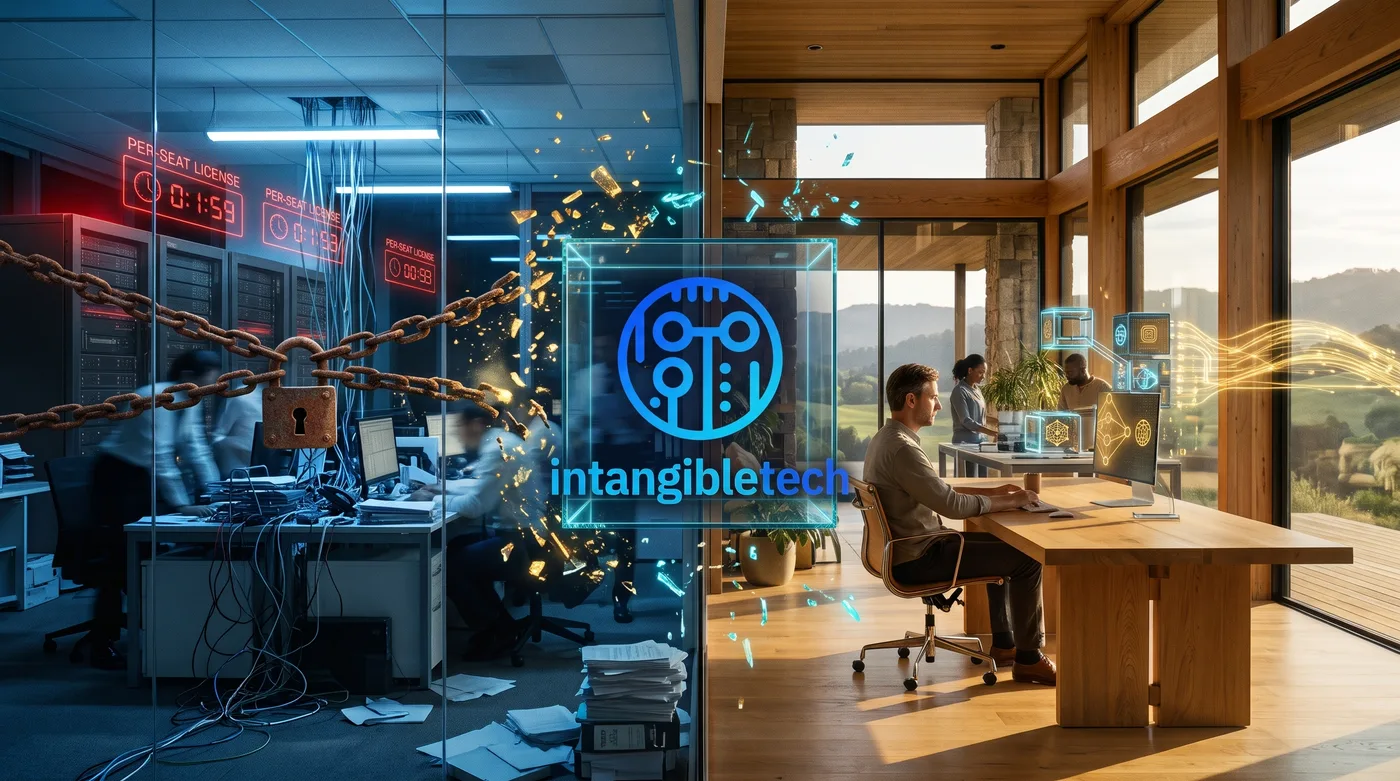
- The SaaS Vendor prices by the “Seat” (and by database bloat): Whether you are buying CRM licenses, ERP access, or project-management tools, the fundamental unit of enterprise SaaS pricing is the monthly active user seat. Now ask yourself an uncomfortable math question: What happens to a SaaS vendor’s recurring revenue if their software is so genuinely efficient that a calm team of 15 people can run an operation that previously required 150 stressed people? The software vendor loses 90% of its seat revenue. Under per-seat pricing, software vendors are financially penalized when their product reduces organizational headcount or eliminates middle-management coordination layers. Their Wall Street net-dollar-retention metric literally depends on your company adding more seats, more logins, and more middlemen clicking buttons inside their walled garden.
- The Consulting Partner bills by the “Hour” (and by complexity): Enterprise software rarely works out of the box. It is sold as a sprawling, labyrinthine toolkit that requires armies of certified consultants from firms like EY, Deloitte, PwC, or Accenture to configure, customize, and patch together. Because those firms bill by the hour, a clean, modular software architecture that snaps together in an afternoon is a financial disaster for a consulting Partner. A brittle, over-engineered monolith that takes three years and four hundred consultants to customize, and requires permanent maintenance contracts forever after, is a goldmine.
Look at those two incentives side by side, and the mystery of the r/corporate post vanishes.
Workers feel like they are trapped playing 40-hour-a-week make-believe inside bloated, convoluted software workflows because the vendors who built the software and the consultants who installed it are paid in direct proportion to how many seats and hours the workflow consumes!
The Enterprise Software Conflict of Interest: Why Your Tools Want You Bloated
2. The Hostage Economics of Vendor Lock-In
If legacy enterprise software is so clunky, expensive, and exhausting for the people who actually use it every day, why don’t companies simply fire their software vendor and switch to something better?
Because of the most lucrative hostage mechanism ever invented in modern capitalism: state-level vendor lock-in.
When you sign up for a legacy ERP, CRM, or cloud data platform, the vendor doesn’t just provide you with an interface screen and some business logic. They swallow your company’s state (your customer histories, your general ledger transactions, your supply-chain dependencies, your employee records, and your workflow permissions) and lock that state inside their proprietary, labyrinthine database schema.
Over five or ten years, your entire organization wraps its muscle memory and custom scripts around that vendor’s proprietary data tables.
Once your company’s memory is trapped inside their silo, the power dynamic flips completely:
- The Switching-Cost Moat: If a CEO or CIO wants to leave an abusive ERP vendor, they discover that migrating ten years of historical state out of Proprietary Schema A and mapping it into Proprietary Schema B will cost $80 million, take thirty-six months, and risk paralyzing the company’s billing and supply chain.
- Ransom Pricing & Innovation Death: Because the vendor knows you cannot leave without blowing up your business, they no longer have to care about your frontline employees’ sanity. They can hike annual license fees by 12% every renewal cycle, leave glaring UX bugs unfixed for a decade, and force your workers to buy expensive “AI add-on seats” just to search their own data, the exact enshittification dynamic that plagues consumer platforms.
- The Human Cost at the Keyboard: On the ground, frontline workers pay the price for this hostage standoff with their lives. Nurses spend more time clicking through nineteen mandatory screens in a locked-in hospital electronic health record (EHR) than looking their patients in the eye. Engineers spend more time updating status tickets across three disconnected trackers than writing code. Salespeople and operations leads spend their evenings manually re-keying orders between a CRM and an ERP that refuse to talk to each other natively.
We call this “enterprise software.” In reality, it is digital feudalism, where corporations pay permanent tribute to software landlords while their own employees act as the serfs carrying buckets of data between castles.
3. Three Mental Inversions That Flip the Value of Software
At Intangible Technologies, we realized you cannot fix corporate burnout or build a real-time economy as long as a company’s state is held hostage inside per-seat SaaS silos.
To break the chains of vendor lock-in and make software serve human beings again, our architecture introduces three foundational mental inversions:
Mental Inversion #1: Decouple Sovereign State from Software Interfaces (Ending Vendor Lock-In Forever)
Why should the company that designs your user interface also own the hostage keys to your database?
Think about how the open web or email protocols work. If you don’t like your web browser or your email client today, you can download a new one in thirty seconds. You don’t have to pay a consulting firm $20 million to migrate the internet, because the underlying protocol state (HTTP / SMTP / IMAP) is standardized and completely decoupled from the application interface.
Why doesn’t enterprise software work the exact same way?
In the Intangible Architecture, your enterprise state never belongs to a software vendor. Every transaction, inventory handoff, customer entitlement, credit bond, and employee provenance record is represented as a standardized, flat 128-byte state vector on our Layer-0 state machine (with private proprietary payloads locked inside your own sovereign hardware enclaves).
Because the data model is universal and protocol-native:
- Software Becomes a Disposable Lens, Not a Prison: An ERP, a CRM, or a supply-chain dashboard is reduced to what it always should have been: a lightweight, stateless View and Logic Container that reads and writes to your sovereign state vector via standardized cryptographic hooks.
- 30-Second Zero-Migration Switching: If your accounting team or warehouse floor hates their current software interface, or if a vendor tries to jack up prices, you don’t need a three-year data migration project. You simply revoke that container’s enclave key at 2:00 PM and spin up a competing open-source container at 2:01 PM. The new software reads the exact same live 128-byte state stream instantly, with zero data loss, zero CSV exports, and zero consulting ransom.
Ask yourself: How differently would software vendors treat your employees on Monday morning if they knew you could fire their software in thirty seconds on Monday afternoon with zero switching cost?
Mental Inversion #2: Flip Software Pricing from “Per-Seat Bloat” to “Velocity & Entropy Reduction”
Once you strip away vendor lock-in, how do software developers and enterprise toolmakers get paid?
If you want software that actually gives humans their time back, you have to forbid pricing models that profit from human seat count or implementation hours.
On the Intangible ledger, enterprise software containers and Confidential Oracle Coprocessors are compensated through Protocol-Native Velocity Royalties (Opcode 0x08) rather than per-seat licensing:
- Instead of charging a company $150 per month for every employee forced to log into a bloated portal (), a software creator publishes a verified, containerized module (for example, an automated logistics routing engine or a one-click clinical charting interface) onto the network’s Dependency DAG.
- When an enterprise attaches that container to its operational node, the protocol measures the container’s real-world impact every 3 seconds: Did this software measurably accelerate transaction velocity (), suppress operational defect rates, and reduce human cycle time ()?
- As long as the software actively lowers entropy and speeds up clean commercial flow, the protocol automatically routes a microscopic basis-point royalty () from the enterprise’s Automated Market Maker (AMM) turnover directly to the software developer’s wallet.
Notice how this completely inverts the psychology of software design:
- Under legacy SaaS, a developer makes more money by designing sticky, bureaucratic dashboards that force 500 people across six departments to log in and click “Approve” all day.
- Under the Intangible Architecture, a developer makes the maximum possible royalty by designing a tool so quiet, fast, and invisible that nobody has to click a button at all, letting the physical work flow effortlessly while the humans focus on their craft.
Mental Inversion #3: From Monolithic ERP Mandates to Frontline Ergonomic Freedom
Think about why big corporate software rollouts crush morale on the front lines.
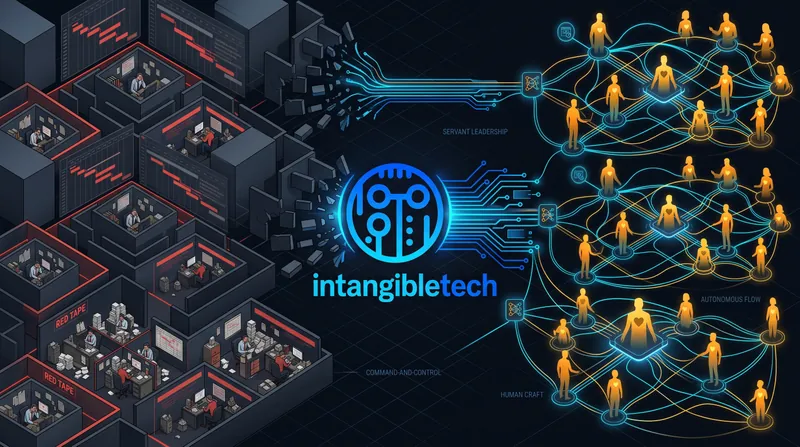
In the legacy world, a CIO and a committee of VPs, who never actually use the software themselves, buy a single monolithic suite and force every department in the company (engineering, sales, warehouse logistics, finance, legal) to jam their unique daily craft into the exact same clumsy interface. Why? Because the CIO needs “one source of truth,” and in the legacy world, the only way to get one source of truth is to force everyone into one vendor’s database.
When the 128-byte Layer-0 state machine serves as the universal, cryptographic source of truth underneath the company, the C-suite never has to dictate which screen the frontline worker uses again.
- The warehouse floor can use an ultra-fast, voice-and-scanner container built specifically for physical ergonomics.
- The engineering team can interact with the exact same enterprise state directly from their terminal or IDE.
- The finance and leadership team can inspect live 3-second balance-sheet telemetry through a high-level simulation canvas.
Every team gets tools tailored to the natural rhythm of their human craft (or even community-lifted native interfaces), while every action settles atomically to the exact same glass-box ledger underneath. You get 100% unified truth at the boardroom level with 0% monolithic tyranny at the human level.
4. Reclaiming the Promise of the Computer
When pioneers like Douglas Engelbart and Steve Jobs first imagined personal and enterprise computing, they called the computer a “bicycle for the mind.”
A bicycle is a masterpiece of human-centric engineering. It does not trap you inside a cage, charge you by the pedal stroke, or force you to fill out a compliance form every hundred yards. It takes a natural human motion and multiplies its grace, speed, and reach with almost zero friction.
Somewhere over the last thirty years, enterprise software stopped building bicycles for the mind and started building digital tollbooths. We allowed a trillion-dollar software and consulting cartel to convince corporate leadership that “digital transformation” meant locking our company memory inside their private clouds, paying them rent for every human seat in the building, and turning our brightest workers into full-time data-entry clerks servicing the machine.
It is time to call that bargain what it is: a failed experiment that is burning out the global workforce while strangling real productivity.
By separating sovereign state from software interfaces, eradicating vendor lock-in at the protocol layer, and paying software builders only when their code makes human life simpler and faster, the Intangible Architecture restores technology to its rightful place:
- Your company owns its memory forever; no software vendor can ever hold your data hostage again.
- Integration consultants and manual CSV reconciliations vanish, because every business reads and writes to the same cryptographic grammar.
- Software finally makes money by getting out of your way, letting people finish their work in calm, focused hours and go home to their lives.
The next time you see an enterprise software ad promising to “connect your business end to end” while your teams are working late into the night fighting their own screens, ask the executives and builders around you three questions:
- If your software vendor makes money by the seat and your consultant makes money by the hour, who in that room actually gets paid when your employees’ lives become simpler?
- Do you actually own your company’s digital infrastructure, or are you just paying annual ransom to a database landlord because the cost of leaving is too high?
- What happens to human creativity at work when we finally fire every piece of software that requires a human being to act like a machine?