Issuer-Pays Conflicts & 90-Day Filings
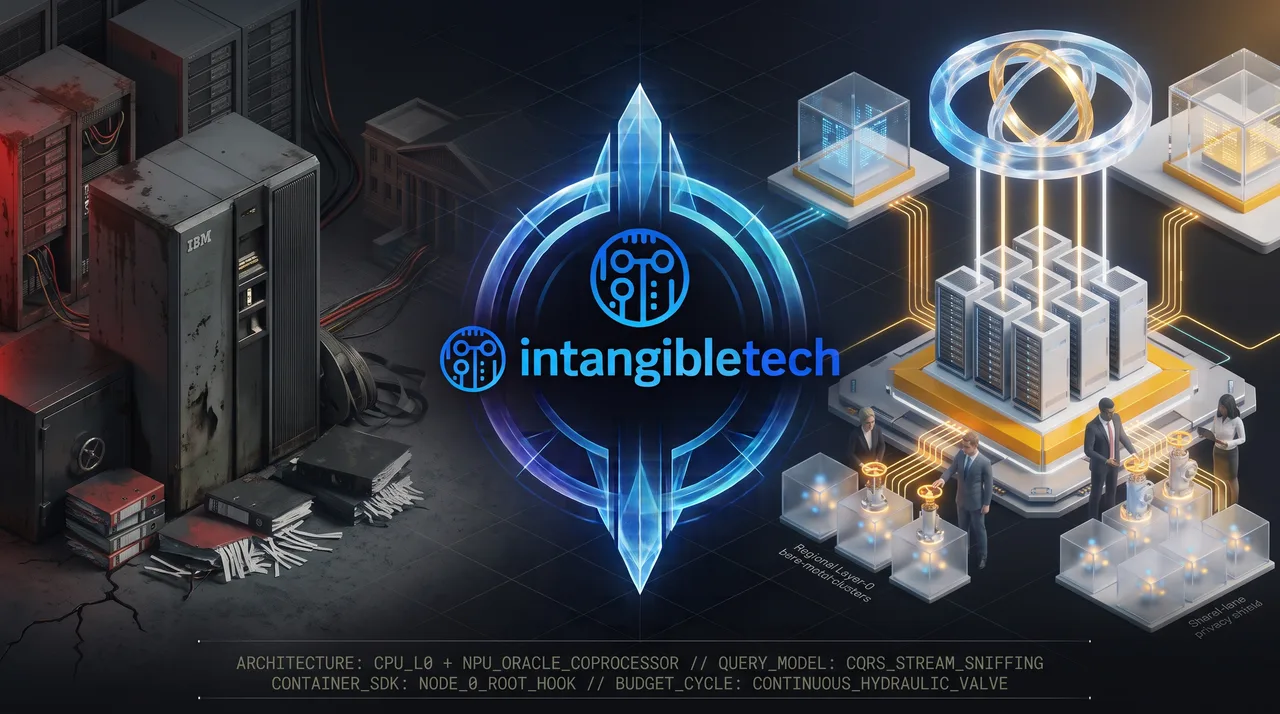
Credit rating agencies and regulators existed because manual auditing took months. However, Moody’s and S&P operate on a conflicted "Issuer-Pays" model using secret proprietary formulas (causing the 2008 AAA subprime crash), while the SEC relies on 90-day delayed quarterly filings (10-Q/10-K) that only catch corporate fraud years after investors are wiped out.
Public Code Over Secret Committees
Stop trusting paid human committees hiding behind closed doors. Financial risk, ecological impact, and regulatory compliance must be calculated continuously by 100% open-source, publicly auditable code running inside hardware-encrypted confidential enclaves.
Containerized NPU Oracles on GitHub + TEEs
Oracles operate as dedicated NPU Coprocessors alongside the Layer-0 CPU. Hosted publicly on GitHub and executed inside hardware Trusted Execution Environments (TEEs), they ingest live telemetry to update enterprise Impact Score Index (ISI) credit ratings in real time—with zero conflict of interest, staked surety bonds (Opcode 0x07), and continuous royalties (Opcode 0x08) for open-source contributors.
Q4 Waste & $100M+ ERP Consulting Failures
Annual corporate budgets and monolithic ERPs (SAP, Oracle) existed because CFOs could only see consolidated financials 30 to 45 days after month-end close. This latency forces companies into annual political rationing, triggers Q4 "use-it-or-lose-it" spending waste, hides bad product management inside multi-year CapEx buckets, and traps firms in $100M+ Big-Bang ERP consulting failures.
From Annual Rationing to Live Liquidity Valves
When money settles in sub-milliseconds on a streaming ledger, annual budgets become obsolete. An enterprise should allocate capital dynamically like a hydraulic grid—opening liquidity valves for high-velocity teams and throttling drag in real time.
Strangler-Fig Data Stacks & Pruning Equity
Existing enterprise data teams (using Kafka, Databricks, dbt, and Atlan) "sniff" the live Layer-0 commit firehose via CQRS without querying the settlement core. CFOs control arterial liquidity spigots while VPs and PMs manage branch and capillary valves—making the Three Invisible Product Disciplines (Pruning, Sequencing, and Cadence) mathematically legible on the balance sheet.
Dead OpEx Trapped Behind Firewalls
When an industrial giant or bank spends $50 million building internal risk or telemetry software, that code sits trapped behind its corporate firewall as a dead Operating Expense (OpEx), while every competitor wastes billions hiring legacy systems integrators to reinvent the exact same wheel.
Turn Operational Know-How Into Yielding IP
Give the foundational macroeconomic equations away for free, and let the market race to containerize industry-specific intelligence. Operational know-how should not be a sunk IT cost—it should be a yield-bearing open-source asset.
The Oracle Gold Rush via the Node 0 SDK
By importing the open-source Intangible Root SDK, legacy incumbents (with deep domain wisdom) and agile startups (with modern engineering speed) race to publish the definitive Oracle container for their sector—earning automatic upstream commercial IP royalties on every industry transaction while routing global base velocity through Node 0.
In our foundational breakdown of Layer-0: The Bare-Metal Monetary Kernel, we established how Intangible Technologies achieves 1,000,000 to 4,000,000 transactions per second per CPU core: by stripping away arbitrary smart contracts and relational database locks, pinning fixed 128-byte Account and Instruction structs directly into the CPU’s 32-kilobyte L1 cache via Linux io_uring kernel bypass, and anchoring global state roots every three seconds to the Stellar Layer-1 Consensus Grid.
When seasoned systems architects, Chief Financial Officers, and Chief Data Officers examine that bare-metal speed, their very next question goes straight to the heart of real-world complexity:
“If Layer-0 achieves 1,000,000+ TPS strictly because it only executes flat, fixed-size 128-byte arithmetic without loops or disk scans, how does the system calculate complex, multi-dimensional realities? Who calculates continuous physical wear on a factory CNC machine? Who traverses a 500-node human-capital dependency graph to pay upstream royalties to teachers and engineers? And how does a bank or enterprise query its historical data if the Layer-0 CPU refuses to run SQL search queries?”
The answer is the second pillar of our Tri-Tier Systems Architecture: The Confidential Oracle Coprocessor Pipeline.
Just as a modern smartphone or AI server System-on-Chip (SoC) pairs a blazing-fast sequential CPU with a dedicated NPU (Neural Processing Unit) to crunch heavy matrix and graph math in parallel without slowing down the main processor, the Intangible Financial Architecture pairs Layer-0 (the sequential monetary CPU) with Containerized Oracle Coprocessors (the dedicated economic NPUs).
And here is the realization that changes everything for modern enterprises, startups, and governments: the technology required to build and query these Oracle Coprocessors is not futuristic sci-fi. It is the exact streaming data stack—Apache Kafka, Databricks, Snowflake, dbt, Atlan, and Docker containers—that thousands of modern data and product teams are already using every single day.
By connecting that modern data stack to a live Layer-0 monetary firehose through our open-source Root Protocol SDK (Node 0), we don’t just replace broken credit rating agencies like Moody’s and S&P. We abolish the annual corporate budget cycle, make Agile product management mathematically visible on the balance sheet, allow enterprises to strangle and retire legacy ERPs without $100 million consulting disasters, and ignite the ultimate modern-day Oracle Gold Rush.
Here is the complete architectural blueprint of how it works.
1. Who and What Are the Oracles? (The “Economic NPU” & The End of Black-Box Rating Agencies)
In the cryptocurrency world, the word “Oracle” has been reduced to a fragile gimmick—usually a script that scrapes a centralized stock-price API and pastes the number into a vulnerable smart contract.
In the Intangible Financial Architecture, an Oracle Coprocessor is a high-trust institutional or domain-specific compute engine that translates noisy, high-frequency real-world reality into flat, cryptographically verified 128-byte state updates for Layer-0.
Why Layer-0 Needs an NPU Coprocessor (And Why Oracles Never Touch Stellar Layer-1)
To preserve nanosecond L1 cache hits, a Layer-0 execution core cannot pause settlement to ingest 60 Hz vibration telemetry from ten thousand commercial jet engines, nor can it chase memory pointers across a 50-tier supply-chain graph.
Instead, Oracle Coprocessors sit off-chain as dedicated mathematical coprocessors bolted directly to Layer-0:
- Zero Monetary Custody: An Oracle Coprocessor holds $0.00 of customer funds. It cannot print money, hold deposits, or alter balances.
- 10,000-to-1 Compression Into Layer-0: The Oracle Coprocessor ingests tens of thousands of raw IoT sensor pings, payroll streams, or clinical outcomes off-chain, executes the continuous calculus inside a hardware-encrypted enclave, and submits a single, flat 128-byte
Opcode 0x06(UPDATE_ISI_TELEMETRY) instruction to Layer-0. Because 10,000 raw events are compressed into a single periodic 128-byte packet, Oracle write-backs consume less than 0.5% of Layer-0’s 1,000,000+ TPS capacity. - Strict Layer-0 Boundary (Never Touching Stellar Layer-1 Directly): Oracles never write custom logic to the Stellar Layer-1 blockchain. Oracles write strictly to Layer-0 via pre-compiled opcodes (
0x06and0x08). Layer-0 then executes the balance-sheet state transitions in sub-milliseconds and commits the unified cryptographic Merkle state root (StateRoot) and macroeconomic velocity scalars (KST) to Stellar Layer-1 every 3 seconds as the ultimate global anchor of truth.
The Tri-Tier "Mobile SoC" Handoff: Oracle NPU → Layer-0 CPU → Stellar L1 Bus
Separating heavy off-chain telemetry calculus (NPU) from nanosecond 128-byte cash execution (CPU) and 3-second global state finality (System Bus).
Hardware-Encrypted Enclaves
Ingests 60 Hz TPM 2.0 sensor streams, enterprise dbt/Databricks pipelines, and multi-tier DAG knowledge graphs. Compresses 10,000+ raw events into a single zk-SNARK receipt (πzk) + flat 128-byte Opcode 0x06 packet via the Intangible Root SDK (Node 0 Anchor).
Custody: $0.00 • Load on L0: <0.5% TPS
Regional 128-Byte State Machine
Verifies the 16-byte zk_proof_commitment on Cores 1–96 in 1ms, updates the target entity's isi_score_fixed (Bytes 96..97) and depreciation (dA/dt) on Cores 97–128 in 1ns, and broadcasts the finalized state out of the Zero-Copy CQRS Commit Firehose.
Custody: 100% Spendable Cash • 1M–4M TPS/Core
Immutable Global Notary
Receives the 3-second aggregated StateRoot and KST macroeconomic heartbeat exclusively from Layer-0 quorums (Qa ∩ Qb ≠ ∅). Never touched directly by Oracles or retail users.
Role: Global Notary & Cross-Region Switchboard
Private & Public Oracle Examples: Rebuilding Institutional Trust from a Blank Slate
Who actually operates these Oracle Coprocessors across the economy? Both evolved private-sector giants and modernized public-sector agencies—operating across a blank slate of real-time data points that were previously impossible to capture:
- Replacing Moody’s, S&P, and Fitch (Transparent, Auditable Credit Scoring):
- Why did Moody’s and S&P trigger the 2008 global financial crisis by stamping “AAA” ratings on toxic subprime mortgage bonds? First, because of the “Issuer-Pays” conflict of interest (the banks packaging the toxic debt paid Moody’s consulting fees). Second, because their rating methodologies were opaque, lagging behind closed doors.
- On Layer-0, creditworthiness is governed by an enterprise’s live Impact Score Index (ISI ∈ [0.000, 1.000]), which directly sets its commercial borrowing rate (re) between 0.25% Prime and 12% Subprime. The Oracle containers that calculate ISI are 100% open-source on GitHub, paid automatically out of neutral protocol velocity (τpool) rather than by the rated company, and backed by multi-million-dollar staked Account Type B Surety Bonds that are automatically slashed via
Opcode 0x07if cross-sensor auditing catches a lie. Every investor on Earth can inspect the exact lines of code generating a company’s credit score in real time.
- The U.S. Securities and Exchange Commission (SEC) — From 90-Day Post-Mortems to Live Systemic Defense:
- Today, the SEC regulates a sub-second algorithmic market using 1930s tools: waiting 45 to 90 days for corporations to file quarterly 10-Q PDFs, and spending five years investigating Enron, WorldCom, Madoff, or FTX after retail investors have already lost their life savings.
- Operating as a sovereign regulatory Oracle sniffing the
Public_GlassBoxLayer-0 stream, the SEC gains a real-time systemic dashboard. Without ever touching private citizen data (ZK_Citizen), the SEC’s Oracle container continuously verifies corporate reserve solvency, flags wash-trading or circular revenue loops across AMM pools in milliseconds, and automatically halts unauthorized leverage breaches (Cgov) before a bubble can form.
- Environmental, Grid & Ecological Oracles (Replacing Subjective ESG Theater):
- Instead of subjective ESG rating agencies grading companies on glossy sustainability PDFs and phantom carbon offsets, municipal utility nodes and independent environmental auditors run Oracle containers wired directly to TPM 2.0 smart meters on electrical substations, municipal water intakes, and agricultural soil probes. They measure exact kilowatt-hours per unit of output, closed-loop material recycling rates, and topsoil carbon sequestration—rewarding genuinely clean manufacturers with a high Ecological Pillar score (Rregen) that automatically slashes their Layer-0 borrowing costs and settlement taxes.
- Additional High-Impact Oracle Domains Previously Impossible to Measure:
- FDA & Post-Market Clinical Efficacy Oracles: Today, pharmaceutical companies run short clinical trials and then profit for decades selling daily symptom-management pills. By sniffing anonymized, Zero-Knowledge clinical outcome streams from hospital nodes, a biomedical Oracle quantifies Permanent Disease Eradication Yield—streaming massive
Opcode 0x08payouts to labs whose therapies permanently cure chronic conditions and reduce downstream hospital readmissions. - FAA Aerospace, Maritime & Commercial Logistics Safety Oracles: Instead of relying on falsifiable paper maintenance logs for commercial airliners, cargo ships, or trucking fleets, consortium Oracles (co-signed by the OEM, Underwriters Laboratories / TÜV SÜD, and Lloyd’s of London insurers) ingest signed hardware engine-cycle and brake-wear telemetry—updating physical asset depreciation (dA/dt) on the carrier’s balance sheet every hour.
- Department of Labor & Trade Guild Apprenticeship Oracles: Verifies active mentorship pairings (
KNOWLEDGE_PARENT) between senior master machinists/engineers and junior apprentices via live payroll and skill-certification trees, preventing corporations from firing junior talent pipelines for short-term AI margin boosts.
- FDA & Post-Market Clinical Efficacy Oracles: Today, pharmaceutical companies run short clinical trials and then profit for decades selling daily symptom-management pills. By sniffing anonymized, Zero-Knowledge clinical outcome streams from hospital nodes, a biomedical Oracle quantifies Permanent Disease Eradication Yield—streaming massive
2. How Oracles Connect Without Querying: CQRS & “Sniffing the Firehose”
Here is a critical technical distinction that separates Layer-0 from every legacy database and blockchain in existence:
Neither Oracles, nor banks, nor corporate ERP apps ever send analytical search queries (SELECT * WHERE...) to the Layer-0 Monetary Kernel.
Why? Because Layer-0 achieves 1,000,000 to 4,000,000 operations per second per core specifically by keeping all active 128-byte Account State Vectors (St) pinned inside the CPU’s tiny 32-kilobyte L1 cache (~1 nanosecond access time). If an Oracle or mobile banking app asked the Layer-0 CPU to scan six months of historical transactions to calculate a rolling 90-day expense average, the CPU would have to pause payment processing, fetch gigabytes of cold data from disk, and flush the hot 128-byte structs out of L1 cache.
Instead, the architecture enforces pure Command Query Responsibility Segregation (CQRS) paired with Zero-Copy Change Data Capture (CDC):
1. The Outbound Layer-0 Commit Firehose
Layer-0 does one thing: it validates and executes 128-byte state transitions (Opcodes 0x01–0x08) in L1 cache and writes the consensus-verified batches (up to 8,192 instructions per batch) to its append-only NVMe journal via io_uring.
At the exact microsecond a batch is finalized by the Viewstamped Replication (VSR) quorum, the network interface card simultaneously broadcasts that signed, immutable batch out of a read-only multicast pub/sub firehose (directly into enterprise event-streaming brokers like Apache Kafka, Redpanda, or AWS Kinesis). Emitting this outbound stream consumes 0.0% additional compute from the Layer-0 accounting cores.
2. “Sniffing the Stream” to Build Granular Read-Databases
Oracles, Commercial Bank DevOps Guardians, and enterprise data teams simply subscribe (“sniff”) to the segments of that live firehose they are authorized to read, and pipe those events into their own high-performance analytical read-databases:
- How Banks Power Modern Mobile Apps: When you open your Chase, Citi, or local Credit Union app on your smartphone to search past coffee receipts, view monthly spending pie charts, or export statements, your phone is never querying Layer-0. Your Bank DevOps Guardian is sniffing the Layer-0 commit firehose in real time, indexing your transactions inside its own cloud read-replicas (ClickHouse, PostgreSQL, Elasticsearch), and serving your mobile UI in milliseconds—while when you tap “Send $50,” the write instruction fires straight into the bare-metal Layer-0 kernel.
- How Modern Data Teams Already Know How to Build This: Ask any Data Engineer or Analytics Engineer at a modern company what their daily stack looks like. They are already ingesting event streams via Kafka/Flink, landing them in Databricks or Snowflake, transforming business logic into clean metrics using dbt (data build tool) Semantic Layers, and governing data lineage and access via Atlan or Unity Catalog.
- Zero New Languages to Learn: Intangible Technologies abstracts the bare-metal C/Zig state-machine complexity completely away. To build a world-class Oracle Coprocessor or enterprise control plane, a company’s existing data team doesn’t have to learn Solidity or esoteric cryptography—they simply point their existing Kafka + Databricks + dbt + Atlan pipeline at the Layer-0 firehose and call our lightweight Root Protocol SDK to emit the resulting 128-byte state update!
The CQRS Stream-Sniffing & Root SDK Write-Back Loop
Layer-0 never pauses for SQL search queries—broadcasting finalized 8,192-tx batches out of a multicast firehose and receiving flat 128-byte SDK updates.
- ClickHouse / Postgres Replicas: Indexes customer streams off-chain in real time.
- Consumer & Commercial UX: Powers mobile app receipt search, spending analytics, and instant statements without touching L0.
- Databricks / Snowflake + dbt + Atlan: Transforms live cash flows into governed semantic metrics.
- Hydraulic Control Plane: Drives live squad Operating Spreads (Ωsquad) and Strangler-Fig micro-apps replacing legacy ERPs.
- AWS Nitro / AMD SEV / TPM 2.0 Enclaves: Executes public GitHub containers on encrypted telemetry.
- 4. Root SDK 128-Byte Write-Back (↑): Packages ISI, dA/dt, πzk + mandatory
node_0_genesis_anchorinto flatOpcode 0x06 / 0x08packets back to Layer-0.
3. Abolishing the Annual Budget: The Hydraulic Enterprise & The Three Invisible Product Disciplines
Now trace what happens inside a corporation or government agency when its data team wires this live Layer-0 settlement stream into its operational control plane.
It immediately kills the single most destructive bureaucratic ritual in modern business: the Annual Planning and Budgeting Cycle.
Why the Annual Budget Existed—and Why It Destroys Value
Why do Fortune 500 enterprises spend four months every autumn locked in political warfare to set static 12-month departmental budgets?
Because of accounting latency. In a legacy enterprise running on SAP or Oracle ERPs, the Chief Financial Officer is flying blind—waiting 30 to 45 days after the end of each month or quarter for batch reconciliations to see where cash actually went and whether a product line is profitable. Because Finance cannot steer the ship in real time, it rations capital once a year into rigid departmental buckets (CapEx and OpEx cost centers).
Look at the perverse incentives that annual rationing creates:
- The Q4 “Use-It-Or-Lose-It” Burn: If a brilliant VP of Product realizes in October that a planned $5 million software initiative isn’t delivering customer value and shuts it down early—saving the company $3.5 million—how does legacy accounting reward that VP? It punishes them. Finance confiscates the unspent $3.5 million and permanently slashes that VP’s budget baseline for next year. Consequently, rational managers spend November and December frantically burning leftover budget on bloated agency retainers, unnecessary cloud capacity, and zombie features just to protect their turf.
- Camouflage for Value-Destroying Projects: Because funding is locked in for 12 to 36 months, pet executive projects with zero real-world adoption can burn tens of millions of dollars in the dark before a post-mortem ever occurs.
The Inversion: The CFO at the Helm of a Fractal Hydraulic Grid
When Account Type A operates as a live, sub-second settlement stream and the enterprise data team sniffs that firehose down to the individual microservice, factory line, and product squad, corporate finance transforms from annual political rationing into continuous hydraulic valve control.
For a 300,000-person enterprise, the CFO does not micromanage 300,000 tiny knobs. Because the protocol’s mathematical equations—velocity (Vt), defect/entropy drag (δ), and Operating Spread (Ω)—are fractal (scale-invariant), the enterprise operates like a biological vascular system:
- The CFO Controls the Arterial Spigots: At the top of the house, the CFO sets the macro liquidity envelopes and risk thresholds across the 5 to 10 major business units, routing excess idle cash into Account Type B productive vaults so the treasury never suffers demurrage (λ) decay.
- VPs and Directors Control the Branch Valves: Business-unit leaders pipe those arterial streams into regional operations and product portfolios, governed by live telemetry circuit breakers.
- Product Managers and Lead Engineers Control the Capillary Valves: At the front line, every cross-functional product squad operates exactly like a modern, nimble startup with a live cash-flow gauge—seeing in real time every dollar of customer revenue or downstream internal utility flowing across their code, against every dollar of cloud compute and payroll drag they consume.
Making the Three Invisible Product Disciplines Mathematically Legible
In a legacy ERP, a salesperson who closes a bad contract is celebrated as a revenue hero on Day 1, while a great Product Manager or Systems Architect is mathematically invisible—booked as flat SG&A / R&D Overhead.
By piping the Layer-0 stream through the enterprise’s semantic layer (dbt + Atlan), the system finally quantifies and capitalizes The Three Invisible Disciplines of Great Product Management:
Quantifying the Three Invisible Product Disciplines (Pruning, Sequencing & Cadence)
Opcode 0x08): Every microservice, semantic data model, and API is registered as a parent node on the internal Capability Dependency Graph. When a downstream customer checkout fires, a proportional share of velocity (ωk) routes automatically back to the upstream platform teams who sequenced the foundation properly.4. Strangling Legacy ERPs & Reinventing Government Around Product-First Principles
How Enterprises Retire SAP and Oracle Without a $100M “Big-Bang” Failure
Walk into any Fortune 500 boardroom and mention migrating off a legacy ERP (SAP S/4HANA, Oracle Financials, Workday), and executives wince. Why? Because traditional ERP transformations require hiring armies of $400/hour systems-integrator consultants (Accenture, Deloitte, PwC) for five years at a cost of $100 million to $500 million—and according to Gartner and McKinsey industry studies, over 70% of large-scale ERP transformations fail to deliver their promised ROI or suffer catastrophic operational disruptions.
Why do they fail? Because enterprises try to execute a “Big-Bang Rip-and-Replace”—attempting to customize a rigid, proprietary 1990s batch database to fit modern, real-time workflows.
With Layer-0 and the streaming Oracle Coprocessor model, enterprises execute a Zero-Downtime “Strangler-Fig” Modernization using the open-source tools their own developers already love:
- Day 1 — Leave the Legacy ERP Untouched as a Dumb Compliance Sink: You do not rip out SAP on Day 1, and you fire the $400/hour ERP consultants. You leave SAP sitting in the basement strictly to print legacy year-end tax PDFs during the transition.
- Month 1 — Wire the Existing Data Stack to the Firehose: Your existing Data Engineers and Analytics Engineers point their Kafka, Databricks/Snowflake, dbt, and Atlan pipelines at the live transaction and telemetry streams, standing up the real-time hydraulic metrics (live depreciation dA/dt, team Operating Spreads Ω, and DAG attribution) in weeks rather than years.
- Month 3 — Full-Stack Product Teams Build Modular Micro-Apps: Because the clean, governed data now sits inside an open semantic layer with standard REST/GraphQL and Model Context Protocol (MCP) interfaces, your internal full-stack engineers (using React, TypeScript, Python, and AI coding assistants) build sleek, custom workflow apps for inventory routing, dynamic supplier factoring, and sprint hydraulic valve control in days.
- The Organic Retirement: Vine by vine, the modern streaming apps strangle the legacy ERP. Within 18 to 24 months, 100% of live operational decisions, supplier settlements, and payroll streams are running on Layer-0 and the internal data coprocessor—allowing the company to simply unplug the legacy ERP mainframe and save tens of millions in annual SaaS and ERP licensing extortion.
Reinventing Government Around “Product-First” Citizen Outcomes
Now apply this exact same inversion to federal, state, and municipal governments.
Why does government software and public administration feel broken? Because government agencies operate on 18th-century annual appropriations and process compliance rather than Product-First Outcomes:
- Congress or a City Council appropriates $500 million for a program (say, homeless services, workforce retraining, or road maintenance).
- Because the agency cannot measure real-time citizen outcomes, success is measured by “Did we spend the $500 million before the fiscal year ended, and did we fill out the compliance paperwork?”
- Worse, agencies pay legacy government contractors billions of dollars for custom, closed-source software that is obsolete the day it launches.
When government agencies plug into Layer-0 (Public_GlassBox mode) and deploy open-source Civic Oracle Containers, public administration is reborn around Product-First Principles:
- Live Outcome Telemetry Instead of Paperwork: A Department of Transportation or Municipal Public Works agency doesn’t wait five years to survey bridge safety; its Oracle container ingests structural strain-gauge telemetry and automated municipal fleet accelerometer data (mapping road potholes in real time) to release parametric maintenance escrows (
Opcode 0x04) to repair crews the day a road degrades. - Funding Tied to Verified Citizen Flourishing: A state workforce-development or public-health program is no longer funded by a blind annual block grant. Using Zero-Knowledge outcome proofs (
zk-SNARKsthat protect individual citizen identity while proving aggregate economic outcomes), the agency’s hydraulic funding valve scales automatically in proportion to verified Longitudinal Wage Mobility and Hospital Readmission Reductions. - Shareable Open-Source Civic Containers: If the City of Indianapolis builds a brilliant open-source Oracle container on GitHub that optimizes municipal water-main pressure and reduces leak loss by 30%, the City of Columbus or Newark doesn’t have to pay a contractor $20 million to build it from scratch. They
git cloneIndianapolis’s verified container in five minutes—and every time Columbus runs it, a fractional public-to-public royalty (Opcode 0x08) streams back to reward the Indianapolis civic engineering team!
5. Technical Deep Dive: GitHub Containers, Confidential Enclaves & Streaming Pull-Request Royalties
Let us look under the hood at how an Oracle Coprocessor container is packaged, how it guarantees both 100% public code transparency and 100% trade-secret data privacy, and how every open-source contributor on GitHub gets paid automatically by Layer-0.
1. Solving the Transparency vs. Trade-Secret Paradox (GitHub + Hardware Enclaves)
Suppose an industrial consortium or a startup builds the definitive Oracle Coprocessor container that calculates the Impact Score Index (ISI) and real-time physical depreciation (dA/dt) for semiconductor fabrication plants.
Immediately, two requirements seem to clash:
- Requirement A (Public Accountability): Every investor, bank, and regulator demands that the exact scoring formula be 100% public and open-source on GitHub so nobody can secretly rig a competitor’s credit score (the old Moody’s trap).
- Requirement B (Corporate Privacy): Taiwan Semiconductor or Intel will never allow their proprietary wafer yields, thermal recipes, or customer batch volumes to be exposed in plaintext to competitors.
How do we achieve 100% public code and 100% private data simultaneously?
By combining Reproducible Open-Source GitHub Containers with Hardware Confidential Computing Enclaves (AWS Nitro Enclaves, Azure Confidential Computing, AMD SEV-SNP, or bare-metal TPM 2.0 TEEs):
- Public GitHub Repository: The complete source code, Dockerfile, and mathematical weights of the Oracle container live in a public GitHub repository. Anyone in the world can audit the code line by line.
- Cryptographic Hardware Measurement (
PCR0–PCR7): When the Oracle operator boots that container inside a hardware Confidential Enclave, the physical CPU silicon computes a cryptographic SHA-512 hash of the exact binary loaded into memory (the Platform Configuration Register hash,enclave_pcr_hash). - Hardware-Encrypted RAM + Zero-Knowledge Output: Raw factory telemetry streams into the enclave over an encrypted TLS tunnel. Because the enclave’s RAM is encrypted at the silicon hardware layer, not even the Oracle company’s own root system administrators or cloud host can read the raw data inside memory. The enclave executes the public GitHub code, verifies the result matches the
enclave_pcr_hashregistered on Layer-0, generates a 200-byte zk-SNARK receipt (πzk), and sends only the flat 128-byteOpcode 0x06scalar update (isi_score_fixed = 9420) out to Layer-0!
2. The Intangible Root SDK & The 128-Byte Handoff Schema
How does a developer actually wire a container into Layer-0? By importing the lightweight, open-source Intangible Root SDK (import { Layer0Client, Opcode06Packet } from '@intangible/root-sdk').
To register an Oracle container on the ledger, the SDK enforces an immutable Container Registration Manifest that hardcodes Node 0 (SID:Intangible_Root) as the foundational root parent of the module (root_protocol_parent = Node_0), binds the operator’s staked Surety Bond vault (Account Type B), and locks in the container’s GitHub commit dependency tree.
Every time that Oracle container emits a state update to Layer-0, the SDK formats the output into our standard 128-Byte Instruction Wire Envelope (It):
- Bytes
16..31(source_account_id): The Oracle Coprocessor’s verified Sovereign ID. - Bytes
32..47(target_account_id): The audited enterprise or municipal node’s Sovereign ID. - Bytes
48..63(amount_or_telemetry): Packed binary scalars containing the updated 16-bitisi_score_fixed, 16-bitpsi_multiplier_fixed(ψk), and 64-bit real-time depreciation delta (dA/dt). - Bytes
64..79(dag_parent_or_escrow): Pointer to the container’s GitHub Commit Dependency DAG (KNOWLEDGE_PARENT). - Bytes
80..95(node_0_genesis_anchor): The mandatory 16-byte cryptographic hash ofNode 0, without which the Layer-0 CPU core drops the packet in 1 nanosecond. - Byte
110(opcode_id): Set to0x06(UPDATE_ISI_TELEMETRY). - Bytes
112..127(zk_proof_commitment): The 16-byte digest of the zk-SNARK receipt (πzk) and hardwareenclave_pcr_hashverified in 1 millisecond by Layer-0’s parallel front-end cores (Cores 1–96).
3. How GitHub Pull Requests Automatically Stream Royalties to Developers Worldwide
Here is where open-source software development changes forever.
Today, thousands of brilliant open-source engineers maintain critical Linux, cryptography, and data libraries on GitHub for free while trillion-dollar corporations capture 100% of the commercial value—leading to maintainer burnout (like the infamous xz or Log4j crises).
When an Oracle Coprocessor container is registered on Layer-0, its GitHub Commit Graph is bound directly to the Layer-0 Capability Dependency DAG (Opcode 0x08):
- Initial Creator Royalty: Suppose a company or startup creates the
Semiconductor-ISI-Oraclecontainer and sets a market-driven commercial IP fee of 50 basis points (0.5%) of the net interest savings or velocity gains (ΔV) unlocked for factories using that Oracle. - The Global Pull-Request Cascade: Six months later, an independent data scientist in Warsaw or a systems engineer in Austin forks that public GitHub repository, discovers a way to optimize the Flink streaming window to cut compute latency by 40% or improve sensor anomaly detection, and submits a Pull Request (PR).
- Automated Shapley Attribution: When the repository maintainers (or the sector consortium) merge that Pull Request and sign the new container release (
enclave_pcr_hash_v2), the contributor’s Sovereign Digital Identity (SID) attached to their Git signature is automatically appended as a child node on the container’s Dependency DAG (KNOWLEDGE_PARENT)! - Daily Cash Yield Per Commit: Every single time a semiconductor factory anywhere on Earth runs a settlement or credit update through
v2of that Oracle container, Layer-0’sOpcode 0x08automatically splits the container’s royalty stream—routing the baseNode 0skim (0.001 bps) to the protocol root, routing the core share to the original container creators, and streaming continuous, daily sovereign currency (USD/EUR) directly into the wallet of the developer whose Pull Request improved the code!
The GitHub Pull-Request to Layer-0 Opcode 0x08 Royalty Waterfall
Trigger Event: Semiconductor Factory clears $10M retooling credit tranche using Semiconductor-ISI-Oracle:v2.4 (saving $400k in interest via high ISI).
Node 0 Protocol Root
Receives the immutable base genesis skim (0.001 bps) + upstream Root SDK parent residual on every execution.
Foundational Container Author
Incumbent or startup that published v1.0 and staked the Account Type B Surety Bond receives primary commercial module royalties.
Merged Pull Request Builders
Global developers (PR #104, PR #219) whose merged commits reduced enclave compute drag or improved zk-SNARK accuracy receive daily Layer-0 USD automatically.
6. The Ultimate Modern-Day Gold Rush: Incumbents vs. Startups (And Why We Give the Math Away for Free)
Step back and look at the macroeconomic game theory this architecture unleashes across every industry on Earth.
People sometimes ask me: “Daniel, if you spent years deriving the 15 macroeconomic equations—the continuous depreciation integral (dA/dt), the Three-Pillar Impact Score Index (ISI), Kinetic Systemic Throughput (KST), and the non-compounding Cumulative Dollar Cap (Mcap)—why are you publishing all of the math openly on your website for free instead of locking it behind patents and charging consulting fees?”
The answer is simple: You cannot ignite a global Gold Rush by hiding the map.
In the history of computing, whenever an architect tried to hoard the foundational math behind a paywall, the standard died in obscurity. When you publish the conservation laws and the 15 equations openly to the public domain while providing the open-source Node 0 Root SDK as the universal wall socket, you create an unstoppable prisoners’ dilemma across every sector of the global economy: Free Physics, Metered Wall Socket.
1. The Enterprise Opportunity: Turning Sunk IT Costs Into Perpetual IP Revenue
Consider a 100-year-old industrial incumbent—a Caterpillar in heavy machinery, a Siemens in industrial automation, a John Deere in agriculture, or a JPMorgan in commercial credit.
Over the last century, these giants have accumulated priceless institutional domain knowledge: they know down to the micron how a turbine blade wears under thermal stress, how soil moisture affects crop yields, and where global supply chains snap.
Yet under legacy accounting, all of the software they built to track that knowledge sits trapped inside their private corporate firewalls as a dead Operating Expense (OpEx).
The moment Layer-0 opens up to containerized Oracle Coprocessors, that incumbent faces a generational opportunity: if they take our free equations, package their century of institutional domain knowledge into the definitive open-source Oracle container for their industry, and publish it first, they transform their business model overnight.
Not only do they slash their own internal ERP and borrowing costs down to 0.4%–1.5% prime capital, but every competitor, supplier, and financing vault across their entire global industry that adopts their verified Oracle container to clear Layer-0 credit automatically streams a perpetual commercial IP royalty straight to the incumbent’s balance sheet!
2. The Startup Counter-Punch: Speed, Modern Data Stacks & Symbiotic Collaboration
Now look at the other side of the starting line: the hungry three-person startup.
- Legacy giants have deep domain knowledge, but they move slowly, bogged down by committees and legacy habits.
- Startups have blistering execution speed, native mastery of modern streaming tools (Kafka, Rust, dbt, zero-knowledge provers), and zero legacy bureaucracy—yet they lack the decades of day-to-day physical domain data and institutional surety capital that incumbents possess.
Look at what happens when both realize the clock is ticking:
- The Race to Establish the Sector Standard: In every vertical—commercial trucking, hospital surgical outcomes, commercial HVAC durability, municipal water utilities, semiconductor lithography, collegiate athletics—a fierce sprint erupts to publish the
v1.0canonical Oracle container on GitHub first and capture the root commercial node (Tier 1) of that industry’s attribution tree. - Unison Through Open-Source Iteration: Even better, incumbents and startups do not have to destroy each other in winner-take-all warfare. Because every Oracle container is open-source and governed by our Shapley Pull-Request Royalty Waterfall (
Opcode 0x08), a legacy manufacturing giant can publish the foundational domain telemetry rules (v1.0) and stake the $10 million Account Type B Surety Bond, while nimble AI and data startups submit high-speed Pull Requests (v1.1,v1.2,v2.0) that optimize the streaming pipelines and zk-SNARK circuits—allowing the incumbent and the startups to share the global royalty stream automatically in exact mathematical proportion to the value each contributed! - Why Agile Finally Becomes a True Competitive Weapon: For twenty years, “Agile” inside large corporations was mostly theater—teams doing daily standups while still trapped inside rigid 12-month waterfall budgets and quarterly earnings manipulation. In the Oracle Gold Rush, true Agile iteration is the only way to survive and capture yield. Every two-week sprint that prunes dead code, sequences cleaner data lineage, or merges a sharper telemetry pull request immediately expands the team’s live hydraulic liquidity valve and compounds their global royalty share.
The Equations Are Open. The Starting Gun Has Fired.
Look at the complete picture of how the three tiers of our architecture lock together:
- Stellar Layer-1 sits at the top as the immutable global Supreme Court—anchoring 3-second state roots and cross-border atomic finality so no nation, bank, or corporation can ever counterfeit money or cook the books.
- Intangible Layer-0 (
Node 0) sits at the bare-metal core—moving 100% of tangible, spendable cash across fixed 128-byte structs in L1 CPU cache at 1,000,000 to 4,000,000 TPS per core, while broadcasting a zero-copy commit firehose to the world. - The Confidential Oracle Coprocessors sit on that firehose as the economy’s distributed NPU—where modern data teams, product managers, startups, and public agencies use the exact streaming tools they already know to replace opaque rating agencies, strangle legacy ERPs, replace annual budgets with live hydraulic valves, and earn perpetual royalties for coding operational truth.
We are not asking enterprises to gamble $100 million on another failed ten-year software migration, and we are not asking developers to buy a speculative crypto token.
We have published the mathematical physics of a human-aligned, real-time economy openly for the entire world to use. The Node 0 wire schema is set. The race to build the Oracles of the new economy begins now.