The Three Commodity & Custody Inversions
How physical hydrocarbons, global reserve bullion, and custodial exchanges transition from artificial scarcity and black-box ledgers to hardware-attested Layer-0 velocity.
Paper Futures Casinos & Artificial Throttling
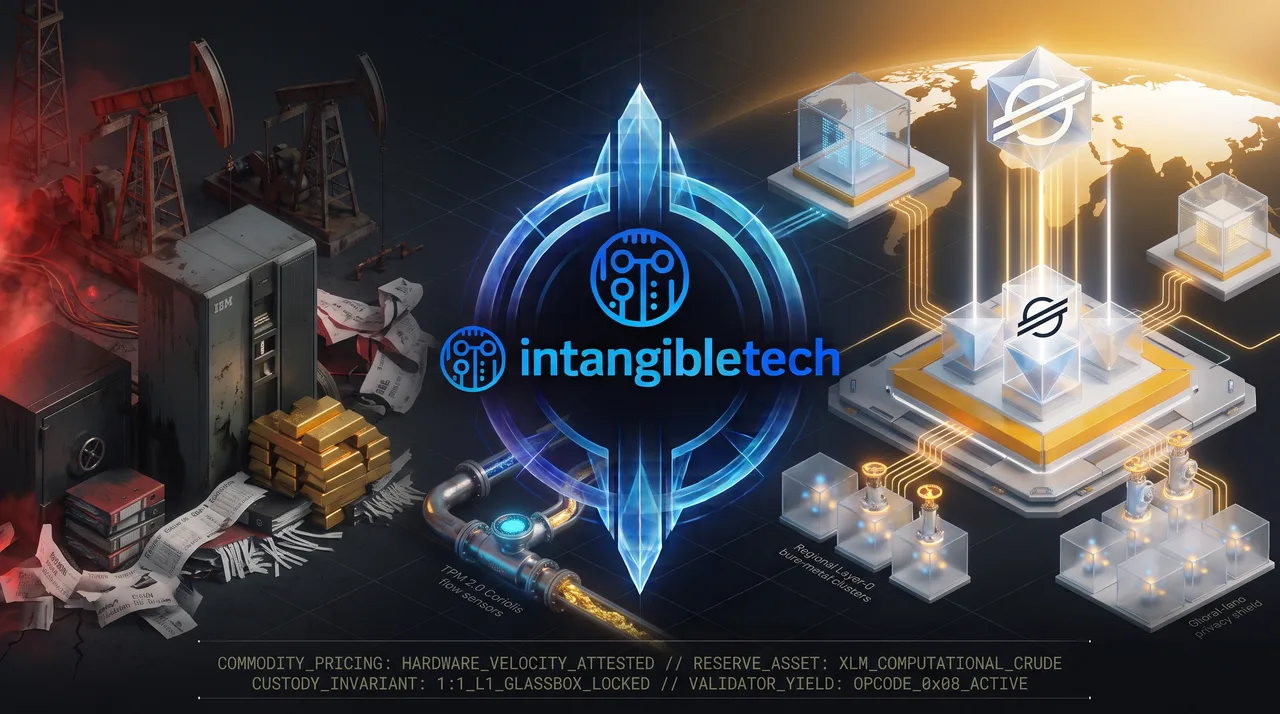
Because 19th-century markets could not verify physical extraction or industrial burn in real time, pricing moved to paper futures exchanges (COMEX/NYMEX) where paper claims outnumber physical barrels and gold bars by up to 100-to-1. Producers maximize profit by throttling supply to spike prices, while gold sits inert in dark vaults generating zero economic velocity.
From Hoarded Scarcity to Hardware-Attested Velocity
A commodity's value should not be set by leveraged paper speculators or artificial shortages. It must be priced continuously by verified physical extraction, active industrial utility (Φk = 1.0), and real-time Automated Market Maker (AMM) settlement velocity (Vt).
TPM Flow Attestation & Energy Grid Oracles
Oil, gas, and mining firms onboard onto Layer-0 via 3-Primitive AMM pools wired to TPM 2.0 Coriolis mass-flow meters at the wellhead and refinery. Speculative hoarding (Φk = 0.0) is penalized by continuous demurrage (λ), while energy producers earn massive velocity yields, instant zero-delay B2B settlement, and perpetual IP royalties by running open-source Grid Stability & Ecological Oracles.
Inert Bullion & Uncompensated Validators
Historically, nations used physical gold as a neutral settlement anchor because they did not trust rival fiat currencies—yet shipping heavy gold across oceans is slow and locks trillions in dead capital. Meanwhile, on Stellar Layer-1, validators currently receive zero protocol rewards or fees, relying purely on volunteer altruism, while the Stellar Development Foundation (SDF) must sell down its XLM treasury to fund operations.
Computational Crude Oil Backing Global GDP
In a real-time digital economy, the most precious commodity on Earth is not a heavy yellow metal sitting in a basement; it is the neutral, finite cryptographic bridge asset required to synchronize every regional Layer-0 ledger and clear cross-border GDP every 3 seconds.
XLM as the Global Engine-Room Commodity
While everyday citizens only ever see and spend sovereign cash (USD, EUR) on Layer-0, every Regional Layer-0 Cluster, Bank Guardian, and Oracle Coprocessor requires XLM on Layer-1 to lock base reserves, anchor ManageData identity proofs, and route cross-currency AMMs. SDF leases XLM via Sponsored Reserves and AMM seesaw pools to earn perpetual Layer-0 USD yield without selling a single token, while Tier-1 Stellar validators earn non-inflationary Opcode 0x08 USD infrastructure yields.
FTX-Style Black Boxes vs. Seed-Phrase Terror
Web3 forced users into a brutal choice: either hold raw crypto on a hardware USB stick where a lost seed phrase or $5 wrench attack wipes out your life savings (and leaves you disconnected from real-world commerce), or trust opaque exchanges (like FTX or Celsius) that secretly commingle and gamble customer funds in off-chain SQL databases.
Glass-Box 1:1 L1 Proofs + 2-of-3 Guardian Custody
True sovereignty is not hiding a piece of paper in a safe; it is cryptographic certainty that your custodian cannot touch your principal, paired with full access to Layer-0 prime credit, tax-cleared dividends, and real USD yield.
The Un-Bustable Custodial Wrapper
Coinbase, Robinhood, and traditional banks operate as Regulated Layer-0 Custodians. Every XLM:Custodian unit on Layer-0 is mathematically locked 1:1 to a public Glass-Box multi-sig vault on Stellar Layer-1 (User Key + Custodian Key + Independent Notary Key). Users never lose custody, earn real USD reserve-leasing yield in Account Type B, and unlock 0.25%–1.5% borrowing power—while banks deploy containerized custody via open-source GitHub Oracles.
For five thousand years, human civilization has searched for a single, incorruptible bedrock asset to anchor global trade.
In the ancient and industrial eras, that asset was physical gold—prized because no king or central bank could print it out of thin air. In the 20th century, after the Bretton Woods gold window closed in 1971, the global monetary anchor shifted to physical crude oil (the petrodollar system)—because every factory, cargo ship, airliner, and agricultural tractor on Earth required liquid hydrocarbons to move physical matter.
Yet when you examine how both gold and crude oil actually function inside today’s financial system, you discover a deeply broken, manipulative architecture:
- Gold Is Dead Thermodynamic Weight: Over $15 trillion worth of refined gold sits locked inside dark underground vaults in London, New York, and Zurich. It powers no machines, feeds no families, and builds no infrastructure. Worse, on paper futures exchanges like the COMEX, leveraged speculators trade tens of millions of ounces of “paper gold” that do not physically exist—manipulating prices while the metal itself generates zero economic velocity.
- Oil & Gas Are Hostage to Artificial Scarcity & Boom-Bust Violence: Instead of pricing energy on verified physical extraction and grid reliability, global oil and gas prices are whipped around by geopolitical cartels (throttling production to manufacture artificial shortages) and Wall Street derivatives desks trading 100 barrels of paper oil for every 1 barrel of physical crude.
Now, step into the architecture of the Intangible Layer-0 Monetary Kernel and ask a provocative question:
When 100% of global commerce, corporate balance sheets, supply-chain telemetry, and sovereign currencies operate on high-frequency regional Layer-0 clusters anchored every three seconds to the Stellar Layer-1 consensus grid, what happens to legacy commodities like oil and gold—and what becomes the single most precious, indispensable resource on planet Earth?
The answer requires a profound mental inversion: In a deterministic, real-time global economy, Stellar’s native asset (XLM) supersedes both gold and crude oil to become the world’s supreme foundational commodity—“Computational Crude Oil.”
Even more remarkably, it achieves this status while remaining 100% invisible to the everyday citizen, transforming how traditional energy giants, the Stellar Development Foundation (SDF), Wall Street banks, and platforms like Coinbase and Robinhood operate.
Let us walk through the exact mechanics of how physical commodities are rewired on Layer-0, why XLM becomes the mathematical mirror of global GDP, how the system guarantees that finite XLM can never run out or be weaponized, and why holding assets inside a Layer-0 Custodian permanently solves the “Not Your Keys, Not Your Crypto” dilemma.
1. Rewiring Legacy Oil, Gas, and Gold Companies on Layer-0: From Artificial Scarcity to Velocity Pricing
Before we can understand how a digital asset like XLM becomes a global commodity, we must first establish how traditional physical commodity producers—ExxonMobil, Chevron, Shell, Rio Tinto, or Newmont Gold—operate on the Intangible Layer-0 ledger.
Why the Old Commodity Model Existed (And Why It Breaks)
In the legacy 1494 accounting world, no market participant had real-time visibility into physical reality. A refinery in Texas or a utility in Frankfurt could not see how many barrels of sweet crude were flowing out of a wellhead in the Permian Basin or North Sea at that exact second.
Because physical flow was invisible and settlement took weeks, Wall Street stepped in and created futures exchanges (NYMEX, ICE, COMEX). Soon, the paper derivative tail began wagging the physical dog: hedge funds and algorithmic traders began trading paper contracts at 50-to-1 to 100-to-1 leverage over physical inventory, causing wild price swings that bankrupt independent producers during gluts and crush consumers during artificial squeezes.
Furthermore, under legacy GAAP accounting, an oil, gas, or mining company only makes money one way: price times volume sold at the spot market. If demand dips or efficiency improves, revenue drops—so producers are perversely incentivized to restrict supply, under-invest in grid resilience, and fight clean efficiency standards.
The Layer-0 Inversion: Hardware-Attested Flow & The 3-Primitive Commodity Pool
When an oil, gas, or mineral producer onboards onto Intangible Layer-0, paper futures casinos are abolished. The commodity producer’s balance sheet is initialized as a 3-Primitive Enterprise Automated Market Maker (AMM) Settlement Reserve wired directly to physical silicon at the point of extraction:
- Silicon-to-Ledger Extraction Attestation (TPM 2.0 Coriolis Meters):
A producer cannot mint “paper barrels” or “paper ounces” on Layer-0. Every physical wellhead, pipeline flange, LNG terminal, and refinery cracker is fitted with Hardware Root-of-Trust Enclaves (TPM 2.0) bolted directly onto industrial ultrasonic and Coriolis mass-flow meters. As physical crude oil, natural gas, or refined bullion flows past the sensor, a heterogeneous m-of-n Commodity Oracle Consortium (co-signed by the producer, the pipeline transport operator, an independent engineering auditor like SGS/Intertek, and the industrial insurer) ingests the 60 Hz flow telemetry and executes
Opcode 0x06(UPDATE_ISI_TELEMETRY) to mint 1:1 Hardware-Attested Commodity Units directly into the producer’s Layer-0 AMM inventory pool. - Separating Productive Utility (Φk = 1.0) from Speculative Hoarding (Φk = 0.0):
In our master macroeconomic equation for Kinetic Systemic Throughput (KST), every transaction is multiplied by the Productive Asset Factor (Φk ∈ {0.0, 1.0}):
- When a manufacturer, airline, chemical plant, or semiconductor foundry buys oil, natural gas, or gold from the Layer-0 AMM pool as an active industrial or energetic input, the ledger verifies the buyer’s downstream production graph and scores the transaction at Φk = 1.0.
- Conversely, if a hedge fund or speculator buys physical oil or gold units simply to hoard them in an idle vault hoping to create a supply squeeze, that position is flagged as inert commodity hoarding (Φk = 0.0, ISI = 0.00) and subjected to continuous holding demurrage (λ)—automatically bleeding value from the speculator’s hoard back into the public velocity pool until they release the commodity back to productive industry!
Φk = 0.0 (speculative hoarding), forcing dormant inventory back into active market supply.
Why Oil, Gas, and Mining Giants Will Enthusiastically Embrace This Shift
At first glance, an outsider might wonder why ExxonMobil, Shell, or Chevron would trade the NYMEX futures casino for Layer-0. Look at the three massive financial upgrades the producer unlocks on Day One:
- 1. Perpetual AMM Velocity Yield (Making Money on Flow, Not Just Spot Spikes): Every B2B fuel contract, refinery swap, and industrial hedging transaction clears directly through the energy company’s Layer-0 AMM pool—streaming continuous liquidity turnover yield (
Y = γ · V_t · Δt) in 100% tax-cleared primary currency to the company and its Velocity Entitlement shareholders daily, even when spot prices are flat and stable. - 2. Zero-Delay B2B Settlement & 0.4% Prime Retooling Credit: Instead of waiting 60 to 90 days for international shipping letters of credit to clear and paying 7% compounding interest on multibillion-dollar offshore drilling or refinery upgrades, maintaining high pipeline safety and ecological efficiency (Rregen) pushes the energy firm’s ISI above 0.90—unlocking 0.4% to 1.5% non-compounding Mcap credit that self-amortizes out of daily pipeline flow.
- 3. Elevation into Paid Civic & Grid-Governing Oracles: Who knows more about high-pressure fluid dynamics, subsurface geology, thermal co-generation, and electrical grid baseload stability than major energy engineers? Instead of treating environmental transition as an adversarial regulatory war, energy giants containerize their engineering telemetry on GitHub as Sectoral Energy & Carbon-Sequestration Oracle Coprocessors—earning permanent
Opcode 0x08IP royalties from every utility and factory in the world that runs their container!
2. Stellar’s XLM as “Computational Crude Oil”: Why It Replaces Gold as the World’s Most Precious Resource
Now take the exact commodity framework we just applied to ExxonMobil and gold miners, and apply it to the Stellar Network (Layer-1) and its native asset, Lumens (XLM).
In our previous articles, we established the strict division of labor between Intangible Layer-0 and Stellar Layer-1:
- 100% of tangible, spendable money—every dollar used by citizens to buy groceries, every corporate payroll stream, and every municipal tax dollar—lives and settles exclusively on Regional Layer-0 Bare-Metal Clusters at 1,000,000 to 4,000,000 TPS per core.
- Stellar Layer-1 is the Global Constitutional Notary and Inter-Cluster Switchboard that anchors 3-second cryptographic state roots (
StateRoot) from every regional Layer-0 cluster on Earth and clears cross-region/cross-border hops (Indiana L0 ↔ Ohio L0, orUS L0 ↔ EU L0).
In this architecture, Stellar is established on Layer-0 just like a foundational commodity producer and global infrastructure custodian—and native XLM becomes the “Computational Crude Oil” of human civilization.
Why XLM Technically Surpasses Physical Gold as the World’s Most Valuable Commodity
Why was gold valuable in the old world? Because it was scarce and nobody could counterfeit it. Yet gold has a fatal flaw: it does no work. You do not need to burn a gram of gold to send an invoice from New York to Tokyo or to verify that a bank in Frankfurt is solvent.
In the Intangible economy, not a single regional Layer-0 cluster, bank, or multinational supply chain can synchronize or cross a border without XLM working down in the Layer-1 engine room:
- Mandatory Institutional Base Reserves (0.5 XLM per Subentry): On Stellar Layer-1, every institutional validator account, every regional Layer-0 state-root anchor, every cross-border
ClaimableBalanceescrow, everyManageDataidentity registry entry, and every interbank AMM trustline requires native XLM locked in protocol base reserves to exist on the ledger. - Continuous Anti-Spam Stroop Fuel (100 Stroops / 0.00001 XLM): Every 3 seconds, when all 50 U.S. state Layer-0 clusters and 190+ national Layer-0 clusters commit their cryptographic state roots and cross-border batches to Stellar Layer-1, those synchronization pulses consume native XLM (measured in stroops).
- The Universal Neutral FX Bridge Asset: When a Nigerian manufacturer (
NGN) pays a Colombian supplier (COP), or when two rival mega-banks settle billions acrossUSD:BankA → XLM → USD:BankB, XLM sits at the center of the Automated Market Maker FX seesaw—providing neutral, sovereign-agnostic settlement liquidity that no single nation or commercial bank can weaponize.
How XLM’s Valuation Directly Mirrors Global GDP
Why will other speculative cryptocurrencies lose their value while XLM becomes the most valuable commodity on Earth?
Because under the laws of monetary physics, an asset’s sustainable value is strictly a function of the economic velocity it carries. Bitcoin and speculative meme-coins sit outside Layer-0 generating zero productive velocity (Φk = 0.0); they do not clear retail taxes (0x01), do not fund Citizen Dividends (0x08), and do not anchor corporate balance sheets.
Conversely, because 100% of global Layer-0 state roots and all inter-regional/cross-border settlements clear across Stellar Layer-1, the required capitalization of the XLM commodity pool scales in direct mathematical lockstep with Global Kinetic Systemic Throughput (KST,global—the real-time equivalent of World GDP):
3. How the Stellar Development Foundation (SDF) Becomes Liquid in Real Dollars—And Unlocks Global Validator Decentralization
Let us look at what this means for the Stellar Development Foundation (SDF) and the global network of Stellar validators.
1. Solving SDF’s “Sell-Down” Treasury Dilemma Forever
Today, SDF is a non-profit foundation holding roughly half of the 50 billion total XLM supply to support network growth. However, under legacy financial rules, SDF is trapped in a painful contradiction: whenever SDF needs real U.S. Dollars (USD) to pay its core C++ and Rust engineers, fund grants, or pay operational expenses, SDF has to sell (dump) millions of XLM onto open crypto exchanges—which permanently shrinks its XLM reserve and creates downward selling pressure on the XLM price.
When SDF onboards onto Intangible Layer-0 as a foundational enterprise entity with its own Account Type A (Liquid USD Checking) and Account Type B (Long-Horizon Productive Vault), SDF never has to sell a single XLM token again to fund its operations in U.S. Dollars:
- Strategy 1 — Global Interbank & FX AMM Seesaw Pools:
SDF deposits billions of XLM into the institutional Layer-1/Layer-0 Automated Market Maker bridge pools (
USD ↔ XLM ↔ EUR / GBP / JPY). When Indiana’s Layer-0 settles an interstate batch with Ohio’s Layer-0, or when a U.S. enterprise pays a German supplier, the value routes across SDF’s XLM pool in 3 seconds. Notice the physics: The XLM is never consumed or removed from the pool. It acts as a permanent mathematical fulcrum (dollars flow in one side, convert across the XLM curve, and euros flow out the other side). Yet every single trade routing across that fulcrum generates a microscopic protocol turnover yield (Y = γ · V_t · Δt) paid out in real, spendable Layer-0 USD directly into SDF’s Layer-0 corporate wallet every millisecond! - Strategy 2 — Institutional Reserve Leasing via “Sponsored Reserves”:
Instead of giving XLM away for free or forcing newly onboarded developing nations and community banks to buy huge stacks of XLM upfront, SDF uses Stellar’s native Sponsored Reserves (
begin_sponsoring_future_reserves) primitive. SDF retains 100% legal ownership of its XLM on Layer-1, locks that XLM into the protocol base reserve on behalf of the bank, municipality, or Oracle, and collects an automated, recurring Reserve Leasing Yield paid in Layer-0 USD out of that institution’s Layer-0 operating fee (γpool).
2. Solving Stellar’s Missing Piece: True Financial Incentives for Global Validators (Without PoS Centralization or MEV)
Look at how validator consensus works on the Stellar network today.
Unlike Proof-of-Work (Bitcoin) or Proof-of-Stake (Ethereum, Solana), Stellar validators currently receive zero financial rewards from the protocol. They earn no block rewards, no staking inflation, no share of transaction fees, and no Maximal Extractable Value (MEV).
Now, Stellar designed it that way for two noble reasons:
- It prevents Proof-of-Stake Whale Centralization (where a single giant entity that hoards the most coins controls consensus).
- It prevents MEV Front-Running (where Solana and Ethereum validators reorder user transactions inside a block to front-run retail traders and extract billions in hidden arbitrage taxes).
However, paying validators $0.00 creates a scaling bottleneck: only companies that already have direct business skin in the game (like MoneyGram, Figure Markets, Franklin Templeton, or LOBSTR) are willing to spend money out of pocket to run high-availability Tier-1 validator hardware.
Intangible Layer-0 solves Stellar’s validator incentive puzzle cleanly—without altering Stellar’s zero-MEV, trust-based Federated Byzantine Agreement (FBA) consensus!
Here is how:
- Every independent institution, university, bank, or sovereign telecom that operates a high-uptime Stellar Layer-1 Validator Node included in the global Byzantine Quorum Intersection (Qa ∩ Qb ≠ ∅) is registered on Layer-0 as a foundational Systemic Infrastructure Node on the Capability Dependency DAG.
- Out of the microscopic infrastructure maintenance fee (γpool) and
Opcode 0x01tax partition collected on Layer-0,Opcode 0x08streams continuous, non-inflationary Layer-0 Sovereign Currency (USD, EUR) directly to Stellar Layer-1 validators strictly in proportion to their verified uptime, low latency, and quorum reliability! - The Result: Validators are never paid by printing inflationary XLM, and they still have zero ability to reorder transactions for MEV front-running—because Stellar’s protocol still randomizes transaction order after quorum agreement. Yet running a Tier-1 Stellar validator suddenly becomes a self-funding, profitable infrastructure business paid in real Layer-0 dollars, triggering a global wave of institutional validator decentralization across every continent!
The SDF Treasury & Validator Yield Flywheel (Zero XLM Sell-Down)
begin_sponsoring_future_reserves for Banks, L0 Clusters & OraclesUSD ↔ XLM ↔ EUR/GBP/JPY seesaw pools clear inter-cluster batches in 3.0sγ ċ Vt) + Sponsored Reserve lease feesQa ∩ Qb ≠ ∅)γpool) pays validators directly in real Layer-0 USD/EUR4. Why Oracle Coprocessors Need XLM (Even Though They Only Write to Layer-0) & Why XLM Can Never Run Out
Let us address two sharp technical questions that every systems architect will ask:
Question 1: “We established that Oracle Coprocessors only send 128-byte updates to Layer-0 and never write logic directly to Stellar Layer-1. Why, then, do Oracles need XLM?”
While an Oracle Coprocessor’s high-frequency telemetry packets (Opcode 0x06) are ingested directly by a regional Layer-0 CPU core, every Oracle Coprocessor requires institutional XLM reserves on Layer-1 for three critical cross-cluster guarantees:
- Global
ManageDataContainer & Enclave Attestation (0.5 XLM per Subentry): Suppose Underwriters Laboratories (UL) or a Semiconductor Consortium deploys the canonicalSemiconductor-ISI-Oraclecontainer on GitHub. That single Oracle container will be used to score fabrication plants in Taiwan (Taiwan L0), Arizona (Arizona L0), Germany (Germany L0), and Japan (Japan L0). How do four separate regional Layer-0 clusters across four continents know for a mathematical fact that the Oracle packet arriving at their door was generated by the authentic, unmodified GitHub container running inside a genuine hardware enclave? Because the Oracle’s master Sovereign ID (module_sid), its 64-byte SHA-512 hardware measurement (enclave_pcr_hash), and its 5-of-7 consortium public-key weights are anchored inside Stellar Layer-1ManageDatasubentries—each requiring locked XLM base reserves! - Cross-Jurisdictional Surety Bond Locking (
ClaimableBalances): Every Oracle must stake a multi-million-dollar Account Type B Surety Bond that gets slashed viaOpcode 0x07if cross-sensor auditing catches a fraudulent rating. If that surety bond lived only on one local Layer-0 server, a corrupt local official could try to block the slash. By anchoring the Surety Bond’s cryptographic escrow predicate inside a Stellar Layer-1ClaimableBalancewithAUTH_CLAWBACK_ENABLED(requiring XLM base reserves per claimant), any global consensus proof of Oracle fraud slashes the bond across the entire planet simultaneously. - Proportional State-Root Stroop Sponsorship:
Every time an Oracle writes state updates into a regional Layer-0 cluster, it modifies that cluster’s Merkle tree, which must be committed to Stellar Layer-1 every 3 seconds (
100 stroops / 0.00001 XLM). Oracles hold or lease an institutional XLM buffer to auto-fund their proportional share of the Layer-1 synchronization heartbeat.
Question 2: “XLM Has a Finite Cap (~50 Billion) and Becomes Extremely Valuable. How Do We Guarantee Institutions Never Run Out of XLM or Get Priced Out?”
If XLM were like physical crude oil, a finite supply paired with exploding global demand would eventually cause an energy shortage that halts the world’s machines.
Why is it systemically and mathematically impossible for the global economy to “run out” of XLM or for a cartel to corner XLM and halt a regional Layer-0 cluster?
Because the protocol combines Layer-1 Consensus Parameter Elasticity with Layer-0 Anti-Hoarding Physics:
Why the Global Economy Can Never "Run Out" of XLM
StateRoot every 3 seconds to Stellar L1—consuming just 100 stroops (0.00001 XLM). At 0.00001 XLM per 3-second sync, a single 1 XLM token fuels a regional Layer-0 cluster's heartbeat for 3.47 days!USD ↔ XLM ↔ EUR), XLM is not destroyed—it is a value-transfer fulcrum. If global GDP adoption causes 1 XLM to appreciate 100× in dollar value, an institutional AMM pool requires 100 times fewer physical XLM tokens to bridge the exact same $500 million cross-border transfer with zero slippage!0.5 XLM) and minimum stroop fee are adjustable consensus parameters. If XLM's unit price rises 100× in dollar terms, Tier-1 validators simply vote at consensus to adjust the base reserve from 0.5 XLM down to 0.005 XLM—instantly freeing 99% of locked XLM back into liquid circulation and keeping the real USD cost of anchoring a new institutional node flat forever!λ) + SDF Sponsored Reserves: Any entity that buys XLM and pulls it out of active validator reserves or AMM pools to hoard it in an idle wallet is classified at Φk = 0.0 and hit with continuous holding demurrage (λ), bleeding their hoard back into the public liquidity pool. Meanwhile, SDF's non-profit Sponsored Reserve leasing guarantees every sovereign nation and Oracle instant, at-cost reserve access.5. Abstracting XLM from “Average Joe” & Turning Coinbase, Robinhood, and Banks into Un-Bustable Layer-0 Custodians
Now let us move from institutional plumbing to the everyday citizen, the crypto holder, and the financial exchanges of the future.
1. Complete Abstraction for the Everyday Citizen
For 99% of human beings who just want to earn their salary, buy groceries, pay their mortgage, and collect their monthly Universal Citizen Dividend (Opcode 0x08), XLM and blockchain mechanics are 100% invisible.
- When you open your wallet on Layer-0, your balance is denominated strictly in your sovereign currency (
USD,EUR,GBP). - You never see a
0.5 XLMbase reserve, you never buy XLM to pay gas fees, and you never sign a raw blockchain transaction. Your Commercial Bank DevOps Guardian handles all Layer-1 state-root anchoring automatically in the background out of the microscopic network velocity fee.
2. What If “Average Joe” Already Owns Native XLM (or Bitcoin/Ethereum)? His Two Profit Paths
Suppose Joe is one of the millions of retail investors who bought 25,000 XLM (or BTC/ETH) on Coinbase or Robinhood and currently holds it either in a self-custody hardware wallet (Ledger/Lobstr) or on an exchange.
How does Joe bring that native XLM into the Intangible economy, and why will every rational crypto holder choose to bring their assets onto Layer-0 through a Regulated Layer-0 Custodian?
When Joe deposits his 25,000 native XLM into a Layer-0 Custodian (an evolved Coinbase, Robinhood, Fidelity, or his local Community Bank DevOps Guardian), the Custodian locks Joe’s 25,000 native XLM inside an auditable Layer-1 vault and credits Joe’s Layer-0 Sovereign ID wallet 1:1 with 25,000 XLM:Custodian Attested Commodity Units.
Once on Layer-0, Joe unlocks two immediate ways to profit that are impossible on raw Layer-1 blockchains:
- Option 1 — Instant 0.4ms Liquidity Conversion (With Automated
0x01Tax Clearance): If Joe wants to spend part of his XLM gains on a new car or a house down payment, he swapsXLM:Custodianacross the Layer-0 AMM pool into spendable Layer-0 USD in 0.4 milliseconds with near-zero spread. Even better: Opcode 0x01 atomically settles the exact micro-tax split at the moment of the swap—meaning Joe never has to track cost-basis spreadsheets, hire a crypto CPA, or file an IRS Form 8949 in April! - Option 2 — Lock in Account Type B to Earn Real, Non-Inflationary USD Yield (Without Selling a Single XLM):
Even smarter, Joe does not have to sell his XLM to live off its value! By sweeping his
XLM:Custodianunits into his Account Type B Long-Horizon Productive Vault (Opcode 0x03), Joe’s XLM is classified as active Institutional Reserve Collateral (Φk = 1.0, λ = 0.0). His Custodian leases the underlying Layer-1 XLM utility to Oracles, Regional L0 Clusters, and Cross-Border AMMs—streaming continuous, daily yield paid in real, spendable Layer-0 USD directly into Joe’s Account Type A checking wallet, while simultaneously allowing Joe to borrow against his Account Type B vault at 0.25% to 1.5% non-compounding prime rates!
3. Answering the Web3 Skeptic: Why Layer-0 Custodians Eliminate FTX Risk (“Not Your Keys, Not Your Crypto”) AND Increase Decentralization
Mention the word “Custodian” to a veteran Web3 enthusiast, and they will immediately shout the famous mantra: “Not your keys, not your crypto!”
And in the legacy crypto world, they had every reason to be terrified! When users deposited money into FTX, Celsius, Voyager, or Mt. Gox, those companies took the user’s real crypto on the blockchain, credited the user with a fake number inside a private, un-auditable SQL database, and then secretly gambled or stole the underlying crypto behind closed doors.
Under Intangible Layer-0 + Stellar Layer-1, an FTX-style custodial collapse or fractional-reserve rug-pull is mathematically impossible. Look at the three silicon-enforced invariants that protect every user who deposits with a Layer-0 Custodian:
- The 1:1 Layer-1 Glass-Box Minting Invariant (Zero Fractional Reserve):
A Layer-0 Custodian (like Coinbase, Robinhood, or Chase) cannot simply type
+25,000 XLMinto a private SQL database. On Layer-0, the 128-byte state machine will only mint25,000 XLM:Custodianinto Joe’s Layer-0 struct if the 3-second Stellar Layer-1 State Root cryptographically proves that an exact corresponding 25,000 native XLM is locked inside the Custodian’s public Glass-Box Vault on Stellar Layer-1. Every customer’s claim is 100% backed 1:1 on the public Layer-1 ledger every 3 seconds. If Joe ever clicks “Withdraw Native XLM to Layer-1,” the physical XLM is 100% guaranteed by consensus to be sitting in the vault ready to release. - The 2-of-3 Guardian Multisig Enclave (Zero Unilateral Seizure or Executive Theft):
Unlike FTX—where Sam Bankman-Fried held the master keys to customer vaults—every Layer-0 Custodial Vault is governed by the hardware-enforced 2-of-3 Guardian Multisig Root (Bytes
108..127):- Key 1: Held inside Joe’s own smartphone hardware enclave (Biometric / Passkey).
- Key 2: Held by the Regulated Custodian (Coinbase / Robinhood / Bank Guardian).
- Key 3: Held by an Independent Judicial / Recovery Notary.
Think about what this means: The Custodian holds only 1 of 3 keys. Coinbase or your bank literally cannot move, lend out, rehypothecate, or seize your underlying crypto without your cryptographic signature (
Key 1 + Key 2). Yet if your house burns down or you drop your phone in the ocean—an event that permanently destroys your life savings in Web3 self-custody—your Custodian and Recovery Notary (Key 2 + Key 3) verify your biometric Sovereign ID and restore your vault to your new phone in 3 seconds!
- How Layer-0 Custodians Actually Increase Network Decentralization (Rather Than Centralizing It):
On Proof-of-Stake blockchains like Ethereum, when millions of users deposit ETH into Coinbase, Coinbase controls over 12% of all staked coins—dangerously centralizing consensus.
On Stellar Layer-1 + Intangible Layer-0, holding more XLM gives an operator zero extra voting power in Stellar’s Federated Byzantine Agreement consensus! Even better, to earn the maximum Account Type B infrastructure yield (
Opcode 0x08) on the XLM deposited by their customers, protocol rules require Custodians to distribute their Sponsored Reserves and AMM liquidity evenly across independent, geographically diverse Tier-1 Validators and regional Layer-0 clusters. Thus, every dollar of XLM brought into a Layer-0 Custodian actively funds more independent validators worldwide!
Legacy CEX vs. Raw Web3 Self-Custody vs. Intangible Layer-0 Guardian Custodian
How 1:1 Layer-1 Glass-Box proofs and 2-of-3 hardware enclave keys abolish both FTX-style insolvency and seed-phrase loss while unlocking real USD yield.
Opaque Off-Chain SQL Black Box
Off-chain private SQL database with 0% on-chain proof of reserves. Exchange executives can secretly commingle, rehypothecate, or gamble customer funds behind closed doors—resulting in total wipeout and multi-year bankruptcy court freezes.
100% User Burden & $0 Real USD Yield
Losing a 24-word paper seed phrase or hardware USB stick means permanent 100% loss of life savings. Generates $0 real USD yield (only inflationary token dilution) and remains blocked from AUTH_REQUIRED real-world merchant rails and prime credit.
1:1 L1 Glass-Box + 2-of-3 Enclave + USD Yield
1:1 L1 Glass-Box Proof: Cannot mint XLM:Custodian without a 3-second Stellar L1 cryptographic lock proof.
2-of-3 Enclave Keys: [User Phone + Custodian + Notary]—custodian cannot touch funds unilaterally, yet lost phones recover in 3s.
Superior Benefits: Streams spendable Layer-0 USD yield in Account Type B, unlocks 0.25%–1.5% non-compounding credit, and guarantees zero dark-money laundering via ZK_Citizen Sovereign ID compliance.
6. How Coinbase and Robinhood Monetize Open-Source Custody Containers for Every Bank on Earth
Finally, look at how this transforms the business model of crypto-native giants like Coinbase, Robinhood, Kraken, and Anchorage Digital—and connects them directly to the Oracle Gold Rush we detailed in our companion monograph.
In the old world, Coinbase and Robinhood made nearly all their money charging retail users high transaction spreads (1% to 2% fees) to gamble on volatile meme-coins—a feast-or-famine revenue model that crashes every time a crypto winter hits, while putting them in constant adversarial conflict with traditional banks.
Now look at how Coinbase and Robinhood position themselves on Intangible Layer-0:
- Eliminating Back-Channel Dark Money While Capturing Global Institutional Flow:
Because every regulated enterprise, retail terminal, and municipal treasury on Layer-0 enforces
AUTH_REQUIREDbound to a verified Sovereign Digital Identity (SID), no anonymous, un-audited back-channel crypto transfer can ever enter the real-world economy. Every holder of digital assets around the globe has an overwhelming game-theoretic incentive to onboard their holdings through a verified Layer-0 Custodian so they can access Account Type B USD yields, 0.5% prime credit lines, and instant retail liquidity. - Packaging Multi-Chain Custody as an Open-Source GitHub Oracle Container: Consider the thousands of regional commercial banks and local community credit unions across the United States and Europe. When their depositors ask to hold XLM, BTC, or ETH inside their Account Type B vaults, a three-branch community credit union in Indiana does not know how to run multi-chain cryptographic validator bridges or Layer-1 Sponsored Reserve leasing engines from scratch. Coinbase and Robinhood already built that exact infrastructure! By importing our open-source Node 0 Root SDK, Coinbase or Robinhood packages its institutional custody, multi-sig key orchestration, and Layer-1 reserve-leasing engine into a Certified Open-Source Custodial Oracle Container hosted on GitHub.
- White-Labeling Custody to 10,000 Banks via
Opcode 0x08Royalties: Any community bank, credit union, or wealth manager in the world can deploy Coinbase’s or Robinhood’s verified container onto their local bare-metal Layer-0 server in ten minutes:- The Community Bank Wins: The local credit union instantly offers its members institutional-grade digital commodity custody, 2-of-3 key recovery, and daily Account Type B USD reserve yields—matching JPMorgan’s capabilities overnight with zero upfront R&D cost.
- Coinbase & Robinhood Win: Every single time a customer at any of those 10,000 community banks swaps a commodity unit, leases XLM reserves, or collects daily Account Type B yield through that container, Layer-0’s
Opcode 0x08Dependency DAG automatically streams a fractional B2B software & liquidity royalty in real-time Layer-0 USD straight back to Coinbase or Robinhood—while routing the foundational base skim (0.001 bps) through Node 0!
The Custodial Container B2B Royalty Network (Coinbase / Robinhood → 10,000 Community Banks)
ClaimableBalances & multi-chain vaults locked 1:1 on-chainNode 0 SDK)git pull and run inside on-premise Confidential Enclaves0.001 bps foundational protocol royalty routed to Intangible Technologies (Node 0)Would You Hold XLM as a Long-Term Investment Asset in This World?
Let us close by answering the ultimate investor question: In an economy where everyday citizens only spend sovereign dollars on Layer-0 and never see XLM at the grocery store, would rational individuals, family offices, and sovereign wealth funds still want to hold XLM inside their Account Type B vaults as a long-term investment asset?
More than any commodity in human history.
Think about why investors bought gold or oil in the old world:
- If you bought a bar of gold, it sat in a vault producing 0.00% cash yield, hoping someone would pay a higher dollar price for it later.
- If you bought crude oil futures, you suffered constant futures roll-decay (contango) and wild geopolitical volatility.
Now look at what happens when an investor holds XLM:Custodian locked inside an Intangible Layer-0 Account Type B Productive Vault:
- Zero Demurrage (λ = 0): Because your XLM is actively leased out via your Custodian to sponsor Layer-1 institutional base reserves and power cross-border AMM seesaw pools, the ledger scores it as a 100% productive computational asset (Φk = 1.0).
- Real-Time Global GDP Appreciation: Because every new city, enterprise, Oracle Coprocessor, and nation that joins Layer-0 increases the global demand for Layer-1 state-root syncs and cross-currency AMM depth, the intrinsic value of the finite XLM supply scales mathematically alongside aggregate human economic velocity (KST).
- Continuous Daily Cash Yield Paid in Spendable USD: Unlike gold—which forces you to sell your bullion to realize a profit—your Account Type B XLM position streams daily cash dividends paid in 100% tax-cleared, spendable Layer-0 USD directly into your checking account from every cross-border trade and institutional reserve lease it powers across the globe!
Gold was the barbarous relic of an era that could not verify trust across oceans.
Crude oil was the combustible fuel of an industrial century that priced matter through scarcity.
Paired with the bare-metal speed of Intangible Layer-0, Stellar’s XLM becomes the clean, inexhaustible Computational Crude Oil of a synchronized planet—turning the velocity of human progress itself into the ultimate reserve asset of civilization.