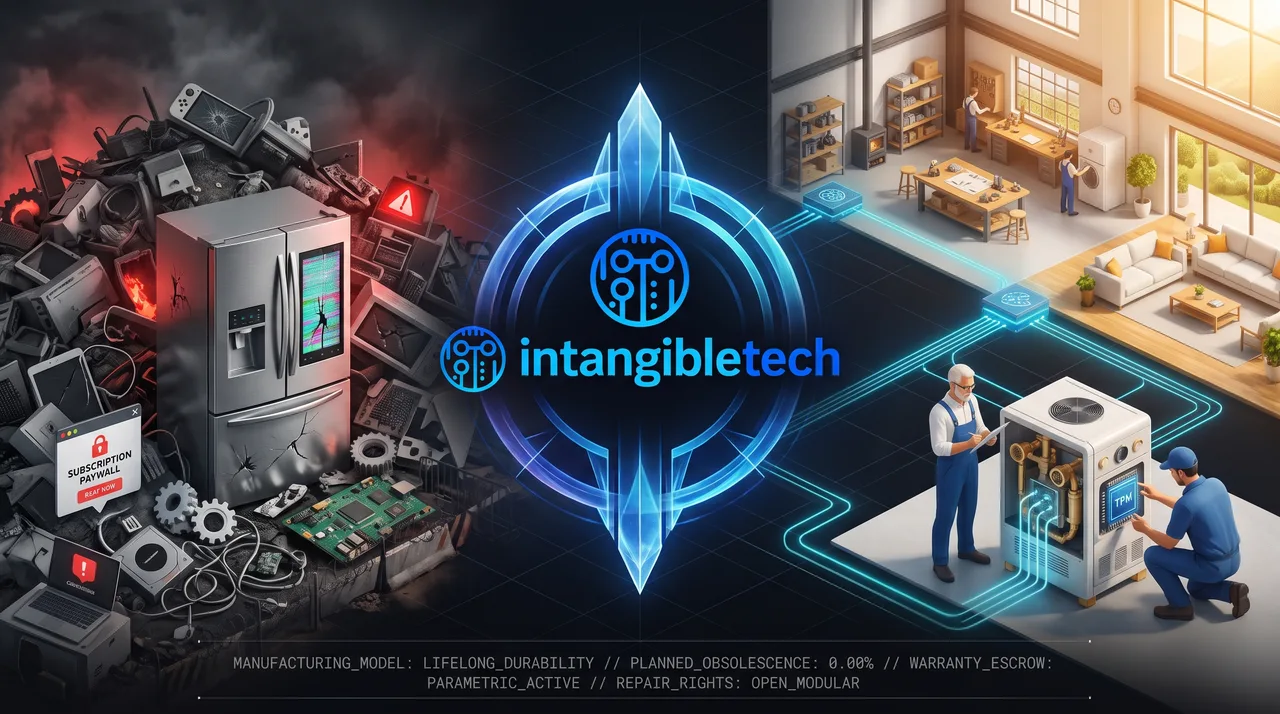
Walk into the kitchen of almost any middle-class home today, and you will stand before a monument to modern economic dysfunction: the four-thousand-dollar “smart” refrigerator.
On the surface, it looks like a marvel of twenty-first-century engineering. It has brushed stainless-steel doors, Wi-Fi connectivity, internal cameras, and a twenty-one-inch high-definition touchscreen embedded in the door.
Yet live with that machine for thirty-six months, and the nightmare reveals itself:
- First, a mandatory over-the-air software update turns the kitchen touchscreen into a billboard, displaying unsolicited banner advertisements and recipe promotions every time you reach for a carton of milk.
- Next, the water dispenser locks itself shut. The water filter is not clogged, but the manufacturer embedded a proprietary radio-frequency identification (RFID) microchip inside the plastic filter cartridge. Unless you buy the manufacturer’s official sixty-dollar replacement filter every six months—preventing you from using an identical twenty-dollar generic filter—the refrigerator’s software refuses to pour water.
- Then, four years and two months after purchase—just beyond the expiration of the warranty—the refrigerator stops cooling.
When you call an independent appliance repair technician, they give you the grim news. The manufacturer replaced time-tested cast-iron reciprocating compressors with cheap, high-strung linear compressors filled with thin plastic valves, and potted the main control board in un-serviceable epoxy resin. Fixing the unit will cost fourteen hundred dollars, the replacement part is on a six-month backorder, and the technician advises you to simply throw the four-hundred-pound machine into a municipal landfill and buy a new one.
Meanwhile, out in that same family’s garage sits a rounded, steel refrigerator built in 1956. It has no touchscreen, no Wi-Fi, and no microchips. It has been humming continuously for seventy years without a single mechanical failure.
This rot is not limited to kitchen appliances. It infects every corner of modern life:
- Washing machines whose bearings are sealed inside welded plastic drums so that a twenty-dollar bearing failure totals the entire machine.
- Tractors and cars that brick themselves if an independent farmer or mechanic replaces a sensor without paying a dealership five hundred dollars to clear a proprietary software lock.
- Beloved software applications that begin as fast, clean, useful tools, only to be bloated with tracking scripts, pop-up upsells, degraded search results, and labyrinthine cancellation menus.
Author and technologist Cory Doctorow gave this digital decay a name that instantly entered the global lexicon: Enshittification—the predictable lifecycle in which platforms first create value for users, then abuse their users to extract value for business customers, and finally claw back all value for themselves until the product becomes a hollowed-out shell.
Pair digital enshittification with physical Planned Obsolescence, and you have the defining consumer experience of the twenty-first century: Everything costs more, nothing lasts, software gets progressively more hostile, and nobody can fix anything.
Why is this happening? Have our materials scientists, mechanical engineers, and software architects forgotten how to build things that last?
Not at all. Modern engineers possess metallurgical precision, solid-state electronics, and computational tools that engineers in 1955 could only dream of. We could easily build a residential refrigerator, a washing machine, or an HVAC system that runs quietly and efficiently for fifty years with minimal maintenance.
We do not build fifty-year appliances because, under the rules of legacy corporate finance, building a product that lasts fifty years is corporate suicide.
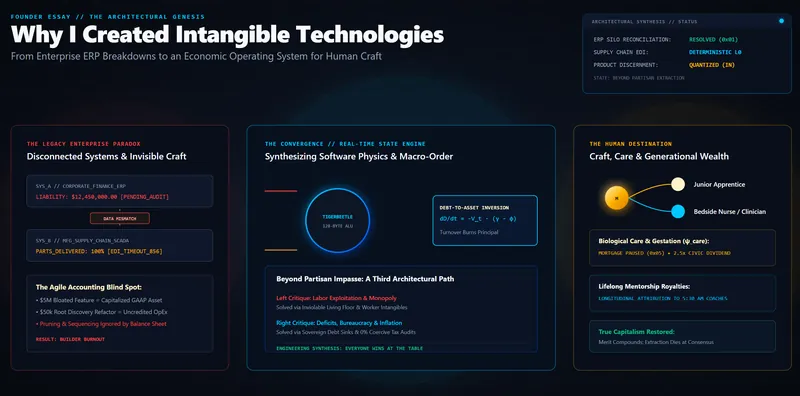
To rescue our households, our wallets, and our planet from this mountain of disposable junk, we cannot rely on consumer boycotts or slow-moving regulatory fines. We must rewrite the balance-sheet physics of how corporations recognize value.
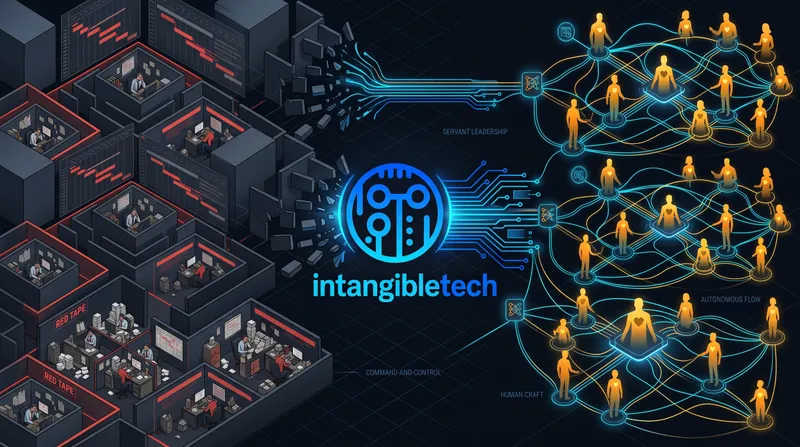
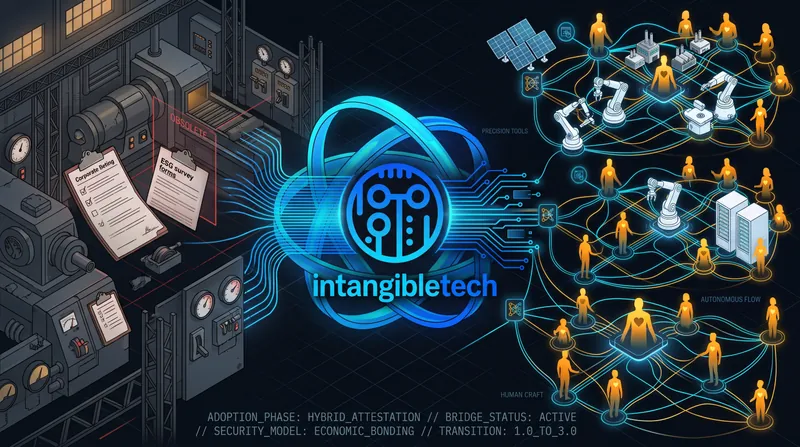
By replacing point-of-sale replacement churn with continuous longevity yields, converting warranties into self-executing parametric escrows, and making the active lifespan of physical and digital products the primary driver of corporate borrowing rates, Intangible Technologies makes building heirloom-quality, lifelong products the most lucrative strategy in global business.
1. The Anatomy of the Rot: Why Legacy Accounting Forces Good Engineers to Build Trash
To reverse the degradation of our physical and digital world, we must first understand why rational corporate executives mandate it.
In 1924, the world’s leading lightbulb manufacturers—including Osram, Philips, and General Electric—gathered in Geneva to form the Phoebus Cartel. At the time, lightbulb technology had become too good; bulbs were regularly lasting 2,500 to 5,000 hours, and sales were plummeting. The cartel signed a secret agreement requiring member engineers to intentionally re-engineer filaments to burn out after exactly 1,000 hours, levying steep fines on any manufacturer whose bulbs lasted longer.
Today, corporations do not need a secret cartel in Geneva to enforce planned obsolescence. Generally Accepted Accounting Principles (GAAP) and Wall Street equity markets enforce it automatically.
Look at the structural trap of the legacy corporate income statement:
- The Point-of-Sale Cliff: Under legacy accounting, a manufacturer recognizes 100% of a product’s value at the single moment of the retail transaction. The day you hand over two thousand dollars for a refrigerator, the manufacturer books the revenue. The next morning, you vanish from their financial universe.
- Durability as Market Cannibalization: If an appliance company builds a flawless refrigerator that lasts forty years, every sale permanently removes a customer from the market for four decades. Once the market reaches saturation, the company’s quarterly sales drop, Wall Street analysts downgrade the stock for “stagnant top-line growth,” the board fires the Chief Executive Officer, and corporate raiders step in to strip the company for parts.
- The Private Equity Quality Squeeze: When predatory private equity or quarterly-driven executives take over a heritage brand with a reputation for durability, they execute a predictable playbook. They keep the high retail price tag that the brand earned over fifty years, fire the senior mechanical engineers, swap heavy brass and steel components for injection-molded plastic, and pocket the margin spread for eight quarters before exiting the stock.
The exact same trap governs modern software:
- A software team builds a brilliant, clean tool for productivity, photo editing, or project management.
- Once every target customer has bought the tool, growth slows.
- To manufacture an additional 20% in Annual Recurring Revenue (ARR) for the next quarterly board meeting, product managers are ordered to degrade the software: moving core features behind higher subscription tiers, injecting “AI assistant” bloatware nobody asked for, harvesting user telemetry for ad networks, and designing deceptive user-interface “dark patterns” that make canceling a subscription feel like navigating a minefield.
The engineers hate doing it. The product managers feel dirty designing it. And the consumers despise living with it.
Yet everyone stays locked on the treadmill because legacy finance only knows how to measure the velocity of transactions, never the preservation of utility.
2. The Mental Inversion: From Replacement Churn to Living Asset Stewardship
To break the cycle of planned obsolescence and enshittification, executives, engineers, and consumers must execute a foundational mental inversion:
- The Old Rationale (Point-of-Sale Extraction): A product is a disposable revenue event. Once sold, a durable product is a dead weight on future growth because it prevents the customer from buying a replacement. Therefore, maximize profit by minimizing component lifespan, locking down repairs, and forcing recurring subscriptions.
- The Protocol Inversion (Continuous Utility & Longevity Stewardship): A product is a living, attested node of physical or digital utility on the global ledger. An enterprise’s balance-sheet valuation, credit access, and ongoing yield are directly tied to how long its deployed artifacts operate defect-free in the real world. Therefore, maximize profit by engineering products that never break, require minimal energy, and can be effortlessly repaired and upgraded for decades.
Let us contrast these two paradigms clearly:
Under Legacy Corporate Finance:
- Primary Profit Trigger: The product breaks just after the warranty expires, forcing a replacement purchase or a high-margin proprietary repair.
- Balance-Sheet Status of Sold Goods: Zero. A forty-year refrigerator operating in a customer’s kitchen is completely invisible to the manufacturer’s balance sheet.
- Repair Dynamic: Hostile. Glue the casing shut, serialize parts with digital locks, and starve independent repair shops of schematics.
- Software Trajectory: Progressive bloat, surveillance ad-injection, and artificial paywalling to juice quarterly churn metrics.
Under the Intangible Architecture:
- Primary Profit Trigger: The product operates continuously at peak thermodynamic efficiency with zero mechanical or software defects over decades.
- Balance-Sheet Status of Sold Goods: An active, appreciating Intangible Provenance Asset that directly lowers the manufacturer’s corporate borrowing rates and generates ongoing secondary yield.
- Repair Dynamic: Open and collaborative. Modular, standardized parts and public schematics empower local technicians to keep the fleet alive.
- Software Trajectory: Lean, sub-millisecond execution where utility and high organic retention directly multiply upstream attribution royalties.
3. The Crystal-Clear Math: How Companies Make More Money When They Sell Less Stuff
Whenever we propose ending planned obsolescence, skeptical corporate executives and CFOs immediately ask the million-dollar question:
“This sounds wonderful for consumers and the environment. But how does a manufacturer stay in business—let alone grow its profits—if people only buy a refrigerator or a washing machine once every thirty-five years? Where does the money come from if we aren’t constantly selling replacements?”
In the Intangible Architecture, transitioning from a high-volume “disposable junk” manufacturer to a low-churn “fifty-year durability” manufacturer unlocks four massive, compounding profit engines that dwarf the margins of legacy planned obsolescence:
Engine 1: The Corporate Capital Spread Multiplier (The Impact Score Index)
Manufacturing physical goods—automobiles, appliances, HVAC systems, industrial machinery—is one of the most capital-intensive endeavors on Earth. Major manufacturers carry billions of dollars in working capital lines, factory equipment financing, and supply-chain credit facilities.
Under legacy banking, these companies pay 7% to 9% in compounding commercial interest, burning hundreds of millions of dollars every year just to service their debt.
Under our protocol, an enterprise’s borrowing cost across all capital facilities is governed dynamically by its Impact Score Index (ISI). For a hardware manufacturer, a primary determinant of its ISI is Verified Fleet Longevity and Defect Suppression:
- Every appliance or machine manufactured is equipped with a tiny, fifty-cent Layer-0 Hardware Root of Trust (TPM 2.0) chip on its power and sensor bus (with zero cameras, zero microphones, and zero personal surveillance—strictly cryptographic proof of mechanical operation and energy draw).
- As millions of a manufacturer’s refrigerators hum quietly across the nation for ten, twenty, and thirty years without compressor failures or thermal leaks, that active fleet telemetry continuously validates the manufacturer’s engineering excellence on the ledger.
- Because its deployed fleet operates far beyond industry baseline lifespans with near-zero defect rates, the manufacturer achieves a top-decile ISI rating.
- That rating compresses the manufacturer’s corporate borrowing rate from 8.5% down to 1.5%.
Look at the cold, hard balance-sheet arithmetic for an appliance manufacturer carrying $2 billion in industrial credit facilities:
- At legacy 8.5% interest, the company pays $170 million per year to commercial banks in pure interest overhead.
- At a protocol-native 1.5% prime rate, the company pays $30 million per year.
- By building durable machines that don’t break, the manufacturer instantly unlocks $140 million per year in pure, unencumbered net cash flow.
Suddenly, when a junior cost-accountant walks into the engineering department and suggests replacing a five-dollar forged brass valve with a fifty-cent plastic valve to save four dollars on the assembly line, the Chief Financial Officer stops them immediately.
Why? Because if those plastic valves snap in Year 4, the resulting spike in fleet defect telemetry will drop the company’s ISI, spiking its corporate interest rates by four hundred basis points and costing the company eighty million dollars on its credit lines.
Saving four dollars on cheap plastic becomes a balance-sheet catastrophe. Durability becomes the ultimate guardian of corporate profit.
Engine 2: Continuous Thermodynamic & Grid Efficiency Yield (Opcode 0x08)
A poorly built appliance does not just fail early; it wastes vast amounts of electricity as its seals degrade, its insulation settles, and its cheap compressor struggles under load. Furthermore, every time a four-hundred-pound refrigerator is thrown away after four years, municipal sanitation departments must spend public money to haul, crush, and bury it, while industrial grids burn megawatts smelting new steel to replace it.
In our architecture, prevented waste is quantized as real economic value:
- Municipal energy grids and environmental waste sinks operate on the same Layer-0 ledger.
- When a manufacturer’s refrigerator operates at peak thermal insulation efficiency for twenty-five years—drawing thirty percent less peak power from the municipal grid than cheap competitors and staying out of the municipal landfill for decades—the protocol calculates that Averted Entropy and Landfill Loss.
- Through Opcode 0x08 (Atomic Upstream Attribution), a fractional, non-dilutive Longevity & Efficiency Yield streams continuously from municipal utility and environmental loss-mitigation pools directly into the manufacturer’s treasury vault for every year the appliance remains in active service beyond the baseline standard.
Instead of getting paid once when you buy the fridge and hoping it breaks, the manufacturer earns a continuous, passive royalty stream for every year the fridge stays alive!
A refrigerator running in a customer’s kitchen in Year 22 is literally generating pure, 100%-margin dividend revenue for the company that built it.
Engine 3: Modular Upgrades & Secondary Market Royalties
When you build a physical chassis out of heirloom-grade stainless steel, heavy copper coils, and serviceable joints, the core frame can last a century.
How does the manufacturer generate active commercial sales over those decades? Through Open Modularity and Secondary Market Velocity:
- The Plug-and-Play Core: Instead of throwing away a four-hundred-pound steel box because a control board or compressor aged, the appliance is engineered around standardized, hot-swappable modular bays. Ten years after buying your fridge, if a breakthrough in solid-state magnetocaloric cooling cuts energy use in half, you don’t buy a new fridge. You slide out the old cooling module in five minutes and slide in the new $300 core, while the manufacturer recaptures your old module for 100% remanufacturing.
- Secondary Market Attribution: Under legacy capitalism, when you sell a used appliance or car to a neighbor, the original manufacturer makes zero dollars. Under our protocol, every durable good carries a Physical Asset Provenance ID on the ledger. When a family moves and sells their twenty-year-old heirloom refrigerator for $1,500 (because it still has thirty years of attested life left in it), the transaction clears across Layer-0 rails, and Opcode 0x08 automatically routes a 2% secondary-market royalty back to the original manufacturer.
The higher the resale value of the product, the more money the manufacturer makes every time it changes hands across generations.
Engine 4: Intangible Provenance as a Balance-Sheet Capital Asset
Under legacy GAAP accounting, if a company builds the most reliable machines on Earth, that engineering reputation is worth $0.00 on its formal balance sheet.
Under the Intangible Architecture, the verified, active fleet of millions of long-lasting machines operating in the field is quantized as Appreciating Intangible Capital.
That proven engineering track record sits directly on the enterprise’s balance sheet, expanding its equity valuation and allowing it to attract patient Account Type B Senior Productive Capital at top-tier terms.
4. The Warranty Inversion: From Denial-of-Service Scams to Instant Parametric Escrows
Let us examine how warranties work today, and why every consumer dreads them.
In the legacy economy, the “Extended Warranty” is not an engineering guarantee; it is an unregulated, high-margin insurance casino.
When a retailer or manufacturer pushes you to buy a $300 three-year extended protection plan on an appliance, the financial structure is openly adversarial:
- The retailer immediately pockets 50% of that $300 as pure sales commission.
- The remaining 50% is handed to a third-party warranty administrator whose entire corporate profit margin depends on denying, delaying, or exhausting your claim.
- When your appliance breaks, you are forced to sit on hold for two hours, upload paper receipts that have faded, pay a $125 “service call deductible,” wait three weeks for a contracted repairman to say the part is unavailable, and eventually receive a prorated gift card worth a fraction of what you paid.
Furthermore, notice the disconnect: because the manufacturer sold off the warranty liability to a third-party underwriter, the engineering team never feels the financial pain of the broken part.
The Intangible Architecture abolishes the warranty scam and replaces it with Opcode 0x04 (Parametric Escrow Trigger):
How a Protocol-Native Warranty Works
- The Bonded Lifespan Attestation: When a manufacturer sells a refrigerator, they do not hand you a six-page booklet of legal exclusions. They register an immutable Engineering Lifespan Invariant on the ledger—attesting, for example, that the cooling system will operate within specified thermal tolerances for 15 years (or 130,000 operational hours).
- The Locked Parametric Reserve: A small, transparent fraction of the purchase price is locked inside a Protocol-Native Parametric Escrow Vault (sitting in Account Type B, where it earns safe senior yield for the manufacturer as long as the machine works properly).
- Zero-Friction Hardware Fault Trigger: Suppose in Year 8, the compressor valve fails. You do not call a 1-800 number. You do not dig through a shoebox for a faded paper receipt:
- The appliance’s onboard TPM 2.0 chip detects the pressure drop and thermal failure at the sensor bus.
- The hardware signs a cryptographic Defect Assertion Payload (Opcode 0x06) directly to Layer-0.
- Four-Second Autonomous Settlement: The moment the hardware fault is verified at consensus:
- Opcode 0x04 triggers automatically.
- The parametric escrow immediately releases a pre-agreed $250 Spoiled-Food Indemnity directly into the homeowner’s Sovereign Digital Wallet in under four seconds.
- Simultaneously, the escrow funds an open Repair Guild Bounty, dispatching a certified local technician with the exact modular replacement part already routed to their van.
- The homeowner pays $0.00 out of pocket and never fills out a single form.
And what happens if the appliance never breaks during its 15-year attested window?
The manufacturer keeps the entire escrow principal plus fifteen years of compounded senior yield.
Think about how that single mechanism transforms every corporate boardroom on Earth:
- Every mechanical failure immediately drains the manufacturer’s escrow yield and downgrades their Impact Score Index.
- Every year of flawless operation compounds the manufacturer’s escrow reserve and lowers their corporate debt interest.
The incentive to build fragile junk is mathematically annihilated.
5. Reversing Software Enshittification: Ending the Subscription Hostage Crisis
Now let us turn from physical steel and copper to the digital tools we use every day: software.
Why has modern software become so unbearable?
Twenty years ago, when you bought a piece of software—whether a word processor, a photo editor, or an enterprise database—you paid a fair price, installed it on your machine, and owned a fast, deterministic tool that worked offline for a decade.
Today, almost all software has been converted into Cloud SaaS Subscriptions and Attention Traps:
- Even the simplest utility—a calendar app, a PDF reader, a note-taking tool, or a home security camera—demands $14.99 a month forever.
- Because the software company must justify that monthly rent to venture capital investors demanding 100% year-over-year net dollar retention, they cannot simply leave a finished, working product alone.
- They bloat the interface with intrusive pop-ups, move previously free features behind “Pro Enterprise” paywalls, lock your data inside proprietary cloud formats so you cannot leave (switching-cost hostage-taking), and sell your usage data on the back end.
In the Intangible Architecture, software is liberated from the subscription hostage model through Capability Nodes and Organic Retention Velocity:
1. Micro-Settlement Utility vs. Extractive Rent
Because our Layer-0 engine and Stellar settlement rails clear transactions in sub-second finality for fractions of a penny, software developers no longer need to trap users in $20/month recurring subscriptions or inject surveillance ads to survive:
- Software modules are registered on the global Dependency Directed Acyclic Graph (DAG) as authenticated Capability Nodes.
- When a user or enterprise executes real work using that software, Opcode 0x08 routes a microscopic, fractional attribution split to the software creator in real time.
- If the software helps a small business design a precision part, edit a commercial photograph, or clear logistics faster, the software developer earns yield strictly proportional to the actual velocity and value delivered—never by holding the user’s files hostage when they stop paying monthly rent.
2. The Dark-Pattern Penalty on the Brand Fidelity Vector
In our previous monograph on Marketing and Brand Architecture, we introduced the Brand Fidelity Vector—which measures the difference between voluntary, organic customer loyalty and coerced lock-in.
On our ledger, software enshittification triggers an immediate, automated penalty:
- Data Portability Invariant: To register as a compliant capability node on Layer-0, software must support open, zero-friction state export. A user’s data belongs to their Sovereign Digital Identity (SID), not the app vendor’s AWS bucket. If an app degrades its interface, the user can switch to a competitor’s interface in one click without losing a single file or historical record.
- Bloat and Latency Drag: Because software execution is benchmarked against deterministic efficiency, pushing bloated updates that slow down user hardware or inject dark-pattern cancellation hoops registers as an Operational Entropy Defect.
- The software company’s Impact Score Index drops, and competitors offering clean, fast, respectful software instantly capture the user base because switching costs are zero.
When you reduce switching costs to zero and reward real downstream utility, enshittification becomes immediate commercial suicide. Software returns to being clean, fast, quiet, and fiercely loyal to the user.
6. The Unseen Dynamic: The Right-to-Repair & Local Craft Renaissance
There is one more transformative dynamic that unfolds when you invert the economics of durability: the rebirth of the independent local technician and the death of the proprietary repair monopoly.
Today, manufacturers wage ruthless legal and technical warfare against independent repair shops and DIY owners:
- Appliance, smartphone, and agricultural equipment manufacturers lobby state legislatures to defeat Right-to-Repair bills.
- They use “parts pairing” (cryptographically tying a replacement battery, screen, or tractor hydraulic sensor to a single serial number so that even a genuine part taken from an identical machine will not work without a manufacturer software unlock code).
- They refuse to sell replacement components, withhold circuit diagrams, and threaten independent technicians with copyright lawsuits.
Why do they do this? Because under legacy accounting, an independent repair deprives the manufacturer of a new replacement sale or a $400 dealership service fee.
Now watch what happens under the Intangible Architecture:
Because the manufacturer’s corporate borrowing spread (1.5% vs. 8.5%) and ongoing longevity yield depend entirely on keeping their machines running defect-free in the physical world for as many decades as possible, the manufacturer’s relationship with independent repair technicians flips 180 degrees overnight!
- Every Independent Mechanic Becomes the Manufacturer’s Best Friend: If a refrigerator in rural Ohio or a combine harvester in Indiana has a worn gasket or a damaged relay, the manufacturer desperately wants that machine fixed within the hour so its operational uptime streak remains unbroken on the ledger.
- Open-Source Schematics and Standardized Parts: Manufacturers voluntarily publish high-resolution 3D CAD schematics, repair manuals, and diagnostic interfaces on the open DAG. They design machines with standard metric fasteners, accessible service panels, and interchangeable parts.
- Attested Repair Provenance: When a local, independent appliance technician replaces a worn component and signs the repair with their Sovereign Digital Identity, the appliance returns to peak efficiency, the technician is paid instantly from the parametric maintenance pool, and the manufacturer’s Impact Score Index stays pristine.
This triggers a massive, nationwide Blue-Collar Craftsmanship Renaissance:
- Instead of throwing away millions of tons of appliances and hiring low-wage warehouse workers to ship cheap replacements from overseas factories, thousands of high-paying, respected local jobs emerge in every town: Master Appliance Technicians, Modular Upgraders, and Precision Remanufacturers.
- Young apprentices learn electronics, thermodynamics, and mechanical repair, earning six-figure incomes maintaining the enduring physical wealth of their communities.
7. Household Wealth Reclaimed: The Return of the Heirloom Economy
Step back and consider what this transformation means for the budget and peace of mind of an everyday working family.
Under the legacy economy, a working family is trapped on a Depreciating Junk Treadmill:
- Every five to seven years, the family is hit with a sudden financial emergency: the $2,500 refrigerator dies, the $1,200 washing machine snaps its drum spider, the $1,000 dishwasher floods the floor, the $8,000 HVAC compressor burns out, and the $1,200 smartphones slow to a crawl.
- Over a forty-year adult life, a typical household is forced to buy six refrigerators, seven washing machines, six dishwashers, and fifteen laptops—bleeding over $100,000 in after-tax household wealth just to continually replace the exact same baseline appliances!
- Every single one of those purchases depreciates to $0 the moment it crosses the threshold of the home.
In the Intangible Architecture, working families step off the replacement treadmill forever:
- Buy Once, Own for Life: When a young couple moves into their first home and purchases a refrigerator, a range, and a washer-dryer, they are buying fifty-year industrial artifacts engineered with the precision of commercial aviation hardware.
- Non-Compounding Acquisition: Because high-ISI durable goods carry verified multi-decade lifespans, they qualify for 0% Non-Compounding Utility Financing—amortizing cleanly over years for a few dollars a month with zero credit-card interest gouging.
- Retained Balance-Sheet Equity: Twenty years later, that refrigerator is not worthless scrap metal; it is an attested, modular physical asset that still commands strong resale value on the secondary market—or is handed down to their children when they buy their first home.
The hundred thousand dollars that every family used to burn replacing broken corporate junk stays right where it belongs: in the family’s sovereign savings vault, compounding real wealth across generations.
The Pride of the Builder
Beyond all the balance sheets, interest rates, and cryptographic proofs, there is a deeper human reason why this transformation matters.
Ask any mechanical engineer, industrial designer, or software developer why they chose their profession when they were young.
Not one of them went through four years of grueling thermodynamics, materials science, or computer science courses because they dreamed of designing a plastic washing-machine gear engineered to shear off at 1,200 cycles.
Not one software engineer learned to code because they dreamed of building an un-closable pop-up modal designed to trick an elderly grandparent into an unwanted monthly subscription.
Human beings are builders by nature.
There is a sacred, irreplaceable dignity in looking at an object—a bridge, a watch, a locomotive, a piece of software, or a kitchen appliance—and knowing that you poured your highest intellect, care, and honesty into its creation. There is profound human pride in knowing that the work of your hands will still stand, still serve, and still bring quiet comfort to a family long after you are gone.
For half a century, a broken financial system stole that pride from our builders and replaced it with the cynicism of the landfill.
The Intangible Architecture gives our builders their souls back.
By aligning the financial physics of the enterprise with the physical endurance of the artifact, we end the era of enshittification and planned obsolescence forever:
- Where a company’s highest profit comes from building a machine that refuses to break.
- Where a warranty is not a legal trap, but an instant, mathematical bond of honor.
- Where software is clean, fast, and subordinate to human intent.
- Where local technicians and craftspeople are celebrated stewards of community wealth.
- And where we stop burying our planet in the rubble of quarterly earnings theater, and start building a durable, beautiful, and enduring civilization worthy of the generations who will inherit it.
The era of disposable junk is over.
The age of enduring craft has begun.