To understand why the cryptocurrency movement spent a decade building Decentralized Autonomous Organizations—and why almost every single one of them imploded—you first have to understand the legitimate anger that birthed them.
Following the 2008 global financial crisis, an entire generation of engineers, technologists, and everyday savers looked at the traditional 20th-century joint-stock corporation and saw a rigged machine.
In the legacy corporate world, the people who actually build value—the software engineers, machinists, nurses, and product designers—are booked on the balance sheet as disposable Operating Expenses (OpEx) to be minimized. Meanwhile, corporate executives whose compensation is tied to short-term stock tickers borrow billions in debt to execute share buybacks, gut research and development, engineer planned obsolescence into physical products, and lay off thousands of staff just to manufacture an artificial two-cent beat on quarterly Earnings Per Share (EPS). When those reckless bets blow up, executives exit with thirty-million-dollar golden parachutes while socializing the losses onto taxpayers and workers.
Seeing this rot, the pioneers of Web3 asked a seductive question: What if we got rid of the CEOs, the boards of directors, the corporate lawyers, and the banks altogether? What if we replaced the corporation with a Decentralized Autonomous Organization (DAO)—an internet collective governed entirely by smart contracts and token-holder votes?
On paper, it sounded like the ultimate triumph of digital democracy.
In practice, it became an unmitigated catastrophe.
It is a supreme historical irony that the very first major experiment in decentralized governance—“The DAO,” launched on Ethereum in 2016—lasted less than two months before an attacker exploited a recursive reentrancy bug in its Turing-complete smart contract, draining sixty million dollars of investor capital and forcing the Ethereum network to execute a contentious hard fork just to survive.
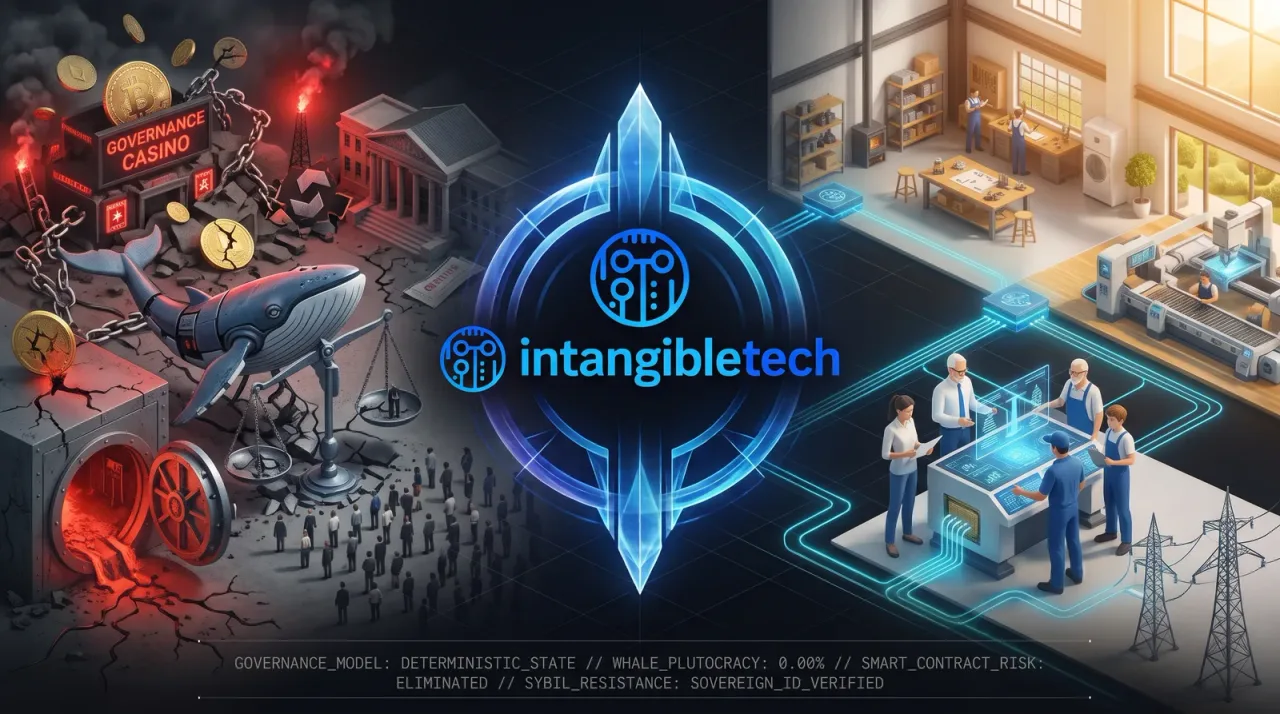
Over the decade that followed, thousands of DAOs were launched across decentralized finance (DeFi), regenerative finance (ReFi), and infrastructure networks. Instead of liberating humanity or replacing a single Fortune 500 supply chain, they reproduced the worst pathologies of Wall Street inside an unregulated, hyper-volatile casino:
- Plutocratic Whale Capture: Replacing corporate boards with “1-token, 1-vote” coin voting allowed wealthy venture insiders and anonymous syndicates to buy up 51% of governance tokens, override operational logic, and legally loot community treasuries.
- Ponzi Tokenomics: Lacking real-world commercial revenue, DAOs sustained themselves by printing unbacked governance tokens out of thin air to pay contributors—creating hyperinflationary death spirals that wiped out 95% to 99% of retail participants the moment speculative hype cooled.
- Paralysis and the “Grant Circus”: Talented engineers who joined DAOs to escape corporate bureaucracy found themselves trapped in endless Discord forum politics, forced to beg non-technical token speculators for manual grant payouts just to fix core infrastructure.
- Legal & Regulatory Ruin: By attempting to operate as anonymous, stateless collectives outside the law, DAOs made themselves unadoptable by real-world enterprises and left ordinary token voters exposed to unlimited personal legal liability as unregistered general partnerships.
Whenever executives or technologists first encounter the Intangible Financial Architecture, those scarred by the crypto boom often ask: “Is this another DAO?”
Let us be unequivocal: Intangible Technologies is the exact antithesis of a Web3 DAO.
Web3 failed because it misdiagnosed the disease. Crypto engineers assumed that the problem with modern capitalism was structure, legal identity, and leadership, and that the cure was anonymous decentralization.
They were wrong. The problem with modern capitalism is not that organizations have leaders, laws, or structure. The problem is that the underlying 1494 accounting ledger rewards extraction over durability, debt compounding over velocity, and human replacement over mentorship.
You do not fix a broken accounting engine by putting every invoice up for an anonymous internet vote. You fix it by upgrading the mathematical physics of the balance sheet itself.
1. Anatomy of the DAO Failure: Why Token Collectives Collapse
To understand why our architecture diverges completely from Web3, we must examine the four structural failure modes baked into every traditional DAO.
First: The Plutocracy of Coin Voting and Flash-Loan Governance
In a democratic society, human rights and civic voice are anchored to the principle of one person, one vote. In a DAO, because wallets are anonymous and anyone can spin up ten thousand cryptographic keypairs in milliseconds (a Sybil attack), the protocol has no idea who is a unique human being.
Forced to abandon human identity, DAOs defaulted to 1-Token, 1-Vote.
What happens when voting power is literally for sale on the open market?
- Whale Oligarchy: Venture capital funds, early founders, and wealthy speculators control massive blocks of tokens, allowing three or four wallets to dictate the outcome of 90% of governance proposals while retail holders possess zero real agency.
- Governance Extractable Value (Hostile Raids): In numerous DeFi protocols, attackers have used instantaneous “flash loans” to borrow tens of millions of dollars in governance tokens for a single block, vote synchronously to transfer the entire DAO treasury into their own wallet, and repay the loan twelve seconds later.
- Voter Apathy: Because ordinary participants have neither the time nor the technical expertise to audit fifty governance proposals a week on snapshot forums, voter participation in major DAOs routinely drops below 2%.
Second: The “Grant Proposal Circus” That Punishes Builders
Ask any senior software architect who has worked inside a major DAO what their day-to-day life actually looked like.
In a functional enterprise, if a database engineer sees that a core server pipeline needs refactoring to prevent an outage, they fix it as part of their job. In a DAO, workers are treated like precarious political freelancers. Before writing a line of code, the engineer must draft a lengthy political proposal on a public forum, campaign on Discord calls, and convince anonymous token holders—who care only about whether the token price goes up this week—to vote on a manual multisig disbursement.
The result is perverse: charismatic marketers and hype-men who promise flashy gimmicks win millions in DAO treasury grants, while the quiet infrastructure engineers maintaining the actual system are starved of funds and burn out.
Third: Ponzi Tokenomics vs. Conservation of Value
How did DAOs fund these grants? Almost universally by minting their own speculative governance token out of thin air.
In physics and sound economics, yield cannot be conjured from nothing; it must be derived from real work and verified commercial utility. When a DAO prints fifty million “Governance Tokens” and hands them to contributors or liquidity farmers, no real goods have been manufactured, no patients have been healed, and no energy has been generated. The moment those contributors need to pay real-world rent or taxes, they dump the governance token onto retail buyers on secondary exchanges, driving the token price toward zero.
Fourth: The $10 Billion Turing-Complete Honeypot
Because DAOs are built on general-purpose virtual machines (like the Ethereum Virtual Machine), their treasuries and voting rules are governed by complex, arbitrary smart-contract code. Over the last decade, reentrancy exploits, proxy upgrade bugs, and compiler vulnerabilities have drained over ten billion dollars from audited smart contracts. No serious industrial manufacturer, hospital system, or sovereign treasury will ever place its working capital inside a smart contract where a single missing mutex lock can vaporize the enterprise in twelve seconds.
2. The Decentralization Delusion: Why Civilization Needs Accountable Structure
At the root of the DAO failure lies a philosophical error that has poisoned technology discourse for fifteen years: the belief that decentralization is the ultimate moral good, and that all centralization, hierarchy, and legal authority are inherently evil.
If you have ever stepped foot inside an aerospace machine shop, a trauma hospital, or an enterprise data transformation, you know immediately that leaderless decentralization is a fantasy.
You do not want a passenger airliner designed by an anonymous Discord poll. You do not want a hospital emergency room run by token-holder referendums. And you cannot run a global supply chain without enforceable legal contracts, clear executive accountability, and regulatory compliance.
Human civilization requires both coordinated leadership and individual sovereignty. The problem with legacy corporations was never that they had Chief Executive Officers or legal charters; the problem was that executives were insulated from the downside of their mistakes while capturing 100% of the upside of their workers’ craft.
Look at how the Intangible Architecture solves the crisis of leadership and compliance—not by abolishing executives or hiding from regulators, but by binding them to deterministic mathematical skin-in-the-game:
1. Executive Accountability via the Operating Spread (Δexecutive)
In our architecture, we do not replace executive leadership with mob rule; we wire executive compensation directly to the thermodynamic reality of their decisions.
- Narrow Specialist Shielding: Frontline engineers, machinists, and clinicians have their Sovereign Digital Identities (SID) scoped strictly to the specific products, parts, or clinical outcomes they touch. If their craft is high-quality and low-defect, their personal yield ratio stays near 100% positive—completely shielded from C-suite blunders.
- Executive Authorization Exposure: Whenever a CEO or Vice President uses their cryptographic authority to sign off on a twenty-million-dollar vendor contract, a corporate acquisition, or a strategic restructuring, their Sovereign ID is bound to the origin block of that decision. Every downstream dollar of capital outlay and operational drag hits the executive’s personal ledger denominator.
- Real-Time Consequence: If a leader orchestrates genuine operational velocity across ten teams, their yield multiplier compounds across the entire enterprise’s throughput. But if they force a vanity acquisition or bloat administrative overhead that generates zero real velocity, their personal Operating Spread (Δexecutive) collapses in real time, automatically compressing their compensation while leaving frontline workers whole.
2. The Technical Veto and Dissent Mechanism
Why do corporate disasters—from Boeing’s engineering crises to catastrophic software outages—happen in the legacy world? Because executives routinely override the explicit safety warnings of their engineers to hit a quarterly deadline, and then scapegoat the technical team when the system fails.
In the Intangible Architecture, preventative teams (systems architects, cybersecurity leads, quality-assurance engineers, and legal counsel) possess a protocol-native Cryptographic Dissent Primitive:
- If an executive orders a rushed product release or sub-spec material substitution over the objections of the engineering lead, the Lead Architect signs a formal cryptographic dissent on the internal decision ledger.
- That signature mathematically detaches the engineering team’s Intangible Capital ledgers from any subsequent defect spikes, warranty failures, or oracle clawbacks resulting from that release.
- One hundred percent of the downside balance-sheet drag routes directly to the executive who overrode the warning.
Overnight, executive scapegoating becomes impossible, and management is mathematically compelled to respect technical reality.
3. Sovereign Legal Compliance and Judicial Restitution Over “Code is Law”
DAOs operate in a legally murky shadow world where anonymous wallets launder funds and “Code is Law” dogma dictates that if a hacker steals your life savings, the theft is legitimate because the code permitted it.
Intangible Technologies is built from the ground up for strict institutional, national, and constitutional compliance:
- Sovereign Digital Identity (SID) with Zero-Knowledge Privacy: Every wallet and corporate node on the ledger binds cryptographically to a verified legal identity, completely eradicating anonymous shell companies, tax evasion, and Sybil attacks. At the same time, individual citizens are protected by an Asymmetric zk-SNARK Constitutional Firewall—proving to the network that they are a valid, tax-compliant citizen without ever exposing their private purchases, medical records, or personal life to state surveillance.
- Protocol-Native Judicial Clawbacks (Opcode 0x07 & CAP-35): We reject the sociopathic lie of “Code is Law”. Real-world commerce encounters fraud, coercion, and contract breaches. Through pre-compiled clawback and restitution primitives, a verified court order or multi-sig judicial oracle can deterministically freeze stolen assets, slash a corrupt auditor’s surety bond, or attach an automated revenue garnishment valve (0x07) to a bad actor’s incoming receipts—delivering all the legal protections of commercial banking without the multi-year friction of paper litigation.
3. The Three Mental Inversions: How the Protocol Replaces Both Wall Street and Web3
To understand why this framework succeeds where both legacy corporations and Web3 DAOs failed, both traditional executives and crypto engineers must execute three foundational mental inversions.
Inversion 1: Stop Voting on Accounting—Automate It via a Deterministic State Machine
- The DAO Way: Treat the organization like a political parliament where token holders vote on treasury allocations, fee parameters, and contributor payouts.
- The Intangible Inversion: You do not hold a political vote to decide whether gravity exists, whether a factory machine experienced thermal wear, or whether an invoice should clear. We strip human politics out of operational accounting entirely.
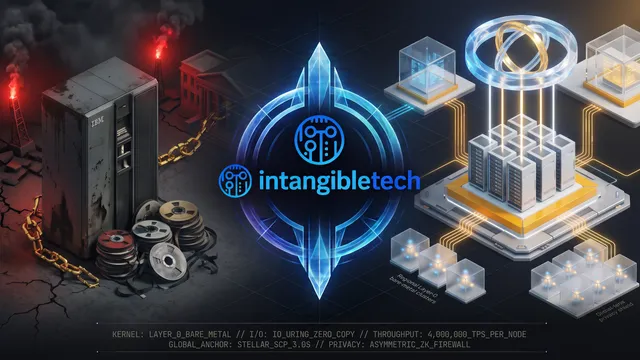
Running on a TigerBeetle-inspired 128-byte deterministic state machine (Layer-0) anchored to the Stellar Consensus Protocol (Layer-1), the ledger replaces Turing-complete smart contracts with 8 Pre-Compiled Financial Opcodes executed directly in bare-metal silicon:
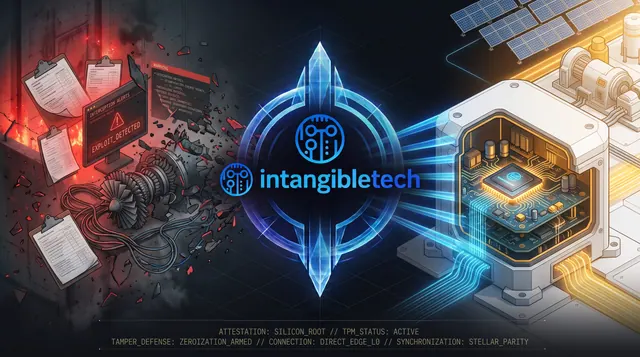
- When industrial hardware runs, onboard TPM 2.0 secure enclaves stream runtime hours and thermal stress directly to the ledger, depreciating book value (dA/dt) and funding maintenance escrows automatically.
- When a customer pays an invoice, Opcode 0x01 atomically clears the payment in milliseconds while partitioning federal, state, and municipal micro-taxes—abolishing annual IRS tax filings forever.
- When an engineer, machinist, or teacher contributes to a capability dependency tree, their Sovereign ID is automatically credited with Time-Series Intangible Capital (Ahuman), streaming continuous daily yield to their wallet as downstream commerce flows across their work—no Discord grant proposals or committee begging required.
Inversion 2: Replace Speculative Governance Tokens with the 3-Primitive AMM Balance Sheet
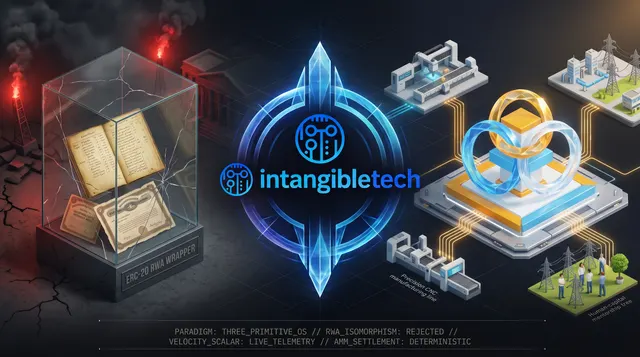
- The DAO & RWA Way: Mint a volatile governance token out of thin air, or wrap a 1494 paper stock certificate or compounding debt bond inside an ERC-20 token (Real-World Asset tokenization) and trade it in a secondary casino.
- The Intangible Inversion: Intangible Technologies mints zero speculative platform altcoins. Instead, every real-world enterprise operates an Automated Market Maker (AMM) Settlement Reserve structured around three non-speculative primitives:
- Primitive 1: Primary Reserve Cash (Account Type A & B): Regulated, 1:1 reserve-backed commercial stablecoins or sovereign liquidity. Idle cash hoards sitting in Account Type A above the statutory exemption floor (Efloor) experience continuous liquidity decay (demurrage, γ), forcing dormant capital out of offshore hoards and into Account Type B long-horizon productive vaults where γ = 0.
- Primitive 2: Continuous Velocity Entitlements (“The New Stock”): Instead of a static share certificate traded on the NYSE or a useless DAO governance token, equity is a direct mathematical stake in the enterprise’s primary AMM settlement pool. Every time a customer buys a product, the transaction clears through the pool and streams net velocity yield in primary cash directly to the investor’s wallet daily—ending the “4% rule” sell-down trap and making debt-fueled share buybacks mathematically suicidal.
- Primitive 3: Velocity-Amortized Bonds (“Credit-as-an-Asset”): When an enterprise finances factory retooling (Parametric Retooling Vaults) or extends credit, it issues a restricted, non-speculative settlement bond (
AUTH_REQUIRED) governed by a hard Cumulative Dollar Cap (Mcap). Compounding interest is abolished forever. As commercial velocity (Vt) flows through the enterprise’s AMM pool, a programmatic slice of turnover continuously burns the principal balance down to zero. Faster real-world production boosts the investor’s annualized Internal Rate of Return (IRR) while liberating the manufacturer from debt years ahead of schedule.
Inversion 3: The Goal Isn’t Decentralization—It’s Gamified, Humanity-Aligned Incentives
- The Web3 Fallacy: Believing that if you simply decentralize a database, corporations will magically stop acting greedily.
- The Intangible Inversion: Sustainable systemic change cannot rely on moral lecturing or leaderless anarchy; it requires shifting the Nash Equilibrium so that the most selfishly profitable move for a Chief Financial Officer is also the most beneficial move for human workers and the physical planet.
How do we achieve that alignment? Through the Enterprise Impact Score Index (ISI, scored from 0.000 to 1.000) stored directly inside bytes 96–97 of every corporation’s 128-byte state struct:
An enterprise’s commercial borrowing rate (re) and point-of-settlement tax weighting (τISI) are mathematically slaved to three tamper-proof telemetry pillars:
- Product Durability (Ddurability): Verified in-field product lifespan vs. premature warranty failures. Building a twenty-five-year modular refrigerator instead of a four-year planned-obsolescence junk appliance pushes Ddurability above 0.95.
- Workforce Vitality & Apprentice Succession (Llabor): Measured directly from verified payroll streams, worker retention, sustainable 4-to-6-hour deep-work cadences, and the Institutional Succession Index—requiring an active ratio of mentored junior Apprentice Nodes (
KNOWLEDGE_PARENT) to senior architects. - Ecological & Supply-Chain Efficiency (Rregen): Attested via substation smart-meter energy/water ratios, closed-loop material recovery, and recursive upstream supplier ISI scores.
Look at the game-theoretic hammer this creates: If a corporation cuts product quality, burns out its workers, or fires its junior engineers to replace them with unchecked AI agents, its ISI collapses. Instantly at consensus, its Sectoral Leverage Cap (Cgov) contracts by 70% and its corporate borrowing rate spikes from 0.4% Prime up to 9.5% Subprime.
Conversely, a master builder that engineers twenty-five-year durable goods and actively mentors human apprentices unlocks 0.25% to 1.5% non-compounding capital and a 50% settlement tax discount. We do not ask corporations to be charitable; we make human dignity and physical durability the only mathematical path to prime balance-sheet profitability.
4. When Humans Do Vote: Liquid Democracy, Quadratic Voice, and the Anti-LBO Poison Pill
While daily accounting, yield distribution, and credit pricing run deterministically without human politics, strategic governance—such as electing corporate boards, approving major charters, or allocating discretionary municipal infrastructure budgets—still requires collective human voice.
Here is how the Intangible Architecture upgrades democratic and corporate voting beyond anything possible in legacy Wall Street proxy systems or Web3 DAOs:
1. Decoupled Liquid Democracy (Voice Without Surrendering Custody or Yield)
In legacy finance, retail shareholders rarely hold their own voting power; shares sit at the DTCC while giant custodians like BlackRock vote proxies by default. In Web3 DAOs, delegating voting tokens often requires locking them in risky smart contracts or surrendering liquidity.
On the Intangible ledger, ownership, daily cash yield, and voting weight are three completely separate cryptographic primitives:
- Your Velocity Entitlement tokens never leave your sovereign non-custodial wallet, continuing to stream daily cash yield uninterrupted.
- Using native key-value state entries (
ManageData), you can programmatically delegate your voting weight on specific domains to trusted independent specialists—for example, delegating environmental audit votes to a clean-water engineering guild, and technical roadmap votes to a senior systems architect. - If your delegate ever casts a vote you disagree with, you can revoke or override that delegation in a single second with one cryptographic signature.
2. Sybil-Proof Quadratic Voting
Why did Quadratic Voting—weighting votes by the square root of credits allocated (Votes = √Creditsi) so intense local conviction can overcome casual majority apathy—fail in Web3? Because in an anonymous DAO, a whale with 100 credits simply splits them across 100 fake wallets to cast 100 votes instead of 10!
Because the Intangible protocol anchors every human citizen to a Zero-Knowledge verified Sovereign Digital Identity (SID) where one human equals exactly one identity anchor, Sybil attacks are mathematically impossible. Using ephemeral, non-transferable VOICE primitives with restricted trustlines (AUTH_REQUIRED), communities and corporate stakeholders can execute true Quadratic Voting—preventing both 51% majority tyranny and billionaire whale capture.
3. Immunity to Hostile Takeovers & The Intangible “Poison Pill”
In both Wall Street and Web3 DAOs, a predatory corporate raider or private equity buyout shop can borrow massive leverage, secretly accumulate 51% of circulating shares or tokens, take over the organization, strip its treasury, and fire the workforce.
Under the Intangible Architecture, a hostile leveraged buyout (LBO) is mathematically impossible for three reasons:
- Sectoral Leverage Caps (Cgov): The protocol blocks uncollateralized acquisition debt at consensus; a corporate raider cannot load 80% debt onto a target company’s balance sheet.
- Antitrust Intangible Overlap Gating: The protocol calculates the Intangible Asset Overlap Ratio between merging firms. If a merger shares ≥ 70% overlapping capabilities—proving the acquirer intends to eliminate competition and lay off redundant engineers—consensus automatically blocks the pool merger.
- The Ultimate Worker “Poison Pill”: Even if a hostile raider spent billions of their own cash to buy up circulating liquid pool shares with the intent to exploit the company, the human workforce holds the nuclear key. The moment the company’s engineers, machinists, and researchers collectively unlink their Sovereign Digital IDs from the firm’s dependency graph, the enterprise’s Intangible Capital score (Ahuman) and ISI instantly drop to zero, its prime credit lines freeze, and its AMM velocity engine stops cold. The hostile raider is left holding an empty, worthless digital shell, while the workers walk across the street, link their intact Sovereign ID provenance trees to a new cooperative vault, and immediately qualify for prime 1.5% capital on Day One.
The Realization of the Free Market
For fifteen years, the brightest young minds in cryptography and distributed systems were sold a false choice.
They were told that to escape the rot of 1494 corporate accounting, predatory bank usury, and quarterly Wall Street extraction, they had to retreat into an anarchist digital wilderness—building leaderless DAOs, minting speculative governance tokens, and praying that anonymous coin-voting wouldn’t end in another hundred-million-dollar exploit.
It is time for every Web3 builder and every enterprise leader to see the light.
We do not need to abolish legal identity, executive leadership, or the rule of law to liberate human potential. And we certainly do not need another speculative governance token.
What humanity needs is an honest measuring stick.
By replacing both the 1494 double-entry corporate silo and the broken Web3 DAO with a deterministic, hardware-attested state machine, Intangible Technologies finally delivers what both capitalism and decentralization originally promised:
- Where day-to-day accounting, tax clearing, and yield distribution execute with the quiet, incorruptible certainty of silicon physics rather than political forum theater.
- Where executives are rewarded handsomely for unlocking genuine human throughput, and penalized automatically when they generate bureaucratic drag.
- Where every engineer, machinist, nurse, and teacher owns an un-cancellable cryptographic equity stake in the downstream velocity of their craft.
- And where the free market is finally governed not by who can hoard the most tokens or engineer the most debt, but by who can build the most durable, regenerative, and life-affirming value for human civilization.
The era of the DAO casino is over.
The age of the deterministic enterprise has arrived.