
Walk into any corporate boardroom, hospital executive suite, or municipal planning meeting today, and you will witness a modern tragedy disguised as mathematics.
If an enterprise purchases a $500,000 robotic steel press that stamps sheet metal, corporate accounting celebrates the expenditure. It is placed on the balance sheet as Capital Formation, granted tax-sheltered depreciation write-offs, and counted proudly as an asset that makes the company wealthier.
Yet, when a mother takes six months away from commercial employment to nurse and bond with a newborn child, legacy accounting registers her economic contribution as $0.00. Her career seniority is penalized, her retirement savings freeze, and the rent on her home continues ticking without mercy.
When a master toolmaker spends three hours a day patiently mentoring a struggling young apprentice, corporate spreadsheets book those hours as an operational inefficiency—a drag on quarterly margins. When a dedicated public school teacher stays late to teach a child to read, or when a bedside nurse gently sits with a dying patient in hospice care, legacy finance labels their labor Unproductive Overhead (OpEx) to be cut, outsourced, or suppressed.
Consider the distortion of this worldview: A mechanical machine that depreciates into scrap metal is classified as wealth, while the human beings creating all future ingenuity, science, and care are classified as costs.
This is not a failure of human empathy; it is a structural failure of accounting code. Our planetary civilization is operating on an information ledger designed in 1494 that was physically incapable of measuring the invisible wellspring of all prosperity: intangible human capital.
By redesigning the financial operating system to treat human craft, biological care, and generational mentorship as tangible, appreciating balance-sheet equity, we do not simply modernize enterprise software. We dissolve the artificial economic terror that is tearing apart our families, our workforces, and our cultural fabric.
1. The 5:30 AM Principle: The Upstream Source of All Wealth
To understand why this change is essential, step away from financial theory and stand on the cold tile of a collegiate swimming pool deck at 5:30 AM in the middle of winter.
A coach is standing on the wet concrete, investing thousands of hours of patience, technical precision, and quiet discipline into young athletes. Years later, those young men and women do not merely win athletic contests. Because of the neurological resilience, humility, and time-management cadence forged in the early morning dark, they go on to become top trauma surgeons, honest business founders, ethical public servants, and master engineers.
Yet how does modern corporate finance evaluate that 5:30 AM pool deck?
Because standard balance sheets can only see cash transactions occurring within the current 90-day fiscal quarter, collegiate Olympic sports, music programs, and youth development are treated as net financial losses. Across the nation, universities systematically eliminate non-revenue sports, school districts cut arts and technical shop classes, and community clubs struggle to pay basic pool lane leases. Legacy ledgers are blind to the causal connection between foundational mentorship at age sixteen and economic vitality thirty years later.
The framework built by Intangible Technologies establishes an unbroken, longitudinal attribution path:
- Human Mentorship Trees: When an educator, coach, or craftsman invests in an individual, that relationship forms an upstream node on the ledger.
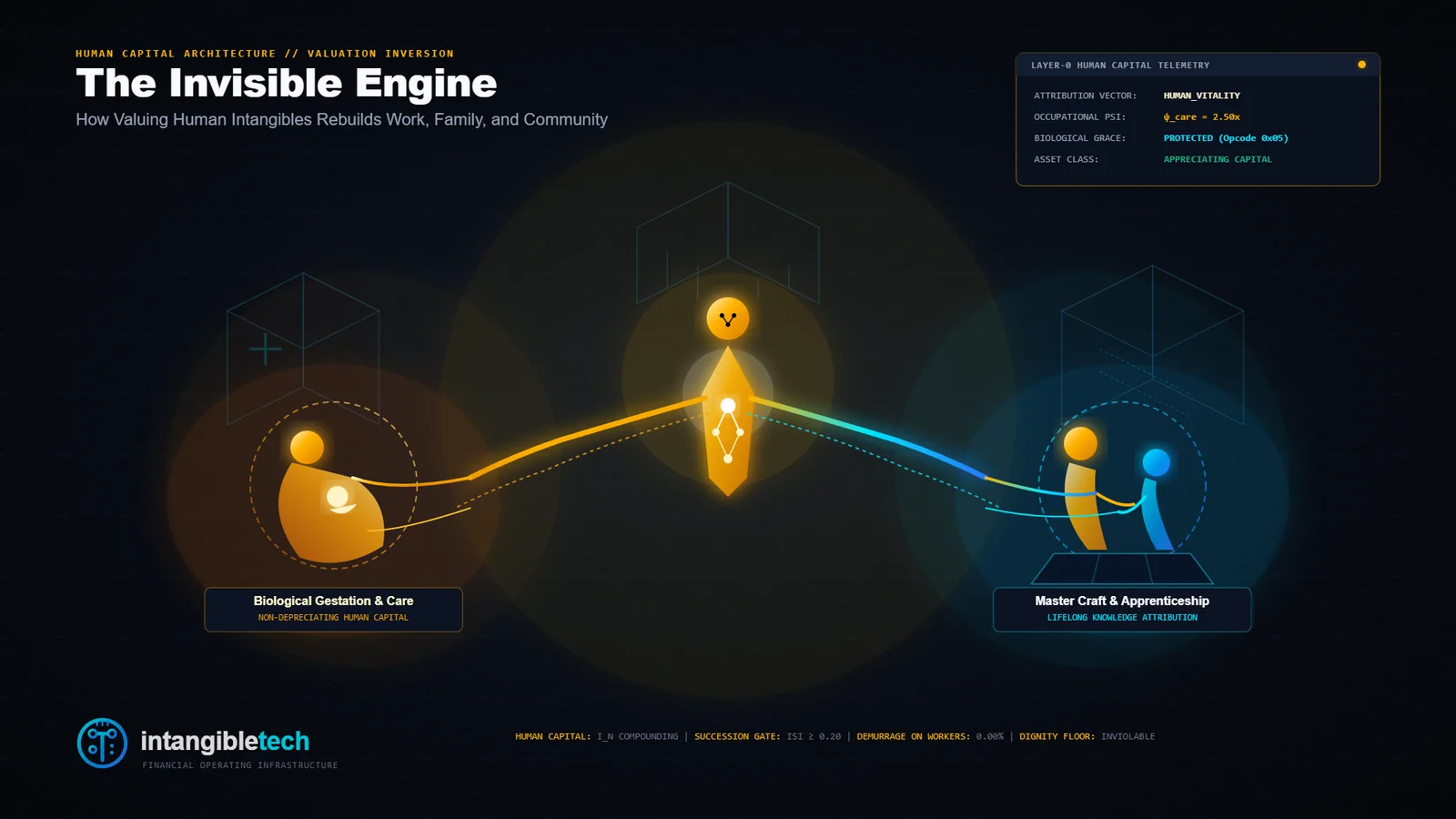
- Shared Long-Tail Prosperity: As students and apprentices enter the productive workforce and generate real-world commercial output, a fractional, non-deficit dividend routes back through the network to the foundational educators and community institutions that nurtured them.
- Mentorship as Prime Capital: Teaching, coaching, and frontline community leadership cease to be acts of financial self-sacrifice; they become recognized as the primary capital investments of an enduring society.
2. A Common Ground for Family and Life: Eradicating Economic Coercion
For half a century, political factions and moral communities have fought an agonizing, bitter war over the collapse of family formation and the tragedy of abortion. Yet, while politicians argue over legal mandates, neither side has addressed the underlying economic machine driving the crisis.
Empirical public-health surveys reveal a devastating reality: over 73% of women who undergo elective abortions cite immediate financial terror as the primary driver of their decision.
They choose abortion not out of ideological desire, but because an unyielding financial ledger holds an economic threat over their heads. In our current economy, pausing commercial wage labor to carry a child means facing immediate risk of eviction, skyrocketing hospital deductibles, lost career momentum, and the terrifying prospect of being unable to feed existing children. Simultaneously, young working couples across the developed world postpone marriage and parenthood for years because starter homes and basic child-rearing costs are unpayable under compounding bank debt.
The Intangible Financial Architecture addresses this crisis not with political rhetoric, but with foundational thermodynamic protection:
- The Biological Care Multiplier: When a citizen enters verified biological gestation or the critical 24-month early childhood bonding window, their baseline civic income automatically multiplies by 2.5x, establishing an unconditional floor of family stability.
- The Debt & Mortgage Freeze: Just as industrial factories receive automatic amortization pauses while retooling their machinery, a family welcoming a child automatically receives a zero-interest grace window on their home facility, preventing eviction or mortgage delinquency during pregnancy and infancy.
- Continuous Retirement Accrual: Mothers and family caregivers do not forfeit their future. Dedicated public reserve pools continuously credit their long-term savings vaults with active contribution credits equivalent to full-time employment.
By encoding biological reality directly into the ledger, no mother or couple is ever forced to surrender the life of a child out of economic desperation. We replace cultural condemnation with material abundance, restoring the home as an inviolable sanctuary.
3. The Dignity of Work: Why Humans Outshine the AI Hype Cycle
In corporate boardrooms today, a reckless narrative is taking hold: the belief that enterprises can soon fire their junior workforces, replace entry-level humans with Generative AI agents, and extract effortless profits.
This is a dangerous corporate illusion.
When an organization replaces its human pipeline with autonomous algorithms, it creates a zombie architecture. It may appear hyper-profitable on paper for twelve months, but it has severed its own generational immune system. An autonomous model cannot exercise moral judgment, cannot debug novel edge cases that lie outside its training data, and cannot step onto a factory floor to physically verify that a structural weld holds true. If a company hires zero junior apprentices today, it will have zero senior architects capable of steering the company tomorrow.
Under legacy GAAP, this corporate self-destruction is encouraged because training an apprentice is booked as pure overhead. Under the Intangible Architecture, the economic incentive inverts:
- The Succession Solvency Gate: An enterprise’s access to prime, low-cost capital is tied directly to its Enterprise Impact Score Index (ISI). A company that eliminates human mentorship in favor of pure automated scripts sees its fragility rating spike, automatically triggering higher borrowing costs across all credit facilities.
- Apprentices as Operational Shields: Junior workers do not compete with AI by writing boilerplate text; they act as adversarial verification nodes. By catching hallucinations, auditing data schemas, and grounding models in physical telemetry, apprentices protect the firm from catastrophic system failures.
- Inverting the Layoff Trap: Because human skills, safety track records, and operational craft are booked as appreciating intangible capital assets, laying off veteran machinists or seasoned engineers immediately destroys the company’s book value and shrinks its credit capacity. Retention becomes the mathematically optimal corporate strategy.
4. Reclaiming the Calling: Restoring Healthcare and the Classroom
Nowhere is the degradation of human value more painful than in our hospitals and schools.
Today, roughly 30% of all healthcare expenditure never touches a doctor, a nurse, or a medical instrument; it is consumed by a sprawling bureaucracy of billing coders, claims denial administrators, and legal adjusters whose sole function is to dispute paperwork between disconnected hospital and insurance databases. Physicians spend half their shifts clicking boxes in software to justify billing codes, while bedside nurses are stretched to dangerous patient ratios under the banner of “cost containment”.
In education, district administrators and standardized testing cartels consume ever-larger shares of municipal budgets, while public school teachers spend hundreds of dollars out of their own shallow paychecks to buy basic paper and pencils for their classrooms.
By settling transactions deterministically at the protocol layer, the entire claims-denial and billing industry is rendered obsolete. That reclaimed capital remains inside regional operating pools, flowing directly into elevated base pay for bedside nurses, primary care physicians, and classroom educators.
Furthermore, under the Credit-as-an-Asset model, educational debt is restructured. Aspiring doctors, nurses, and teachers no longer face twenty years of compounding interest. Their tuition acts as a service-amortized bond, where every verified clinical shift worked or public classroom semester taught burns down their principal balance directly from public health and education reserve assets. They graduate into freedom, free to serve where they are needed most.
5. An Economy Worthy of the Human Spirit
For five centuries, we have lived under an economic operating system that confused the measuring stick with the territory. We built an economy that knew the price of everything and the value of nothing. An economy where a speculative derivatives swap that created zero physical utility was rewarded with millions, while the mother rocking her newborn child or the craftsman teaching a teenager to shape wood was pushed to the margins of survival.
It does not have to be this way.
When we update our accounting infrastructure to reflect physical reality, we discover that human virtue, discipline, and love are not economically irrelevant luxuries. They are the bedrock upon which all physical wealth is built.
An economy is not an extraction machine designed to bleed human labor into passive capital hoards. It is a living, shared coordinating fabric intended to foster human flourishing, protect the vulnerable, honor the craftsman, and provide an enduring future for our children.
By making the intangible visible, we finally build a civilization where our financial ledgers reflect the true, sacred dignity of human life.