
Years ago, during my MBA studies, I wrote a strategy paper examining a question that felt speculative at the time: Could decentralized technology disrupt Netflix?
Back then, the technology landscape was infatuated with early cryptocurrency tropes: letting customers pay subscriptions in Bitcoin via Coinbase, minting custom “advertising utility tokens” to reward viewers for watching commercials, or imagining that entire 4K movie files would somehow be hosted on an immutable, peer-to-peer blockchain.
My foundational intuition was spot on: media aggregation is a middleman business built entirely to bridge trust and data deficits between senders and receivers. When you have a technology capable of updating shared state across independent parties simultaneously without manual reconciliation, centralized tollbooths become vulnerable.
However, the early crypto playbook was technically naive.
Blockchains are not content delivery networks (CDNs). Storing terabytes of video on consensus nodes is an architectural dead end. Nor do consumers want to speculate on volatile “ad coins” just to stream a television show.
Now, having spent years architecting deterministic financial operating infrastructure, the real disruption path is clear. Netflix’s vulnerability is not a pirate token or a speculative Web3 altcoin. Netflix is vulnerable to the same 500-year-old accounting trap and 1970s payment friction that plagues the rest of the enterprise economy.
When you upgrade the underlying plumbing from batch credit card rails to sub-second deterministic micro-velocity, the entire economic justification for a centralized streaming aggregator begins to unravel.
1. The Original Sin: Why the Subscription Bundle Exists
To understand why Netflix can be disrupted, you must understand why it exists in its current form.
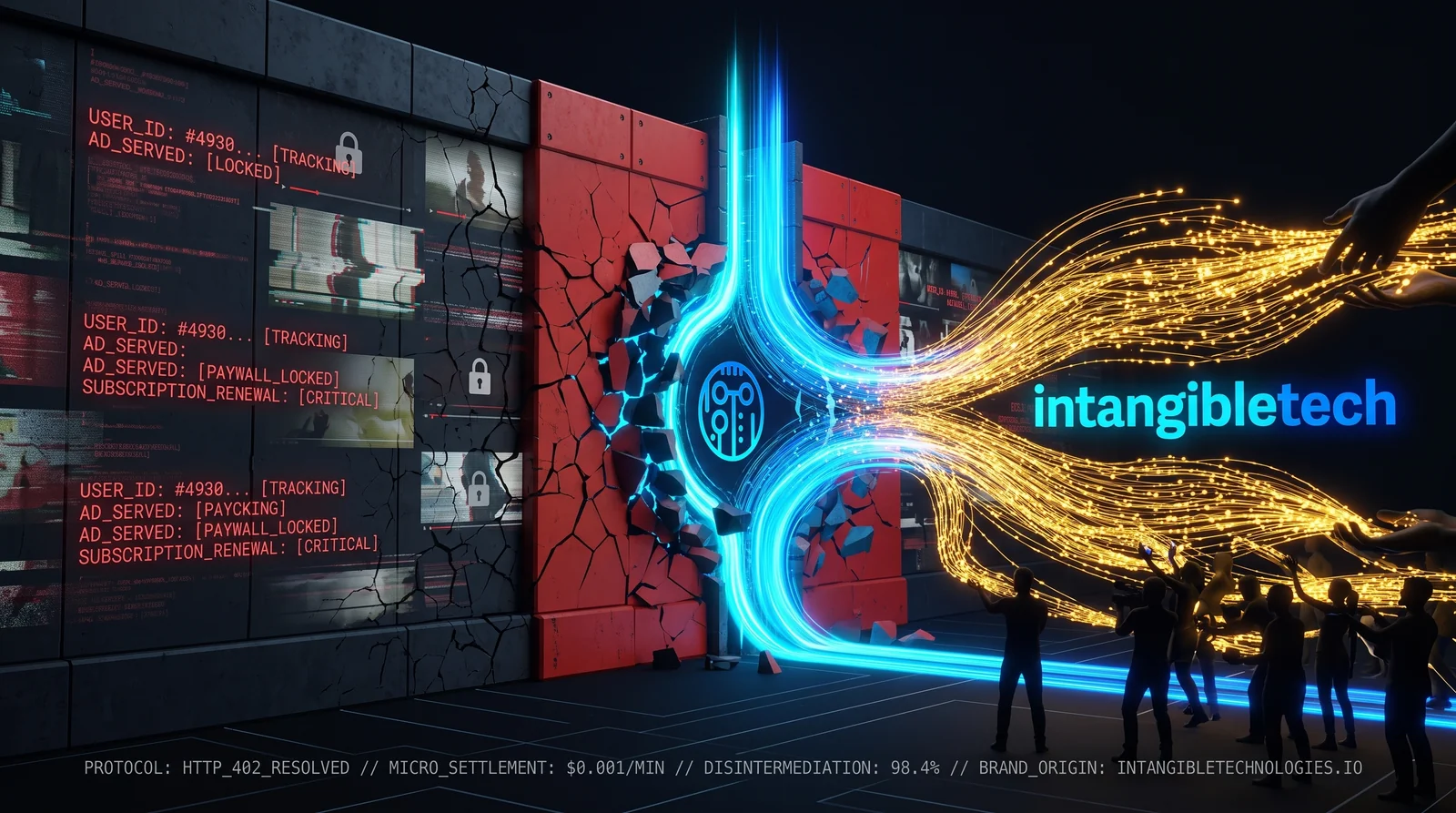
In 1993, when Marc Andreessen and the pioneers of the World Wide Web were designing the browser, they reserved an error code: HTTP 402 Payment Required. The original vision was that the internet would have native digital cash built into the transmission protocol. If you read an article, loaded a page, or watched a video clip, your browser would stream fractions of a cent directly to the creator.
It never happened because modern banking rails made it physically impossible.
Because Visa, Mastercard, and ACH payment networks were built in the 1970s, they impose a fixed minimum fee on every transaction—typically $0.30 plus 2.9%. If a platform attempts to charge a user $0.05 to watch a single episode of a show, the credit card processing fee wipes out the entire transaction.
This processing fee created the Subscription Bundle Dilemma:
- Because platforms cannot process sub-dollar transactions, they are forced to charge users an omnibus, flat monthly fee ($15 to $25 per month) to absorb the fixed swipe fee.
- Because the platform collects a flat fee, it must act as a massive gatekeeper: deciding which scripts get funded, which shows get canceled after two seasons, and taking a massive margin to maintain centralized cloud hosting and corporate overhead.
- Because subscription growth eventually hits a saturation ceiling, the platform is forced into the Surveillance Advertising Model—tracking viewer behavior, slicing demographic data, and selling eyeball attention to Madison Avenue.
Netflix is not just a creative studio; it is a liquidity bundler. It exists because our financial plumbing was too slow and expensive to let viewers pay creators directly—a latency limitation solved by the physical mathematics of micro-velocity settlement.
2. From “Ad Tokens” to Eliminating Surveillance Capitalism
In my original analysis, I explored how Netflix might introduce an advertising crypto token to track viewer attention and subsidize subscriptions.
While centralized platforms did eventually roll out ad-supported tiers, the ad-tech model is fundamentally extractive. It forces creative storytelling to compete with algorithmic rage-bait, cliffhangers, and attention-hijacking hooks designed solely to keep users glued to the screen for commercial impressions.
When you introduce Layer-0 deterministic settlement, the entire ad-tech apparatus becomes obsolete.
On an event-driven ledger capable of sub-millisecond execution, a financial state transition costs less than $0.00001 in compute overhead.
Suddenly, the missing HTTP 402 primitive becomes reality:
- Attention Streaming: A viewer does not pay a monolithic $240 a year for thousands of shows they never watch. As they stream an independent documentary or high-production drama, their digital wallet’s micro-velocity stream releases $0.002 per minute directly to the content’s signed ledger address.
- True Creative Freedom: If a viewer watches 20 minutes of an episode, they pay exactly four cents. If they watch a masterpiece ten times, the creators earn proportionally.
- Starving the Surveillance Machine: Creators no longer have to beg centralized studio executives for greenlights or design stories around commercial breaks. A filmmaker who deeply engages 100,000 dedicated viewers globally earns un-intermediated, living cash flow streamed directly to their wallet.
3. The Real Threat: Creator Attribution Trees and Edge Telemetry
The most disruptive threat to Netflix will not be a pirate network that illegally uploads Hollywood movies onto a blockchain. Hollywood studios have legal teams and DRM technology that can easily restrict unauthorized clients.
The existential threat to Netflix is that top-tier creative talent will no longer need them.
Today, Hollywood accounting is notoriously opaque. A writer, director, or actor signs a contract with a studio, and five years later, the studio’s accountants claim the hit show generated “zero net profit,” denying the creative team their backend royalties.
Under the Intangible Architecture, creative works are registered as Longitudinal Attribution Trees (Directed Acyclic Graphs) (applying the Shapley attribution principles established in The Geometry of Human Value):
- Automated Royalty Splitting at the Silicon Edge: When that four-cent micro-payment clears as a viewer watches a scene, the ledger’s pre-compiled atomic settlement primitive (0x01) automatically splits the payment at consensus:
-
-
40% to the production fund / investors.
-
25% to the writer and director.
-
20% to the cast and crew.
-
10% to the composer and musicians.
-
5% to the decentralized edge-storage node that served the video packet.
-
- Zero Forensic Audits: There are no multi-year royalty disputes, no studio accounting games, and no six-month delays. The cast and crew are paid every single day as global audiences consume their craft.
When independent creators realize they can retain 100% of their intellectual property, distribute directly to global audiences via decentralized storage and edge relays, and receive instant, non-dilutive liquidity every time someone presses play, why would they surrender their life’s work to a centralized aggregator for a flat upfront fee?
4. The Aggregator’s Dilemma
When this transition occurs, streaming platforms face the classic innovator’s dilemma.
Just as telecommunications monopolies once charged $3.00 a minute for long-distance calls before the internet turned data transport into a commoditized utility, streaming giants will watch their aggregation margins collapse.
If content distribution and micro-metered monetization become open protocol primitives:
- The Infrastructure Advantage Evaporates: High-speed edge computing, distributed bandwidth networks, and open video codecs mean anyone can host and deliver video without maintaining multi-billion-dollar proprietary cloud silos.
- Netflix Must Compete Purely on Experience: Netflix cannot survive merely by locking content behind an expensive monthly garden wall. It must evolve into what it should have been all along: an elite curation, discovery, and user-experience layer.
- Fee Compression: Instead of capturing 70% of the value generated by media consumption, aggregators will be compressed down to a thin, competitive discovery fee (1% to 3%), while the vast majority of capital routes directly to the human artists, engineers, and storytellers who created the art (a disintermediation pattern identical to how protocol telemetry dismantles proprietary SaaS vendor lock-in).
Beyond the Screen
Writing that MBA paper years ago was an early glimpse into a broader truth: whenever human coordination relies on centralized databases to bridge an information and trust deficit, an immense amount of value is captured by the middleman.
Netflix was a brilliant 2010s solution to the friction of DVD mailers and legacy cable TV bundles. But it remains tethered to the limitations of centralized cloud hosting, subscription paywalls, and credit card processing tolls.
By building a financial operating system capable of deterministic settlement, micro-velocity payments, and transparent human capital attribution, we aren’t just redesigning bank ledgers or enterprise supply chains. We are building the rails for a creative renaissance. One where culture, art, and storytelling are funded directly by the humans who love them, free from the corporate algorithms of the streaming middleman.