
Modern financial infrastructure operates on an archaic foundation: centuries-old legal fictions wrapped in 1970s electronic clearing networks. While Wall Street routinely celebrates the “tokenization of real-world assets,” simply taking a Dutch East India joint-stock certificate and issuing a PDF or ERC-20 token wrapper around it solves virtually none of the systemic vulnerabilities plaguing global commerce.
The core problem is not the medium of ownership; it is the latency of truth.
The Illusion of Tokenized Equities
When legacy institutions announce tokenized equities or sovereign bond products, what is actually occurring behind the marketing press release?
- A centralized commercial custodian holds paper certificates or depository trust receipts.
- A third-party ledger issues a digital representation pegged to that custodian’s internal registry.
- Settlement between institutional counterparties still requires multi-day netting, risk-weighted regulatory buffers, and manual reconciliation across disconnected databases.
Under this model, the token is nothing more than a cosmetic claim check. If the custodian becomes insolvent or clearinghouse rails freeze, the token inherits 100% of the underlying counterparty risk. We have replaced paper statements with cryptographic hashes while preserving the rot at the center of the architecture.
Legacy Wrapper Model:
[ Paper Assets ] -> [ Central Custodian ] -> [ Clearing House (T+1/T+2) ] -> [ Digital Wrapper ]
                                                      ^ Systemic Drag / Float Risk

Protocol-Native Model:
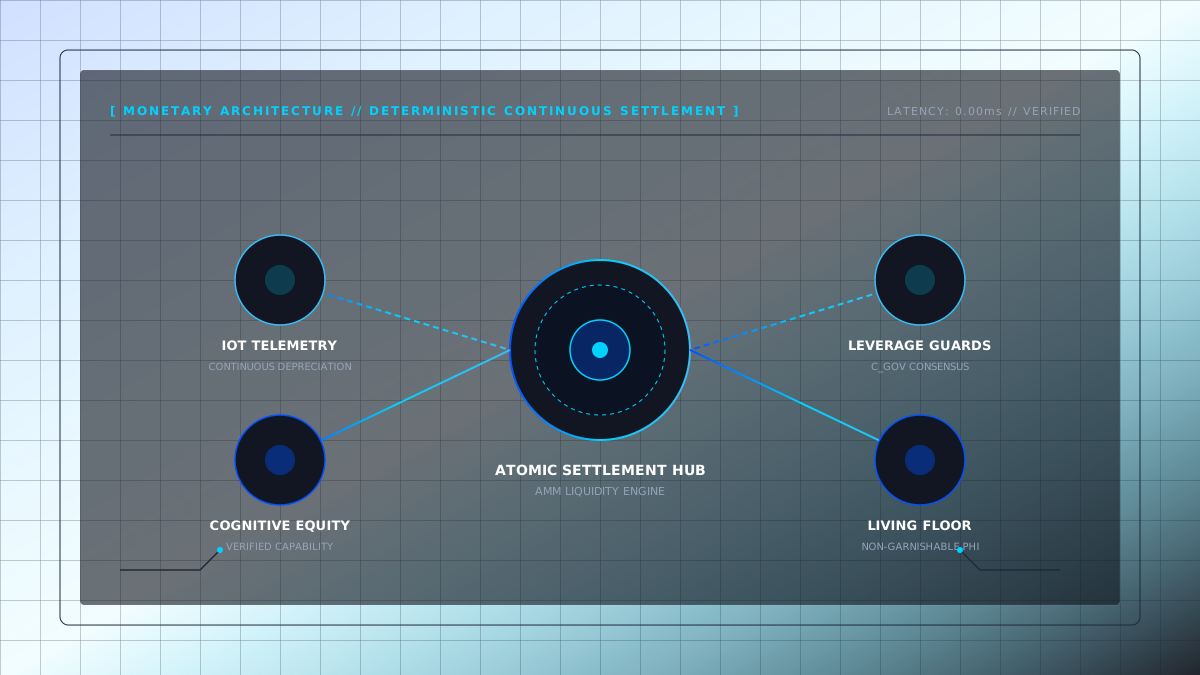
[ IoT Telemetry ] -> [ Cryptographic Ledger ] -> [ AMM Liquidity Corridors ] -> [ Atomic Settlement (0ms) ]
Continuous Telemetry vs. 90-Day Post-Mortems
Legacy Generally Accepted Accounting Principles (GAAP) force organizations into arbitrary 90-day accounting cycles. Corporate health is measured through backward-looking autopsies (the quarterly 10-Q report) rather than living instrumentation.
“If an asset cannot be verified through objective, real-time operational telemetry, its valuation is fiction. We must engineer on verifiable physical throughput, not speculative narratives.”
By binding enterprise physical plant, machinery, data centers, and logistics fleets to certified hardware enclaves, asset depreciation ceases to be an arbitrary straight-line tax depreciation schedule. It is calculated tick-by-tick based on actual machine wear, thermal cycles, and productive operational throughput.
The Four Architectural Transitions
To transition from extractive paper rails to protocol-native throughput, four foundational pillars must be deployed:
- Vector 01: Event-Driven Ledger Telemetry: Balance sheets become real-time queryable data feeds rather than static spreadsheets.
- Vector 02: Human Capital as an Appreciating Balance-Sheet Asset: Individual mastery, team synergy, and institutional problem-solving are cryptographic assets linked to sovereign digital IDs. Layoffs become self-inflicted balance-sheet destruction.
- Vector 03: Deterministic Event Settlement: Replacing subjective commercial insurance claims litigation with binary event pairs settled against certified IoT oracles.
- Vector 04: Sectoral Guardrails ($C_{\text{gov}}$): Programmatic capital-to-debt leverage caps that mathematically prevent speculative contagion without requiring centralized administrative micromanagement.
Conclusion: Engineering Economic Truth
The future of institutional capital is not faster speculation on broken accounting primitives. It is the realization that economic truth can be continuously verified, instantly settled, and anchored directly to real-world velocity.
At Intangible Technologies, we build the deterministic state machines and liquidity corridors that turn human ingenuity and operational capability into permanent, liquid capital.